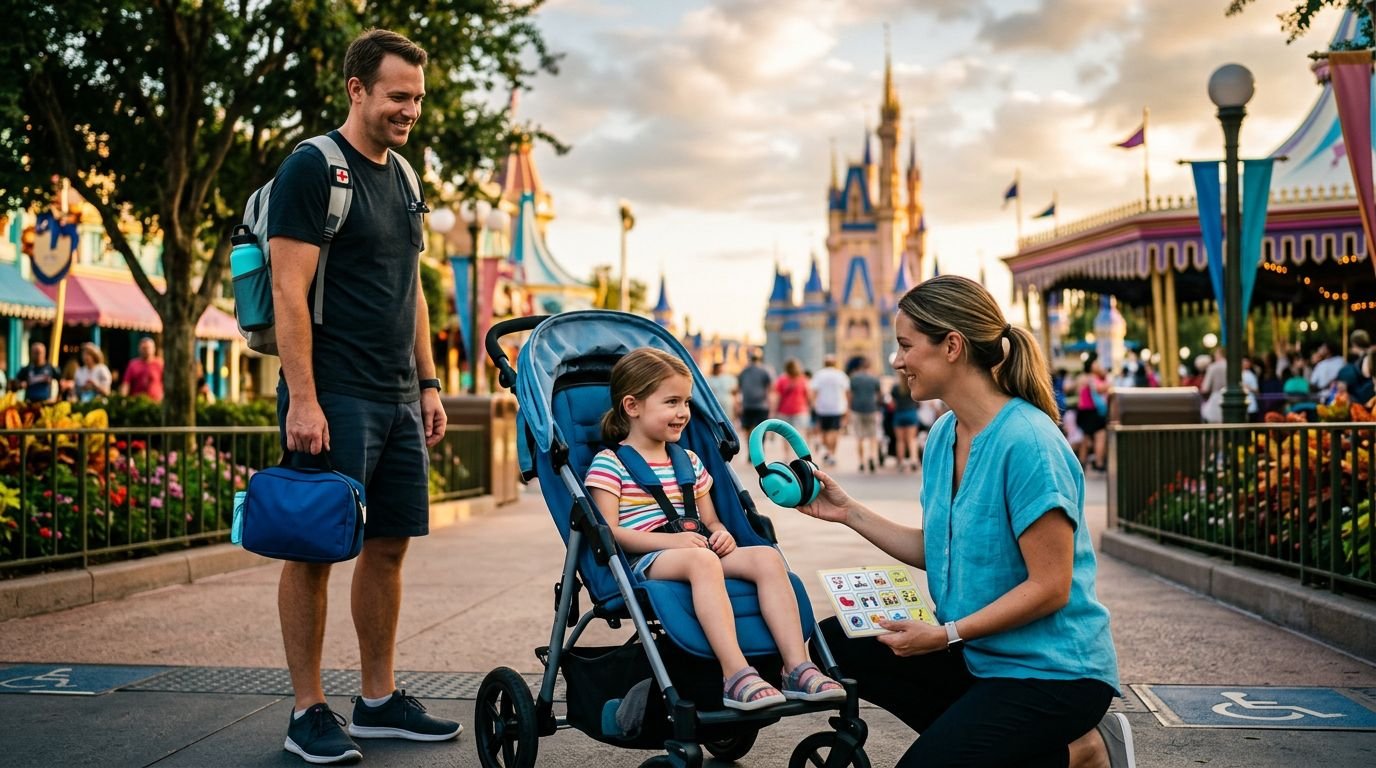
Disney autism planning is easier when your trip reflects your guest’s real support needs. Disney theme parks can be loud, crowded, hot, and full of changes.
Autism may be only one part of the plan. Your family may also be balancing special needs related to mobility, communication, medical equipment, food restrictions, anxiety, elopement concerns, behavioral support, or cognitive disabilities.
Successful vacation planning means building around support needs, not trying to complete a perfect itinerary. It means your family feels supported, comfortable, and able to enjoy the moments that matter most.
Key Takeaways
- Build the trip around your guest’s real support needs, including sensory, communication, mobility, medical, food, and cognitive needs—not only an autism diagnosis.
- Prepare for transitions before you leave, register for DAS if appropriate, and learn how stroller tags, Rider Switch, Guest Relations, and other accessibility supports may help.
- Keep park days flexible with realistic priorities, nearby attractions, planned reset places, familiar food, regular breaks, and permission to leave early.
- Organize the park bag, hotel, transportation, and dining plan around comfort, communication, medication, mobility, and recovery needs.
- A successful Disney vacation does not require completing every attraction; a calmer day with one meaningful experience can be a meaningful success.
Start with a needs profile
Before choosing rides, write down what helps your guest feel safe and settled. A diagnosis of autism spectrum disorder can provide context, but observable daily support needs should guide the itinerary. Keep it simple and practical.
Disney’s accessibility services page is a useful guest services resource for reviewing current programs, mobility information, downloadable guides, and park support options.
Plan around support needs, not a label
Think about difficult parts of a normal day. Is waiting in one place hard? Is walking a long distance painful or exhausting? Does your child need a stroller for safety? Does your guest use AAC, sign language, gestures, or a feeding device?
The same practical approach can help when autism and cognitive disabilities overlap. Use notes from home, school, appointments, or other busy outings to create a concise sensory profile. That list may include:
- A quiet break after a crowded activity.
- A familiar snack before frustration builds.
- Clear warning before a transition.
- A wheelchair, ECV, or stroller for longer distances.
- A low-stimulation place to regroup after a ride or parade.
This gives you a plan that fits the individual guest, not a generic special needs checklist.
Give adults clear roles for the day
If more than one adult is traveling, decide who handles what before entering the park. One person might manage the My Disney Experience app. Another may stay focused on communication, snacks, medication, or helping a child move safely through crowds.
It also helps to have an “if this happens” plan. If a ride closes, choose a nearby backup. If your guest needs to leave quickly, know where you will meet. If the app stops working, take a breath and ask a cast member for help.
Prepare for the trip before the airport or car ride
The vacation starts before you see Cinderella Castle. Travel day can be one of the hardest transitions, especially when routines, sleep, food, and familiar spaces all change at once.
Keep the first day light. Arriving at the resort, checking in, unpacking comfort items, and finding food may be enough. You do not need to add a full park day after a long flight or drive.
Make the travel sequence easy to understand
Use a short visual schedule, photos, simple written steps, or a social story. A sequence such as “car, airport, plane, hotel, pool, sleep” is often easier to process than a packed itinerary.
If your guest likes knowing what comes next, show them resort pictures, transportation options, and the park entrance before leaving home. Review only the parts they need to know. Too much information can feel like another big task.
Bring extra prescription medication in original containers, a medication list, feeding supplies, and any medical information you’d want during an unexpected delay. Keep these items with you, not in checked luggage.
Preview rides and build familiar supports
Ride videos can help you check darkness, loud sounds, drops, motion, restraints, and sudden effects that may trigger sensory overload. Watch only the rides your family is truly considering. You do not need to preview every attraction at Disney World.
Disney also offers services for neurodivergent guests that can help families prepare for attraction queues, dining, and other park details.
Keep communication tools together in one easy-to-reach pouch. Include the AAC device, headphones, charging cord, portable battery, picture cards, and a paper backup. Many families remember the tablet and forget the cable.
For a planning companion you can keep on your phone, the Disney World with Autism Guide PDF and this autism travel guide on Amazon offer extra ideas for park days, breaks, and accessibility support.
Disability Access Service: what families need to know
Disability Access Service, usually called DAS, is not a front-of-the-line pass. It provides eligible guests with a return-time accommodation, so they can wait somewhere other than a conventional queue.
Disney’s current DAS information says the service is for guests with a developmental disability, such as autism or a similar condition, who cannot wait in a standard queue for an extended time.
Register before your Disney World visit
Families can pre-register online for DAS through live video chat. Disney doesn’t offer in-person DAS registration at the resort. The guest requesting DAS must be present for the conversation.
Disney currently allows registration up to 60 days before a park visit, including the date of the visit. Live video chat is available from 7:00 AM to 8:00 PM Eastern Time.
The conversation focuses on how waiting in a conventional line affects the guest. A diagnosis by itself does not guarantee approval. If a guest has cognitive disabilities alongside a qualifying developmental disability, explain the specific functional barrier created by the queue. Be honest and clear about what makes a long, enclosed, crowded, or unpredictable queue difficult.
Policies can change, so verify details on Disney’s current DAS information page before your trip. Do not rely only on a past visit or a social media post.
Use DAS without making the day too rigid
Once you are in the park, the registered guest or an adult linked to their account can request an available attraction return time in the My Disney Experience app. That option is generally based on standby wait times.
After using that scheduled option, you can request another available window. The registered guest must be present and ride with the group.
DAS changes where your family waits. It does not remove every crowd, ride delay, weather problem, or hard moment. In Disney autism planning, a portable charger belongs in the park bag. Your phone may hold tickets, mobile food orders, maps, family messages, and scheduled options.
If the app feels confusing, visit Guest Relations or find a Guest Experience Team location, where a cast member can help. You do not have to solve every problem while standing in a busy walkway.
Use other queue and mobility supports
DAS is only one option. Families with special needs may need more than one support tool, while others may not need DAS at all.
Disney outlines attraction queue support options that include Rider Switch, queue re-entry information, and other services for guests with disabilities.
Ask about a stroller as a wheelchair
A familiar stroller can be more than transportation. For some children, it is a safe place to regulate, rest, avoid running, or recover after walking.
Disney’s guest services team at Guest Relations can explain whether your stroller qualifies for a stroller tag. If approved, this tag may allow your child to keep using the stroller in attraction queues where a mobility device is needed. Ride access and transfer instructions can vary, so always follow the cast member’s direction at the attraction entrance.
The tag is separate from DAS. It doesn’t change DAS eligibility, and attraction-specific mobility instructions still come from a cast member.
Rider Switch can help mixed-needs families
Rider Switch is useful when someone in your party cannot or doesn’t want to ride. This may be a child who doesn’t meet the height requirement, a guest with sensory sensitivities, or someone who needs to stay with a medical device or service animal.
At most participating attractions, the whole group meets a cast member at the entrance. The party is divided into two groups. One group rides while the other adult waits with the non-rider. Then the second group can take its turn without repeating the standard wait.
Disney also has multi-stall restrooms and single-stall companion restrooms throughout the resort. Find nearby companion restroom locations in the app before you need one. A quiet, private bathroom break can make a big difference during a busy day.
Build a park day with room to change plans
A detailed itinerary can look great at home and fall apart by lunchtime. Florida heat, rain, hunger, ride closures, tired feet, and unexpected excitement can contribute to sensory overload.
Choose one park per day when possible. Park Hopper tickets can be useful, but moving between Disney parks adds transportation, security lines, walking, and more decisions.
Group attractions by location
Magic Kingdom is much easier when you spend a few hours in one land instead of racing between Fantasyland, Tomorrowland, and Frontierland. EPCOT needs the same approach. Remy’s Ratatouille Adventure, Frozen Ever After, and Soarin’ Around the World are popular, but they’re spread far apart.
Identify quiet areas before the day begins, so you have a nearby option when the crowds feel overwhelming.
A return time on the other side of EPCOT can create more stress than a longer wait near where your family already is.
Give each day one clear win. It may be riding a favorite attraction, seeing a parade, meeting a character, or enjoying one special meal. Once that happens, the rest of the day can feel like a bonus.
Know your reset places before you need them
A quiet break does not have to mean a formal quiet room. Disney does not promise a designated sensory room in every park. Before the day begins, map indoor seating, shaded paths, nearby companion restrooms, quieter tables, and familiar attractions with a slower pace.
At Disney’s Hollywood Studios, Walt Disney Presents can offer seating and a calmer break from the energy of Toy Story Land or Star Wars: Galaxy’s Edge. At Animal Kingdom, shaded walking paths can give your family space away from the main crowds.
Try a simple reset order: water, restroom, snack, headphones, lower-stimulation space, then decide what happens next. Leaving the park early is always a valid choice.
Match the pace to age, stamina, and communication needs
Age matters, but it is not the whole story. Stamina, communication style, cognitive disabilities, and personal preferences can all shape the right pace.
A teenager may need more breaks than a preschooler. An autistic adult may prefer to choose their own rides and take independent quiet time.
For younger children, keep the goals small
A young child may do best with an early arrival, one priority attraction, a snack break, and a few nearby rides. Familiar areas like Fantasyland can make the day feel more predictable.
Use short, clear choices. “Carousel or snack?” is easier than “What do you want to do now?” Let your child know that “all done” is an option. A Disney day does not need to be a test of endurance.
If naps are still part of life at home, protect them. A hotel break can be more valuable than one more attraction.
Give teens and adults real choices
Older guests may want more control over the plan. Ask which rides, characters, restaurants, or shows matter most to them. Review ride details together, including darkness, motion, restraints, loud sounds, and the possibility of a longer evacuation.
Build in personal space while protecting decision-making. A teen may need to sit with headphones while another family member shops. An adult guest may prefer a quieter meal or a later start. Support should preserve independence, not take away autonomy.
Food, medication, and the park bag matter
Food can become a major issue when hunger, heat, sensory needs, and unfamiliar choices hit at the same time. Plan meals before the family is already tired.
Disney’s special dietary request guidance explains that many table-service and select quick-service locations offer allergy-friendly options for common allergens.
Make dining feel more predictable
Look at restaurant menus before your trip. Save a few realistic meal choices for each park. Before choosing a character dining experience, review the menu, reservation details, noise level, and seating.
If your guest has dietary needs or allergies, speak with the server, chef, or manager when you arrive. Don’t assume a reservation note covers every need.
Quick-service meals can be easier for families who need flexibility. Mobile ordering lets you review choices during a calmer moment instead of standing in a long line. You can also choose seating based on noise and space.
Bring safe snacks that your guest already accepts. A familiar snack can prevent a hard moment while you wait for food, transportation, or a scheduled time.
Keep essentials in one pouch
Your park bag does not need to be huge. It needs to be organized.
- Bring a portable charger and charging cords for phones, tablets, AAC devices, and headphones.
- Keep medication, medical supplies, a change of clothes, and any feeding items easy to reach.
- Pack noise-canceling headphones, sunglasses, fidgets, and a low-tech communication backup if those supports help.
- Add ponchos, sunscreen, refillable water bottles, and dry socks for weather changes.
A charged phone can solve more Disney problems than most families expect. It is your map, ticket holder, food-order tool, communication device, and schedule tracker.
Choose a hotel that supports your routine
The best hotel is not always the closest one or the cheapest one. Whether you choose resort hotels, suites, or rentals, focus on the place that makes sleep, food, breaks, and transportation easier for your family.
Disney’s resort accessibility information explains that Disney Resort hotels have accessible paths of travel and offer accessible and hearing-accessible room options.
| Hotel choice | It may work well when | Plan for this |
|---|---|---|
| Disney Resort hotel | Midday breaks and Disney transportation matter most | Some resorts have long walks, busy food courts, and crowded bus stops |
| Off-site suite or rental | You need a full kitchen, more space, or a quieter room | Driving, tolls, parking, and traffic add steps to every park day |
| Family suite | Separate sleep areas and extra bathrooms would help | Confirm bed setup, noise levels, elevator access, and room location |
Ask for the details that matter
When booking, ask about the actual room setup. Think about wheelchair access, bed height, refrigerator needs, elevator access, distance to transportation, room for a stroller, and a quieter building location.
Art of Animation family suites can be helpful for families who need more sleep space, two bathrooms, and a kitchenette. Disney’s Port Orleans Resort, French Quarter may feel easier for families who prefer a smaller resort layout.
A longer resort trip may also need a real rest day. After two or three park days, a pool morning, Disney Springs visit, laundry break, or quiet hotel day can help everyone recharge.
Lightning Lane is optional, not required
Lightning Lane Multi Pass is a paid service separate from DAS. It can offer scheduled return windows for participating attractions, but it also gives your family another clock to watch.
The best plan doesn’t include every add-on. It includes choices that lower stress for your family.
When Multi Pass may help
Multi Pass may be worth considering if your family has a few true must-do rides and can handle set return windows. EPCOT can be one example if Remy’s Ratatouille Adventure, Frozen Ever After, or Soarin’ are high priorities.
Check the My Disney Experience app before buying. Review current wait times first. Prices, attraction availability, and return windows can change. Look closely at where each ride is located before booking anything.
When a slower plan is better
Skip the extra schedule if changing plans is difficult, midday breaks are necessary, or your child becomes upset when a ride closes. A packed list of scheduled ride windows can create more pressure than it removes.
Ask one simple question: Will a few scheduled ride times help your family relax, or make everyone rush? The answer is enough.
Frequently Asked Questions
Is Disney’s Disability Access Service guaranteed for autistic guests?
No. DAS eligibility is based on how a developmental disability affects the guest’s ability to wait in a conventional queue, not on diagnosis alone. Register through Disney’s current online video chat process and explain the specific functional barrier clearly.
Can a stroller be used as a wheelchair at Disney World?
Some strollers may qualify for a stroller tag that allows continued use in certain attraction queues. Ask Guest Relations about the process, and follow the cast member’s instructions because ride access and transfer rules can vary.
What should families pack for an autistic guest with multiple disabilities?
Pack the supports your guest uses at home, such as communication devices, headphones, chargers, medication, feeding supplies, safe snacks, mobility equipment, and a change of clothes. Keep essential items together and easy to reach, with a low-tech backup when possible.
How can families prevent sensory overload in the parks?
Plan fewer must-do attractions, group activities by location, and identify shaded, indoor, or quieter places for breaks before the day begins. Use a simple reset routine with water, a restroom, a snack, sensory supports, and a lower-stimulation space before deciding what comes next.
Do families need Lightning Lane if they use DAS?
No. Lightning Lane Multi Pass is optional and separate from DAS, so it should only be added if scheduled return windows will genuinely reduce stress. A slower plan may work better when flexibility, rest, or changing plans is especially important.
A Disney trip can fit your family
Disney World can be loud, busy, and full of surprises. It can also be a comfortable, memorable family vacation when your plan leaves room for rest, food, communication, and mobility support. Flexibility matters too, including changing plans or leaving early.
The strongest Disney autism planning starts with realistic priorities. Choose fewer must-dos, use the supports that fit, and let a calmer day count as a successful day.