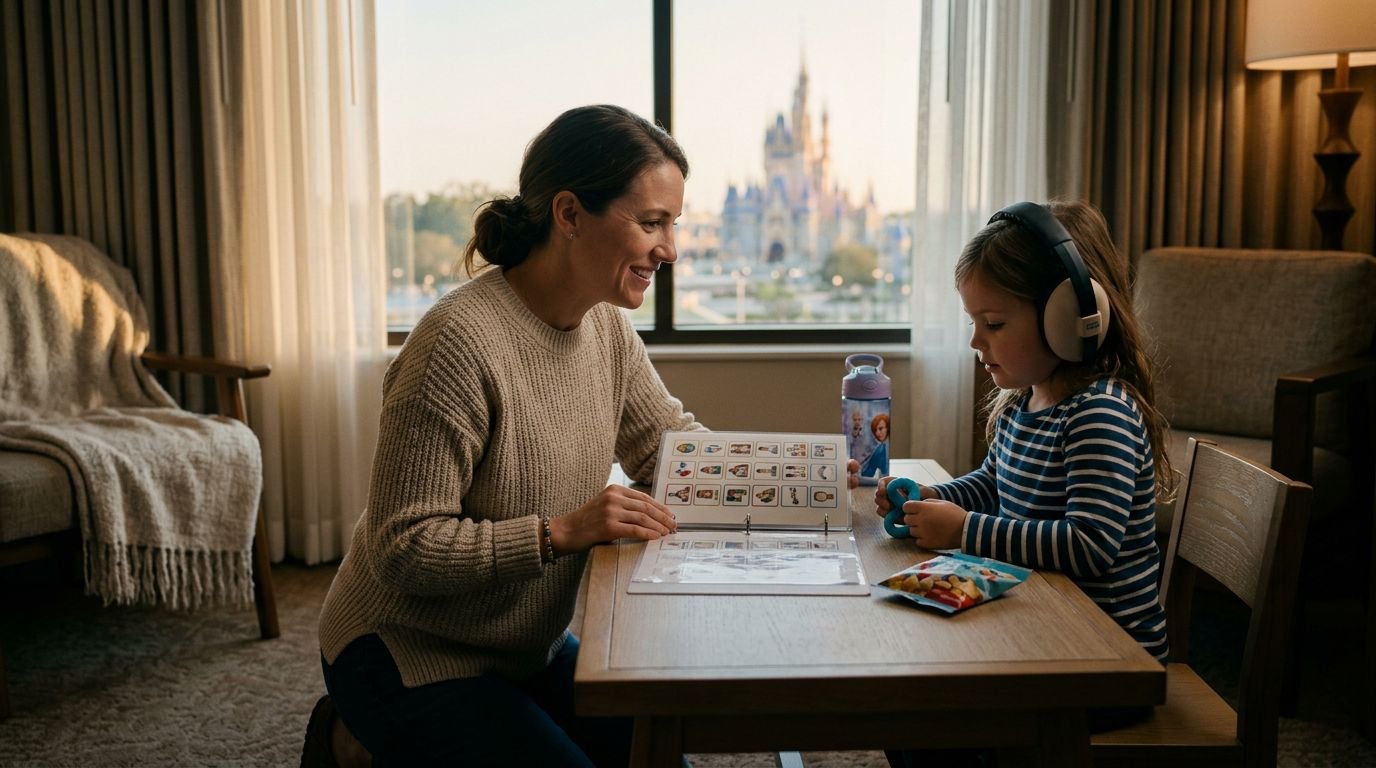
A Disney trip can feel like a lot when you are the only adult managing tickets, meals, transportation, emotions, and safety. A meaningful family vacation does not require a packed schedule.
Disney World autism planning works best when it follows your child’s real routines, not a picture-perfect vacation plan. A slower day with one favorite ride, a familiar snack, and a calm hotel return can be a complete success for a traveler with special needs.
Start by taking pressure off yourself. You are not trying to do everything. You are building a trip your child can enjoy and recover from.
Key Takeaways
- Build the trip around your child’s real routines, familiar foods, sensory needs, and ability to recover—not a packed vacation schedule.
- Prepare before travel with visual plans, practice for unfamiliar experiences, comfort items, communication supports, and a safety plan.
- Learn how Disability Access Service works before arriving. DAS is not immediate ride access, and Disney reviews each family’s needs through its current registration process.
- Choose one park, one or two priorities, and regular breaks for each day. A stroller, supportive resort, rest day, or early return can make the trip more manageable.
- Keep food, transportation, budgeting, and backup plans simple enough to manage alone. Flexibility matters more than seeing every attraction.
Disney World autism planning starts with your child’s routine
Think about what already works at home. Does your autistic child need a quiet morning? Do they eat only a few familiar foods? Is a stroller still useful when walking gets hard? Those answers should shape the trip before you choose a resort or park ticket.
A single parent needs a plan that still works when there is no second adult available to take over. Leave room for bathroom stops, lost items, snack breaks, weather changes, and the moments when your child says “all done.”
Before booking, look through Disney’s neurodivergent guest resources. The attraction information and accessibility tools can help families planning for neurodivergent children identify suitable options.
A break taken before sensory overload is not lost park time. It protects the rest of the day.
Choose one or two priorities for each park day. That might be meeting a character, riding a favorite attraction, or deciding whether a character buffet is worth prioritizing. Once that main goal happens, everything else is extra.
Prepare your child well before travel day
Start preparing six to eight weeks before the trip when possible. You do not need to talk about Disney every day. Small, predictable steps often work better than a big buildup.
Build a simple visual trip plan
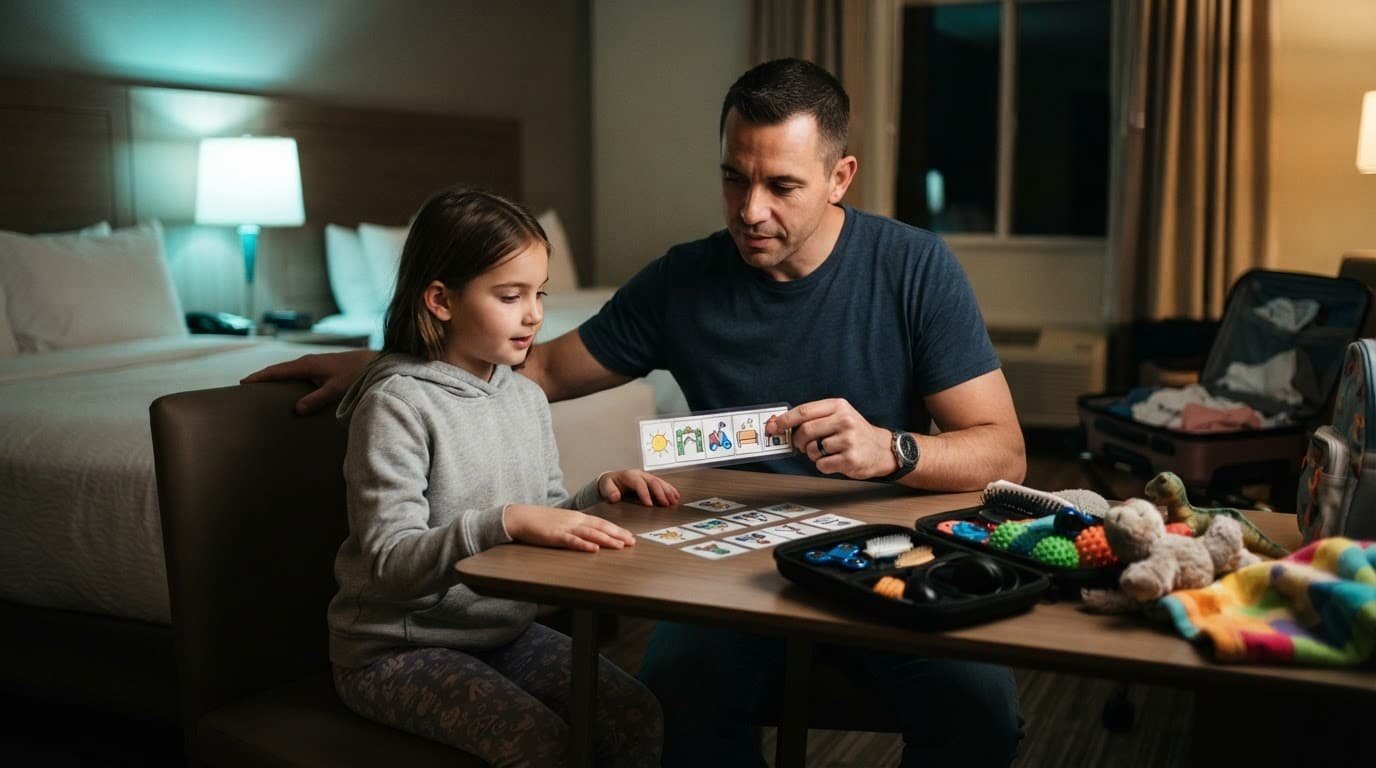
Use pictures, a calendar, or a short written story that matches your autistic child’s communication style and expectations. Include the drive or flight, hotel check-in, security, transportation, one park activity, meals, and returning to the room.
Keep the plan honest. Do not promise that every ride will happen or that every moment will be quiet. Let your child know there may be waiting, rain, loud sounds, and changes.
Practice the parts that feel unfamiliar
Watch short ride or resort videos when they help your child anticipate unfamiliar sensory experiences, without promising exactly what will happen. Practice wearing headphones, using a visual “break” card, or sitting in the stroller with the same comfort item they will use in the parks.
A few familiar items can make an unfamiliar space feel more comfortable:
- Pack headphones, a favorite fidget, soft blanket, hoodie, or stuffed animal your child already uses.
- Keep medications, chargers, communication devices, and backup picture cards in your carry-on.
- Let your child choose one small comfort item for the park bag.
- Download shows, music, games, or calming videos before leaving home.
A child who uses AAC, sign language, gestures, or pictures may also benefit from a short communication card. It can tell cast members what support helps in a crowded walkway, without requiring you to give a long explanation.
Understand Disability Access Service before you arrive
Disney’s Disability Access Service, often called DAS, is for Guests with a developmental disability such as autism spectrum disorder who cannot wait in a conventional queue for an extended period. Autism alone doesn’t guarantee approval. Disney reviews each family’s needs through a conversation.
If approved, your family may refer to the accommodation as a DAS pass. It isn’t a physical pass or immediate ride entry. Instead, it provides a return-time process so your child can wait somewhere else.
Read the current Disability Access Service details before your travel date. Disney can change policies, eligibility procedures, and app features, so verify the latest information before registering.
Register through Disney’s video chat process
DAS registration is currently handled by live video chat, not at an in-person Guest Relations location. For technical or process help, contact guest services. You can register up to 60 days before your park visit, including the day you visit.
The adult requesting DAS must be at least 18. Your child must be present for the video conversation. Have your My Disney Experience account and park admission ready before the appointment.
Disney lists video chat hours as 7:00 AM to 8:00 PM Eastern Time. Give yourself enough time to complete the process without rushing through it. Verify these hours and procedures before your appointment.
Know what DAS does and does not do
DAS does not provide immediate ride access. It gives your family a return time comparable to the current standby wait, so your child can wait somewhere else. These return times aren’t guaranteed ride reservations.
After entering the park, use My Disney Experience to request an available return time. Once you use that return time, you can request another one. The registered Guest must be present and ride with the group.
DAS can reduce the stress of a long line. It cannot remove crowds, heat, noise, or changing plans. Keep your day light even when DAS is approved.
Choose a resort that gives you breathing room
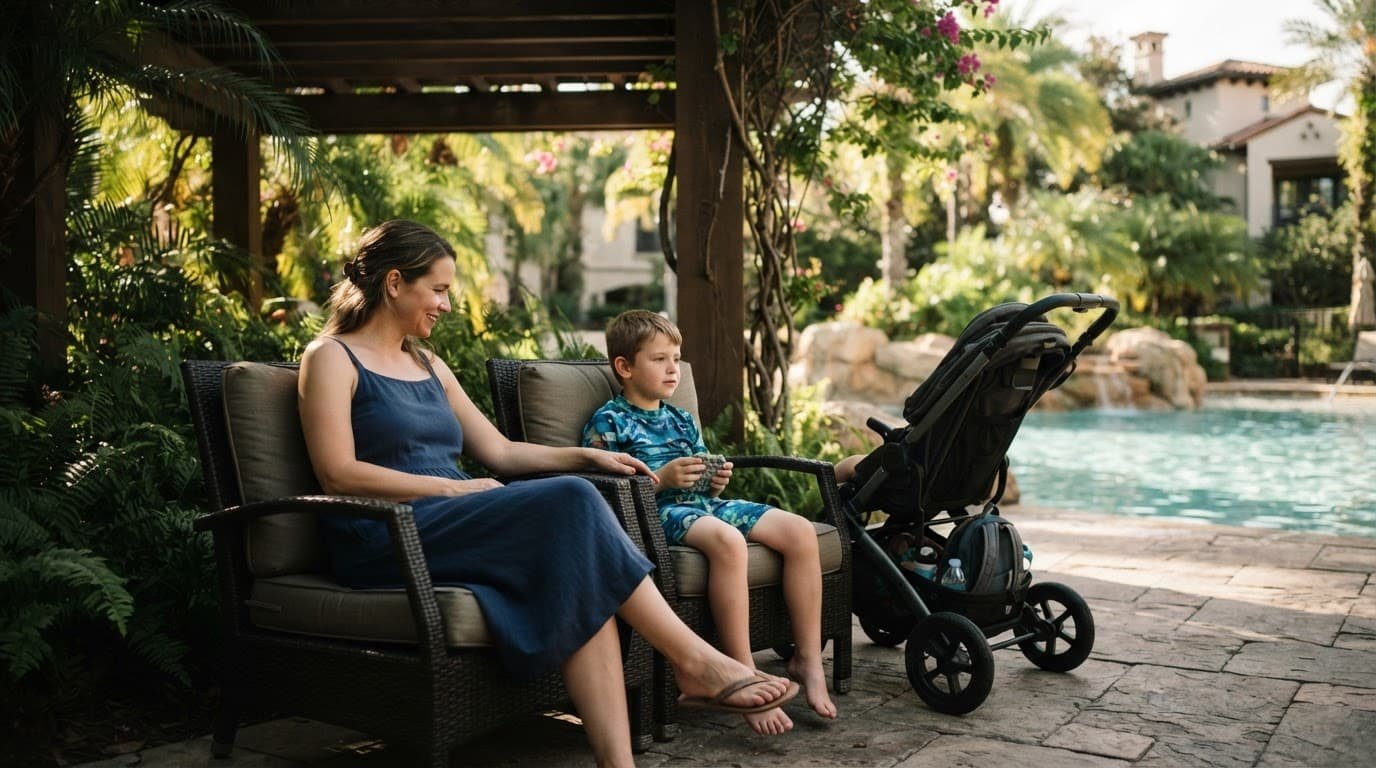
Your hotel room is more than a place to sleep. It is where your child can reset, eat familiar food, change clothes, and decompress after a busy park day.
Disney resort hotels have accessible paths to guest rooms, pools, dining, shops, and other shared spaces. Review Disney’s resort accessibility information before deciding what room setup and location you need.
Match the room to your real needs
Ask about elevator access, refrigerator needs, and space for equipment, including a special needs stroller. Also consider walking distance to transportation and a room location away from busy common areas. Requests aren’t guaranteed, but they’re worth making.
Disney’s Port Orleans Resort, French Quarter can feel easier for families who prefer a smaller moderate-resort layout. Art of Animation family suites can work well when you need more sleeping space, two bathrooms, and a kitchenette for familiar breakfasts and snacks.
An off-site hotel or vacation rental may be the better choice if your child needs a full kitchen, private vehicle, quieter room, or more separation at bedtime.
Give yourself a real rest day
For a longer trip, plan a full non-park day after two or three park days. Treat it as recovery and quiet time, not lost vacation time. Sleep late, use the pool, visit Disney Springs, or stay close to the room.
Pack enough clothes for the trip if possible. Self-service laundry rooms can be busy, noisy, and near pool areas. If laundry takes away the only break your family needs, extra clothes or valet laundry may be worth the added cost.
Decide whether a special needs stroller is worth it
A stroller can be a sensory support, mobility tool, safe resting place, and way to prevent exhaustion. It is not only for young children.
Bring, rent, or request a stroller tag
Bring your own special needs stroller or use a specialty rental if your child needs specific support, size, positioning, or containment. A standard rental may be fine for a child who only needs an occasional ride.
Disney’s standard single stroller rental is currently $15 per day, or $13 per day with a length-of-stay rental. It is recommended for children up to 50 pounds.
If your child uses a stroller as a mobility device, ask a cast member about a “Stroller as a Wheelchair” tag. Disney explains this option, along with Rider Switch and other attraction queue access services.
Pack one bag you can manage alone
Keep the park bag light enough to carry while helping your child. Put the most important items in the same place every day.
If you use magic bands, keep them in the same place each day and test or charge them before the park day. Bring a portable charger, headphones, water, sunscreen, ponchos, medications, wipes, familiar snacks, and a low-tech communication backup. Your phone may hold tickets, maps, DAS return times, dining plans, and messages. A dead phone can make a hard moment harder.
Build shorter, calmer park days
A Park Hopper ticket is not always the best choice for a single parent. Moving between theme parks adds transportation, travel time, security lines, more walking, and more decisions.
Choose one park each day. Consider crowd levels when choosing your park, but remember that lower crowds won’t prevent every sensory or behavioral challenge. Starting during the morning hours can help only when it matches your child’s normal routine. Stay in one area instead of crossing the park for every attraction. At Magic Kingdom, a morning in Fantasyland can be enough. At EPCOT, check attraction locations before committing to plans because the park is larger than it looks.
Give each day one clear win
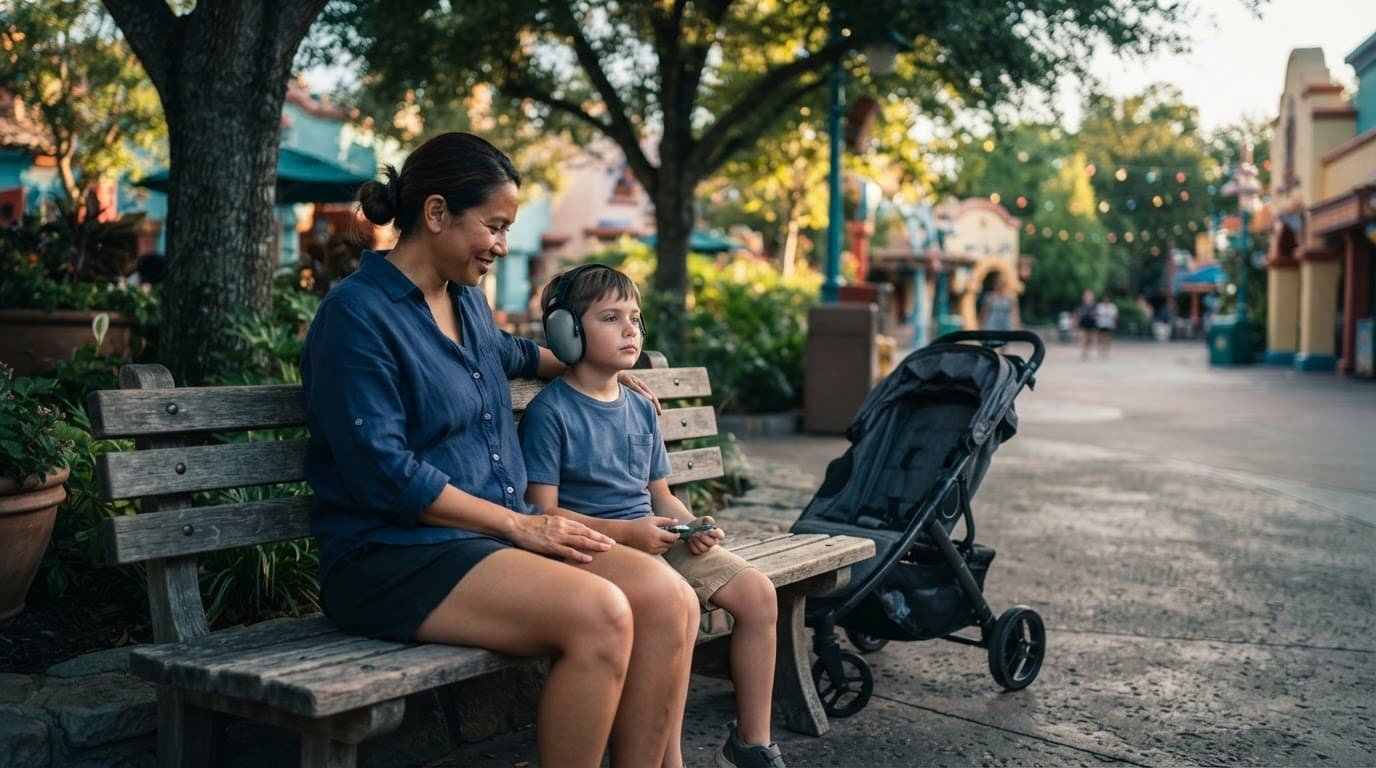
Pick one meaningful experience for the morning. It could be a favorite attraction, a character meeting, or a family photo. Once it happens, the pressure eases.
A good plan gives you permission to leave early. A shorter itinerary can reduce anxiety and stress for both you and your child. If your child is done after lunch, your vacation has not failed. The park will still be there tomorrow.
Use breaks before they become emergencies
Plan a snack break before hunger hits. Find shade before everyone is overheated. Return to the resort before your child is past their limit.
Lightning Lane Multi Pass is a separate paid option from DAS. It can help when your family has a few true must-do rides. It can also create another schedule to manage. Buy it only when timed return windows will make your day easier.
Choose attractions by sensory input, not popularity
There is no universal list of “safe” Disney rides for an autistic child. One child may enjoy a dark ride and dislike a carousel. Another may love fast motion but struggle with a loud pre-show.
Make a simple green, yellow, and red list before the trip, considering each ride’s sensory experiences. Green means familiar or likely enjoyable. Yellow means preview first. Red means skip without guilt.
Preview rides with intense effects
Watch for warning signs before committing to intense rides or shows. Guardians of the Galaxy: Cosmic Rewind, Space Mountain, The Twilight Zone Tower of Terror, and large nighttime fireworks shows can trigger sensory overload in children who struggle with darkness, fast motion, sudden drops, loud sounds, or flashing effects.
Gentler-paced options such as the Tomorrowland Transit Authority PeopleMover, Living with the Land, and a carousel may be easier for some children. They are still not guaranteed to feel calm.
Use Disney’s accessibility planning resources and ask cast members at the attraction entrance about effects, transfers, queue conditions, or a ride’s exit route.
Let your child change their mind
A child may wait for a ride and then decide they cannot board. That is okay. Step away, offer two simple next choices, and move on.
Do not push through because you waited a long time or spent money on admission. A ride is never worth turning a manageable day into a hard one.
Keep food simple and low pressure
Food problems can derail a park day fast. Build meals around what your child already eats instead of using the trip to try new foods.
Mobile Order can make a counter service meal easier to manage. Review menus from a quieter location, choose a pickup window when your child is ready, and skip another line. Take the food to a quieter outdoor table or back to the resort if needed.
Plan for allergies and picky eating
Disney can accommodate many allergy-related and dietary needs at table-service restaurants. Before booking a character buffet, review the menu, timing, noise level, and your child’s tolerance. Tell the restaurant about your child’s needs when you arrive, and speak with a manager if you need more help.
You can also bring food into the parks. Pack familiar breakfast items, shelf-stable snacks, and foods that can rescue a difficult day. A refillable water bottle is useful in Florida heat.
For more support, the Disney World With Autism Guide PDF includes ideas for accessibility needs, breaks, and park days. You can also find the Amazon edition of the guide.
Build a budget that includes recovery time
Good vacation planning weighs total stress, transportation effort, rest, and price, not only the cheapest rate. A cheaper hotel far from the parks can cost you time, transportation energy, and missed rest.
Start with the major costs, then add the items that make the trip more comfortable.
| Expense | How to price it | Single-parent reminder |
|---|---|---|
| park tickets | Check Disney prices for your dates, park, and child’s age | One-day adult tickets start at $119 before tax, but dates change the price |
| Hotel | Compare the full stay with taxes, not only the nightly rate | A closer or larger room may be worth more than a lower rate |
| Food | Set a daily cap and bring familiar snacks | Mobile Order can prevent tired, last-minute decisions |
| Stroller | Standard Disney single rentals are $13 to $15 per day | A specialty stroller may be the better fit for comfort and safety |
| Extras | Price Lightning Lane, ride-share, rain gear, and souvenirs separately | Keep a small backup fund for hard days |
A rest day belongs in the budget. So does a ride-share back to the hotel if bus transportation feels like too much that afternoon.
Keep flexibility and insurance separate
Read cancellation terms before making deposits. Travel insurance may help with a covered cancellation or interruption, but it does not make a nonrefundable booking flexible.
Check covered reasons, exclusions, deadlines, and documentation rules. A clear policy is better than an expensive surprise after the trip.
Use safety and recovery plans every day
Single parents often carry the full safety plan in their head. Put a few supports in place before you reach the park gates, so you aren’t making every decision in a stressful moment.
Prepare for elopement and separation
Take a current photo of your child each morning. Use an ID wristband, shoe tag, or communication card with your phone number if your child will tolerate it.
Teach one simple safety step: find cast members if you and your child become separated. Practice what the Disney uniform looks like before the trip. If you become separated, alert an employee right away and show the morning photo.
A location device can be another layer of support if it fits your family’s safety plan. Test it at home first. Don’t depend on a new device you have never used.
Treat resort time as part of the vacation
A pool afternoon, campfire, outdoor movie, arcade visit, or quiet walk can be enough for a non-park day. Disney’s All-Star Movies recreation options include pools, an arcade, a jogging trail, and outdoor movies, though schedules and weather can change.
This approach works better when the hotel has a purpose. Give your child time to rest, and give yourself time to reset too.
Frequently Asked Questions
Does autism automatically qualify a child for DAS?
No. Autism alone does not guarantee approval, because Disney reviews each family’s needs through a conversation. Check Disney’s current registration rules and complete the video chat process before your visit when possible.
Is DAS an immediate ride pass?
No. DAS provides a return time comparable to the current standby wait so your child can wait somewhere else. It does not remove crowds, heat, noise, ride closures, or the need to keep the day flexible.
Should I bring a special needs stroller to Disney World?
A special needs stroller can provide mobility support, containment, sensory relief, and a safe place to rest, even for an older child. If the stroller is used as a mobility device, ask a cast member about a Stroller as a Wheelchair tag.
How many attractions should a single parent plan each day?
Choose one park and one or two meaningful priorities instead of building a full schedule. A favorite attraction, character meeting, or family photo can be the day’s clear win, and leaving early is a successful choice when your child is done.
What should I pack for an autism-friendly park day?
Bring familiar snacks, water, headphones, a comfort item, medications, sunscreen, weather protection, a portable charger, and a communication backup. Keep a current photo of your child each morning and consider an ID wristband or communication card if your child will tolerate it.
A Disney trip can fit your family
You cannot control Florida heat, ride closures, crowds, or rain. You can choose a slower pace, a supportive resort, familiar food, and room to change the plan.
This approach is not about seeing every attraction during your family vacation. It is about creating a trip where your child feels supported and you are not carrying the whole day alone.
A calm return to the hotel, with everyone safe and still smiling, is a Disney memory worth planning for.