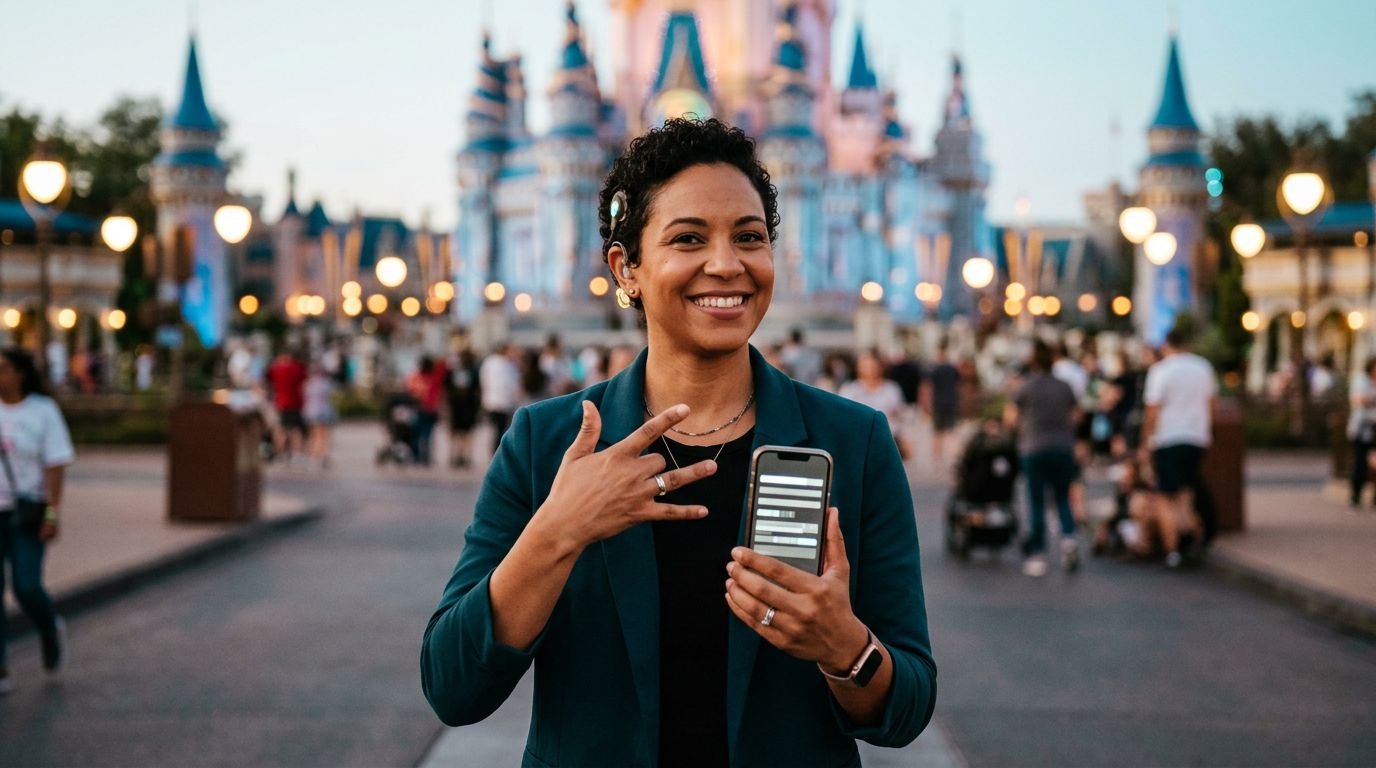
A Disney day shouldn’t depend on catching every word in a dark queue or loud show. Disney World deaf accessibility is strongest when communication support is planned before the first park morning.
Disney offers helpful tools, but they work best when you know where to find them and when to use them. Captions, written dialogue, visual alerts, and resort communication support can make a busy day more comfortable for deaf visitors.
Guests who are hard of hearing shouldn’t have to rely on others to fill in what they missed. You deserve a day where everyone can take part.
Key Takeaways
- Contact Guest Relations before your trip to discuss ASL, captioning, written dialogue, interpreter support, and other communication needs.
- Request a resort room communication kit early, and confirm the equipment again at check-in.
- Use Disney’s Handheld Device, caption-ready monitors, written dialogue packets, and assistive listening options where available, remembering that support varies by attraction.
- Confirm rotating ASL-interpreted show schedules in advance, arrive early for a clear view, and plan seating carefully.
- Hearing loss alone does not usually establish DAS eligibility, so build a flexible day with communication backups, breaks, and realistic expectations.
Start your Disney World deaf accessibility plan before travel
Good planning for guests with hearing disabilities starts before you book flights or build a ride list. A few early requests for disability accommodations can remove a lot of last-minute stress.
Contact Guest Relations about your communication needs
Review Disney’s accessibility services for guests before your trip to learn about accessible services, then contact Disney and describe how your group communicates. Tell them if you use ASL, need captioning, or need special accommodations for interpreter support. Ask whether your needs require a disability access request and how to submit it through Guest Relations.
Ask about the attractions and live shows your family cares about most. This gives you time to adjust plans if an experience doesn’t offer the support you expected.
Guest Relations can help in each park. Still, an early request gives Disney more time to confirm schedules and available services.
Request room communication kits early
Your resort room should feel comfortable, not like another place where you have to stay alert. Walt Disney World Resort hotels may provide room communication kits upon request. Available equipment can include door-knock and phone alerts, phone amplifiers, a bed shaker notification, a strobe-light smoke detector, and a TTY telephone.
Contact Walt Disney World Resort before arrival, add the request to your reservation, and confirm it again at check-in. Disney’s resort hotel accessibility information can help with questions, but availability and procedures can change. Request the equipment early and reconfirm it when you arrive.
Disney communication tools in the parks
Disney’s communication support includes several tools, each with attraction-by-attraction limits.
Pick up the Disney Handheld Device early
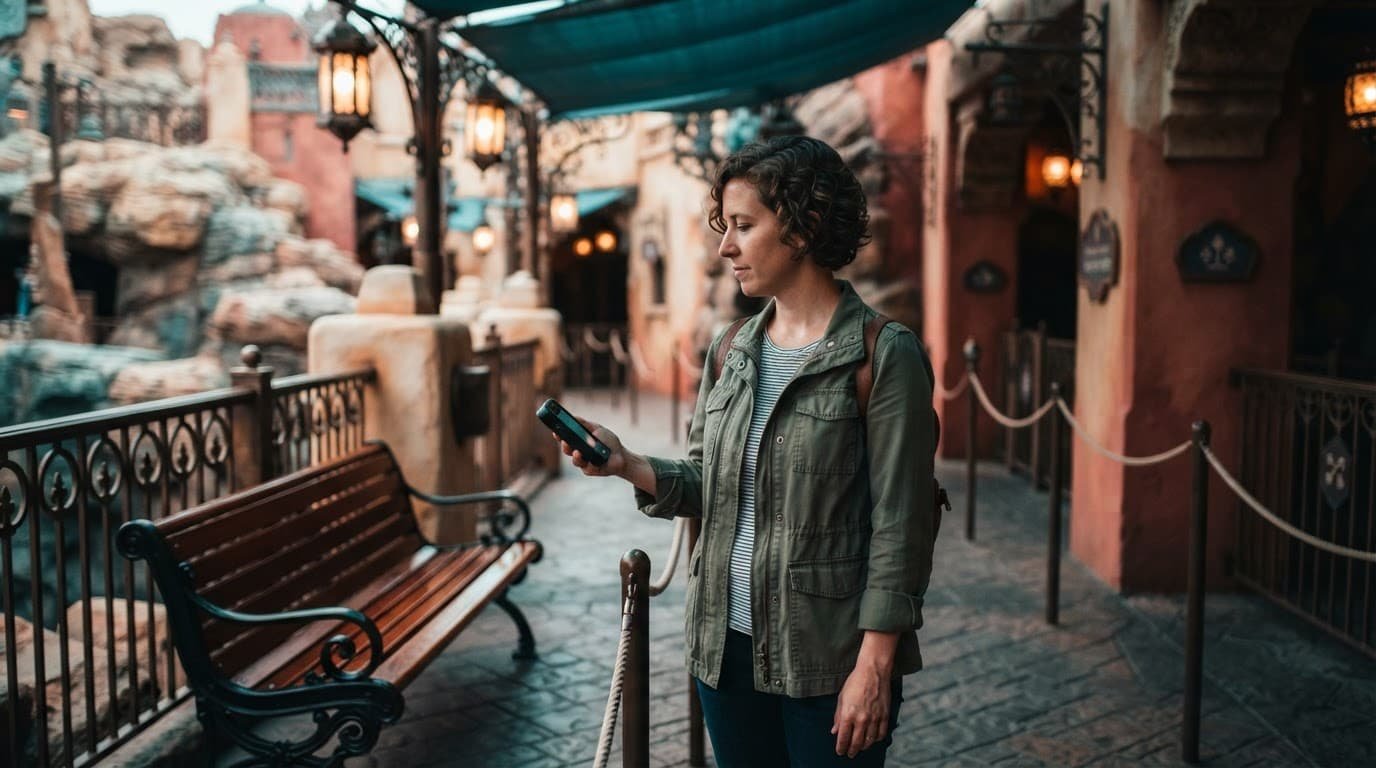
The Disney Handheld Device is a handheld captioning device that may support assistive listening devices, routing sound through headphones or an induction loop. At select attractions and entertainment locations, it may also offer video captioning and audio description.
Its features vary by attraction, so it isn’t a universal solution for every ride or show segment.
Pick it up at Guest Relations as early as you can. Ask Guest Relations which nearby attractions support the device, especially if someone in your group has hearing disabilities. Test assistive listening before entering an attraction, and check the device in dark or crowded queue areas.
Older Disney disability guides have listed a refundable deposit, but Disney’s current service page doesn’t list an amount. Confirm the current policy at Guest Relations when you pick up the device.
Look for captions before the ride begins
Many pre-shows and exhibit areas have caption-ready monitors marked with a CC symbol, and some support video captioning. A Cast Member can point out the right monitor or help activate captioning. If a monitor or setting is unclear, ask Guest Relations for help.
Ask if a written dialogue packet is available for the attraction. These packets can include ride narration and show dialogue, making them especially helpful before entering a dark queue.
Audio description is separate from captioning, so it doesn’t provide dialogue access.
Disney’s captioning and assistive-device overview explains that support is offered at select locations. Check each attraction instead of assuming every part of the experience will be captioned.
ASL interpretation for Disney live shows
American Sign Language interpretation can make Disney entertainment feel more complete, especially for Deaf and hard of hearing guests and families who plan around live shows, parades, and character performances.
Rotating schedules need confirmation
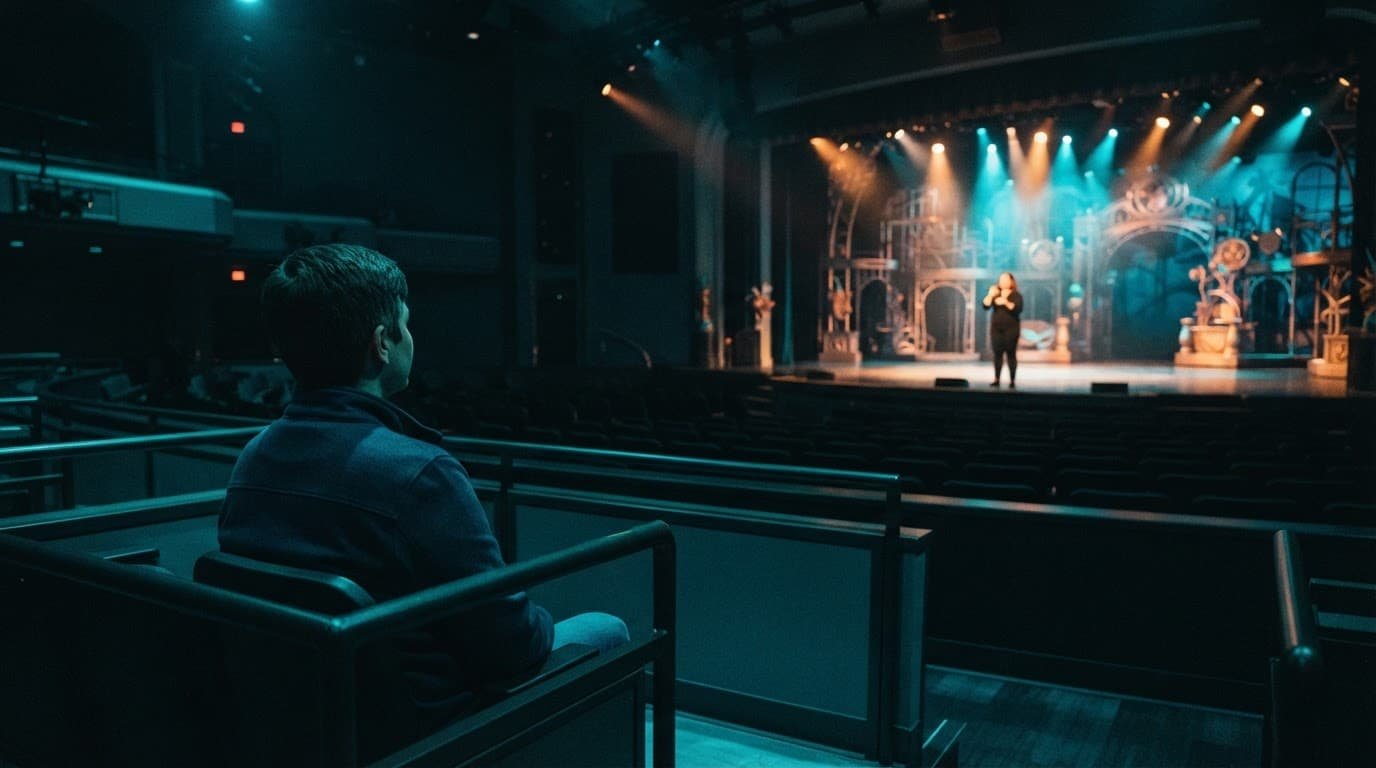
Disney provides American Sign Language interpretation at select stage performances on a rotating schedule across all four theme parks. Interpretation is not available at every performance each day.
Disney has previously asked guests to confirm American Sign Language interpretation schedules at least seven days before visiting. For special entertainment requests, allow at least 14 days. Don’t build your whole trip around an old weekly schedule you found online. Performance times and locations can change.
Guests with hearing disabilities can use Disney’s services for Deaf and hard-of-hearing guests to begin the request, then contact Guest Relations to confirm current options for your dates.
Make the interpreted show easy to enjoy
Once you have an interpreted performance, arrive early and ask Guest Relations where the best viewing area is. You need a clear sightline to both the sign language interpreters and the stage.
Choose seats that don’t force you to turn back and forth for the full show. If you are traveling with family or a group, explain the plan before the lights go down. A little preparation lets everyone focus on the performance.
Disability Access Service (DAS) is not usually the answer for hearing loss
Families often ask whether Deaf or hard of hearing guests qualify for DAS. Communication support is separate from disability accommodations, and hearing loss alone doesn’t usually establish DAS eligibility.
What Disney’s DAS policy covers
Disney’s current DAS criteria focus on guests with a developmental disability, such as autism, who cannot wait in a conventional queue for an extended period. A Cast Member reviews each request individually under Disney’s current rules.
DAS registration is handled through live video chat, up to 60 days before your visit and through the day of your park visit. Disney also offers text-chat access for guests with hearing disabilities. For questions, ask a Cast Member or contact Guest Relations.
Read the current current DAS details before travel because Disney’s disability policies and procedures can change. If an eligibility or service question remains unresolved, follow up with Guest Relations.
Families comparing Disney with Universal Orlando should know that Universal Orlando may reference an IBCCES Accessibility Card. That IBCCES Accessibility Card isn’t a Disney requirement, and Disney’s DAS process shouldn’t be replaced by an IBCCES Accessibility Card.
DAS changes where an eligible guest waits rather than letting guests skip lines. It doesn’t remove every wait, crowd, or change of plan.
Lightning Lane is separate from DAS
Lightning Lane Multi Pass is a paid service with scheduled return times for participating attractions. It isn’t a disability service or a promise to skip lines.
It may help if your family has a few must-do rides. Still, a day packed with timed reservations can become another clock to watch. Choose it only when it fits your travel style.
Make rides easier when captions are limited
A dark, loud attraction queue can make lip-reading difficult. A ride may have captions for the pre-show but not every moving moment after boarding. Planning for those gaps matters.
Ask the right question at the entrance
Don’t only ask, “Is this ride accessible?” Ask which portions of the attraction support a handheld captioning device, video captioning, or assistive listening. Then check pre-show captions, request a written script, and ask where to stand or sit.
If a Cast Member can’t identify the available captioning or written-dialogue support, ask Guest Relations. You’re asking how to understand the experience, not how to skip lines.
Read any written material before you board. In a dark ride vehicle, a small screen may be harder to see than expected.
Captioning may cover a pre-show or key narration, not every moment of a fast-moving attraction.
Give your group a simple communication plan
Before entering a difficult queue, agree on a few simple signals. Decide how you will share a ride closure, a needed break, or an early exit. Keep your phone or communication device easy to reach instead of buried under ponchos and snacks.
When possible, step into a brighter or quieter area before discussing a change. You don’t need to solve every question while standing in a crowded walkway.
Pack communication support and leave room for breaks
A small tech pouch belongs in every Disney park bag. The My Disney Experience app may hold tickets, maps, mobile-order information, attraction details, and messages between adults. Keep another communication backup available.
Keep these items together
- Pack a portable charger and charging cord with every communication device.
- Bring headphones or an induction-loop accessory you already know works well.
- Keep a low-tech backup, such as a printed communication card or written notes.
- Add familiar comfort items if they help someone reset after a loud attraction.
- If a communication device fails, ask Guest Relations for help locating the right support point.
Families often remember the device and forget the cable. Keeping both in one pouch avoids an easy problem.
Plan a day that fits your family
Choose one or two must-do experiences, then leave room for meals, shade, quiet indoor attractions, and a hotel break. Disney World is large, and crossing its theme parks repeatedly can add more stress than expected.
If someone in your group also has autism-related planning needs, our Disney World With Autism Guide on Etsy and Amazon edition of the guide offer practical ideas for breaks, routines, and flexible park days.
Frequently Asked Questions
Does Disney World offer accessibility services for Deaf and hard-of-hearing guests?
Yes. Disney may offer captioning, written dialogue, assistive listening, handheld captioning devices, ASL interpretation at select performances, and resort communication equipment. Availability varies by attraction, show, and date, so confirm current options with Guest Relations.
How can I request ASL interpretation at Disney World?
Start through Disney’s services for Deaf and hard-of-hearing guests, then contact Guest Relations to confirm the schedule for your visit. ASL interpretation is offered at select performances on a rotating schedule, and special requests may need additional notice.
Can I use DAS because of hearing loss?
Hearing loss alone does not usually establish eligibility for Disney’s Disability Access Service. DAS focuses on guests who cannot wait in a conventional queue because of a developmental disability, and each request is reviewed individually under Disney’s current rules.
Does Disney World provide captioning on every ride?
No. Some attractions offer pre-show captions, video captioning, written dialogue, or assistive listening, but support is not available for every part of every experience. Ask at the entrance which portions are supported and request help from Guest Relations when details are unclear.
Can Disney hotels provide communication equipment?
Walt Disney World Resort hotels may provide room communication kits with items such as door-knock and phone alerts, bed shaker notifications, and visual smoke-detector alerts. Request the equipment before arrival, add it to your reservation, and confirm availability at check-in.
A Disney day where everyone can take part
The best plan is personal. Start with the accessible services that fit your hearing disabilities, then let Guest Relations confirm your disability access options.
Captions and interpreters can help, but so can a charged device, a clear family plan, and permission to slow down. A comfortable Disney day is a successful Disney day.