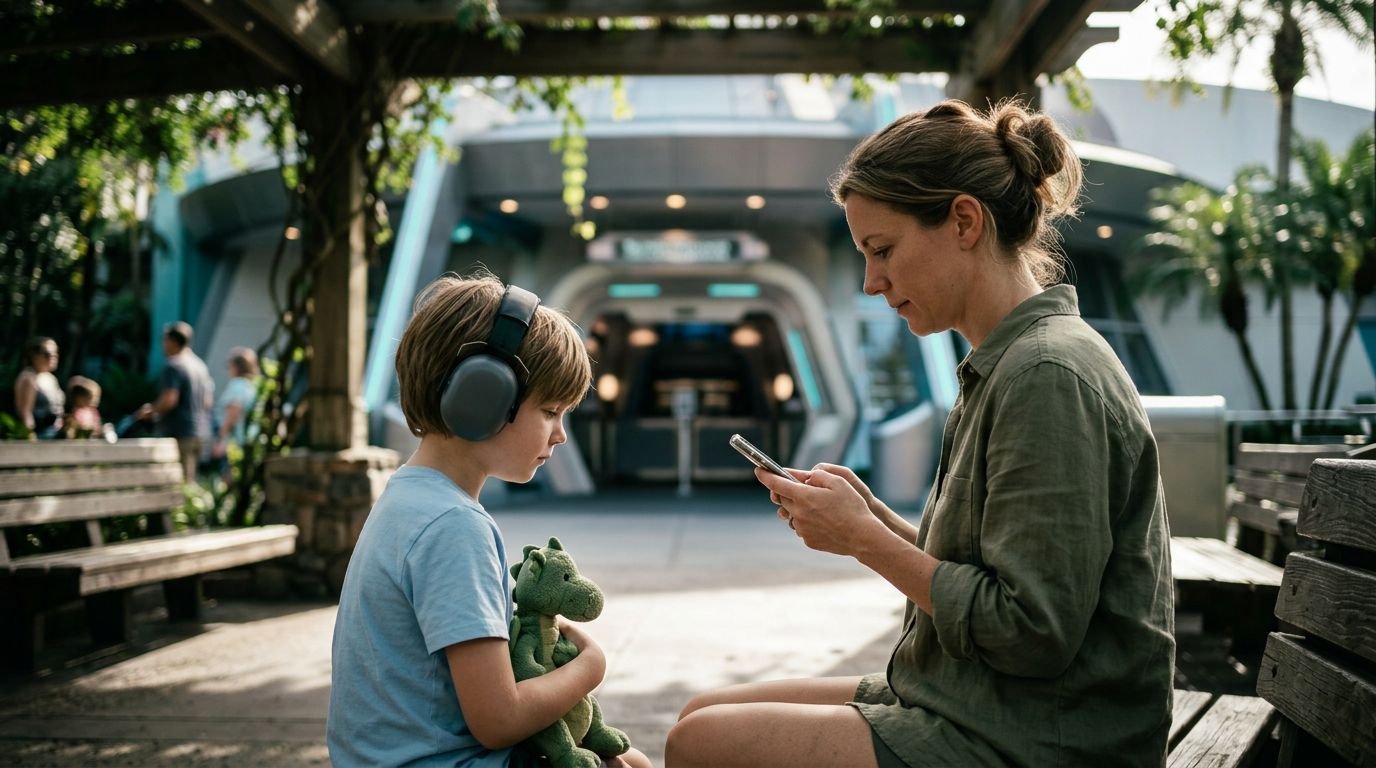
A virtual queue can save your family from standing in traditional theme park queues, but it can also create a new kind of pressure. You still need to watch your phone, know when to join, and be ready when your boarding group is called.
For parents planning a Walt Disney World trip, navigating a Disney World virtual queue autism experience requires careful pacing. The goal is not to fit every ride into one day, but rather to make the visit feel more predictable for a neurodiverse family member, helping you avoid sensory overload and making it easier to adjust when your child needs a break.
Disney systems can change, but a calm plan, a charged phone, and realistic priorities will always help you manage your virtual queue experience with confidence.
Key Takeaways
- Virtual queues help families avoid traditional standby lines by assigning a boarding group via the My Disney Experience app, but they require careful monitoring of your phone and are completely separate from Disability Access Service (DAS).
- DAS must be registered for in advance through a video chat, allowing eligible guests with developmental disabilities like autism to wait outside conventional lines for return times.
- Pacing is essential for neurodiverse families, so prioritizing a few key attractions, taking sensory breaks, and carrying portable chargers will prevent meltdowns and sensory overload.
- Additional tools like Lightning Lane Multi Pass or Rider Switch can help reduce wait times, but families should only use them if they reduce stress rather than adding unwanted scheduling pressure.
Disney World Virtual Queue Autism: Know What Is Separate
Disney uses several different ride-access tools during a Walt Disney World vacation. They can work together, but they are not the same thing. Mixing them up can lead to disappointment before your trip even starts.
A virtual queue is Disney’s system for certain high-demand attractions. Instead of waiting in traditional standby lines, you join a boarding group in the My Disney Experience app. When your group is called, you return to the attraction during the stated window.
A virtual queue is not automatically connected to Disability Access Service, also called DAS. Having Disability Access Service does not place your child into a boarding group. If an attraction is using a virtual queue, your family must still join it through the My Disney Experience app.
Disability Access Service is an accommodation for guests whose developmental disabilities, such as autism, make waiting in traditional standby lines difficult. Disney explains that Disability Access Service provides a return time similar to the current standby wait, so the guest can wait somewhere other than the line. Review Disney’s current Disability Access Service details before your trip because policies and attraction procedures can change.
Lightning Lane Multi Pass is separate from both Disability Access Service and virtual queues. It is a paid service with scheduled return windows for participating attractions, which utilize the Lightning Lane entrance. Lightning Lane Single Pass is also separate and may be available for select popular rides.
Think of these alternate accommodations this way:
| Tool | What it does | What families should remember |
|---|---|---|
| Virtual Queue | Gives your family a boarding group for a limited attraction | You must join through the app when available |
| Disability Access Service | Lets an eligible guest wait outside a traditional standby line | It does not create a virtual queue boarding group |
| Lightning Lane Multi Pass | Paid access to scheduled attraction return windows via the Lightning Lane entrance | It can add structure, but also more times to track |
| Lightning Lane Single Pass | Paid access for select attractions | It is purchased separately when offered |
The right combination depends on your child, your park, and your family’s energy on your Walt Disney World day. You don’t need every option to have a good Disney day.
A virtual queue can reduce time in a physical line, but it does not remove the need for a flexible plan once your boarding group is called.
Start With DAS Before Your Walt Disney World Visit
If your child cannot tolerate a conventional queue because of autism or another developmental disability, look into the Disability Access Service before you leave home. Disney’s current process uses a pre-registration video chat, and the guest requesting the Disability Access Service needs to be present for that conversation.
Disney allows eligible guests to register up to 60 days before their Walt Disney World park visit. You can also register closer to your travel date if needed. Start early if you can. It gives you time to learn the app, connect tickets, and ask questions without doing it in a busy hotel room.

During the pre-registration video chat, explain the real issue with waiting in line. Focus on your child’s needs. Maybe poor queue tolerance stems from an autism spectrum diagnosis where tight spaces, close crowds, unpredictable movement, loud announcements, or long waits cause severe distress. Maybe leaving the traditional standby lines is the only safe option once anxiety builds.
You don’t need to memorize a perfect speech. Be honest and direct about what happens in the busy queue environment and why waiting elsewhere would help your child participate.
Disability Access Service approval is not automatic simply because a child has an autism diagnosis. Disney considers whether the disability makes waiting in a conventional queue unmanageable. If the Disability Access Service is approved, follow the current instructions in the My Disney Experience app and confirm which family members are connected to the service.
The registered guest must be present and ride with the group. Don’t plan for siblings or adults to use the return time without that guest. Disney can use photo verification at attraction entry.
Disney also offers more than one accessibility option. Their accessibility services for guests with disabilities include planning resources, attraction information, and support for different needs. A Cast Member at Guest Relations or a Guest Experience Team location can help when an app screen or queue process feels confusing. Accessibility services at Guest Relations are always ready to assist if you have further questions after you arrive at Walt Disney World.
How to Join a Disney Virtual Queue Without the Morning Panic
The My Disney Experience app is your home base for a Disney World virtual queue autism plan. Your mobile device can hold park tickets, maps, mobile food orders, dining reservations, DAS return times, and virtual queue boarding groups. That is a lot for one phone to handle.
The night before, check that every person’s ticket is linked correctly. Confirm the people joining the virtual queue are in your Family & Friends list. Update the My Disney Experience app before the trip, sign in, and turn on phone notifications if your family uses them.
Disney may offer virtual queue enrollment at different times during the day. The attraction, opening time, and eligibility rules can change. Check the My Disney Experience app and Disney’s official attraction information the evening before and again that morning.
A simple routine can lower stress and help you navigate Walt Disney World:
- Choose one adult to handle the My Disney Experience app, while another adult helps your child with breakfast, headphones, or a familiar activity.
- Set an alarm a few minutes before the enrollment time, not an hour before it.
- Open the virtual queue page early, review all boarding requirements, and confirm your party is selected.
- Join when enrollment opens, then take a breath. Your family does not need to stare at the phone every second.
- Watch for the boarding-group notification and decide whether your child is ready before walking over.

Attractions using a virtual queue may not have a standby line available. That means you cannot always decide to ride later by simply getting in traditional theme park queues. Utilizing these digital systems helps manage wait times, and if a ride is a true must-do, joining should be one of your first morning tasks at Walt Disney World.
Still, keep the ride in perspective. A missed boarding group or a ride closure can feel huge in the moment. It does not mean the vacation is ruined. Have a backup plan nearby. A snack, an indoor show, a calmer attraction, or time at the resort can help everyone reset and handle changing wait times with more ease.
Build Sensory Breaks Into the Wait
Virtual queues are helpful because your child can wait somewhere more comfortable, securing a virtual return time instead of standing in line. Use that time on purpose.
Instead of standing near the attraction entrance in stressful theme park queues, move to a quiet table, a shaded area, an indoor attraction, or a familiar spot in the park. Your child may need headphones, a favorite snack, a comfort item, or a few minutes with a tablet to manage sensory overload. There is no prize for making every waiting period look like a perfect Disney photo.
Put devices, headphones, and charging cords in one pouch in your park bag. Families often remember the tablet and forget the cable. A dead device or phone can make an already hard moment much harder, especially when you are depending on that virtual return time.
Bring a portable charger every day. Your phone may be needed for your boarding group, DAS return time, mobile food order, map, stroller rental information, and messages with the rest of your group. It is not an extra item. It is a park-day essential.

Talk about virtual queue expectations before the trip in simple language your child understands. You might say, “We will ask the phone for a ride time. Then we can do other things while we wait. When the phone tells us it is time, we will go to the ride.”
Some children do well with a visual schedule. Others prefer not to hear about a ride until it is close. Follow what works at home. Disney is exciting, but it is still a new environment with heat, crowds, sounds, and surprises that can trigger sensory overload.
A planned midday break can protect the rest of your day by addressing sensory needs away from a chaotic queue environment. At Walt Disney World, getting back to a resort may take more time than expected. If leaving the park is too much, choose a slower indoor meal or a low-stimulation attraction instead.
Using DAS Return Times Alongside a Virtual Queue
Once Disability Access Service is active, the registered guest or a connected adult can request a virtual return time in the My Disney Experience app for an eligible attraction. Your family waits outside the standby line, then returns through the designated Lightning Lane entrance when the time arrives.
You can generally hold one return time at a time. After you scan into that eligible attraction, you can request another available virtual return time. This rhythm works best when you pick rides near each other instead of racing across the park to manage long wait times.
A Virtual Queue boarding group can come up while you have a Disability Access Service return time. That is why location matters. Don’t request a return time for an attraction across the park if your Virtual Queue ride is likely to call soon.
At Magic Kingdom, staying in one area can reduce stress. If you need attraction queue re-entry during a sensory meltdown, being close to familiar surroundings helps. Avoid bouncing between Fantasyland, Tomorrowland, and Frontierland all morning because the app gave you a tempting return time.
EPCOT needs the same careful thinking. Remy’s Ratatouille Adventure in France, Frozen Ever After in Norway, and Soarin’ Around the World are popular, but they are spread out. Walking back and forth across EPCOT can wear out a child before lunch, making attraction queue re-entry a lifesaver if you need to step out for a quick break and return.
The Disney World virtual queue autism strategy that works best is usually simple. Choose one or two high-priority rides, keep other plans nearby, and leave room for bathroom stops, shade, food, and changes of heart. You can also utilize Rider Switch if someone in your party cannot wait.
If an attraction breaks down, your child refuses to ride, or the wait times feel too hard, talk to a Cast Member. Asking about Disability Access Service options or using Rider Switch can completely turn the day around, and you don’t have to solve every problem while standing in the middle of a crowded walkway.
Should You Buy Lightning Lane Multi Pass Too?
Lightning Lane Multi Pass can be helpful, but it is not required for a successful autism-friendly Disney trip. It is a paid option that lets you schedule return windows for participating attractions so you can use a Lightning Lane entrance to reduce wait times.
For some families, it is helpful on a busy day with a few important rides. EPCOT may be one of those parks if Remy’s Ratatouille Adventure, Frozen Ever After, or Soarin’ are major priorities. It can also help when siblings have very different must-do lists, and you can pair it with Rider Switch if someone in your group cannot board a particular ride.
For other families, more return windows mean more pressure. Scheduled times become another clock to watch. A child who needs frequent breaks may struggle when the family has to rush across a park to avoid missing a reservation.
Ask one practical question before purchasing: Will this make our day easier, or will it make our day busier?
Buy it only for the parks and days where it fits your real plans during your Walt Disney World vacation. You can purchase Multi Pass day by day. You do not need to add it to every park day because it sounds like the “Disney thing” to do.
Disney Resort hotel guests may have earlier booking access than other guests. Check current dates, prices, eligible attractions, and booking windows in the My Disney Experience app before purchasing. Those details change often at Walt Disney World.
The same rule applies to Lightning Lane Single Pass. It may be worth it for one important attraction to help cut down wait times. It may also be an unnecessary expense if the ride is not a true priority for your child.
A good vacation does not depend on buying every add-on. A calmer schedule often matters more.
Give Your Child a Say in the Park Day
Your plan should have structure, but it should not feel like a test. Let your child make a few simple choices before and during your Walt Disney World vacation.
They might choose which comfort item goes in the bag, pick the first snack, choose between two nearby attractions, or decide whether to return to the resort after lunch. Small choices can help a child on the autism spectrum feel more in control when the park feels big and busy. Families can also utilize services like Rider Switch or attraction queue re-entry to better accommodate sensory needs throughout the day.
Use one park per day if switching parks adds too much travel time and uncertainty. Park Hopper tickets can work for some families, but they do not remove transportation, security lines, walking, or crowds. More flexibility is not always better.
A slower day can still be full of memories at Walt Disney World. Ride one favorite attraction twice if it works out. Spend longer in a familiar area, take a pool break, or speak with Guest Relations if you need to request alternate accommodations. Families who want to explore all available accessibility services should also leave before fireworks if late-night crowds are too much.
For more detailed support before your trip, the Disney World With Autism Guide PDF includes practical planning ideas for DAS, sensory needs, and flexible park days. A Disney autism travel guide on Amazon is also available for families who prefer that format.
Disneyland Resort uses a separate DAS program, so do not assume a Walt Disney World approval transfers to California. Families visiting both destinations should review the current Disneyland DAS information before travel, and you can always consult Guest Relations on site with questions.
Frequently Asked Questions
Does having Disability Access Service automatically place my family into a virtual queue?
No, Disability Access Service and virtual queues are entirely separate systems. If an attraction uses a virtual queue, your family must still join it through the My Disney Experience app regardless of your DAS status.
How far in advance should we register for Disability Access Service?
Disney allows eligible guests to register up to 60 days before their Walt Disney World park visit via a pre-registration video chat. Starting early gives you plenty of time to learn the app and connect your tickets without added stress.
Can we hold a DAS return time and a virtual queue boarding group at the same time?
Yes, you can hold both simultaneously, but it is important to choose attractions that are physically close to each other. This prevents your family from having to race across the park when both windows are called.
Are Lightning Lane passes required for an autism-friendly Disney trip?
No, Lightning Lane Multi Pass and Single Pass are completely optional paid add-ons. You should only purchase them if they genuinely make your day easier without overwhelming your child with too many scheduled times.
A Calmer Disney Day Is the Real Win
A Disney World virtual queue autism plan is not about beating every line or following the app perfectly. It is about trading traditional standby lines for a system that gives your child another place to wait and gives your family more room to breathe.
Navigating theme park queues requires flexibility, especially when managing unpredictable wait times. Check the current rules, prepare your phone and park bag, and choose fewer priorities so you can handle changing wait times without stress. When your virtual queue window opens and the plan changes, adjust without guilt.
The best Disney day is not the one with the most rides. It is the one where your family feels comfortable, supported, and together.