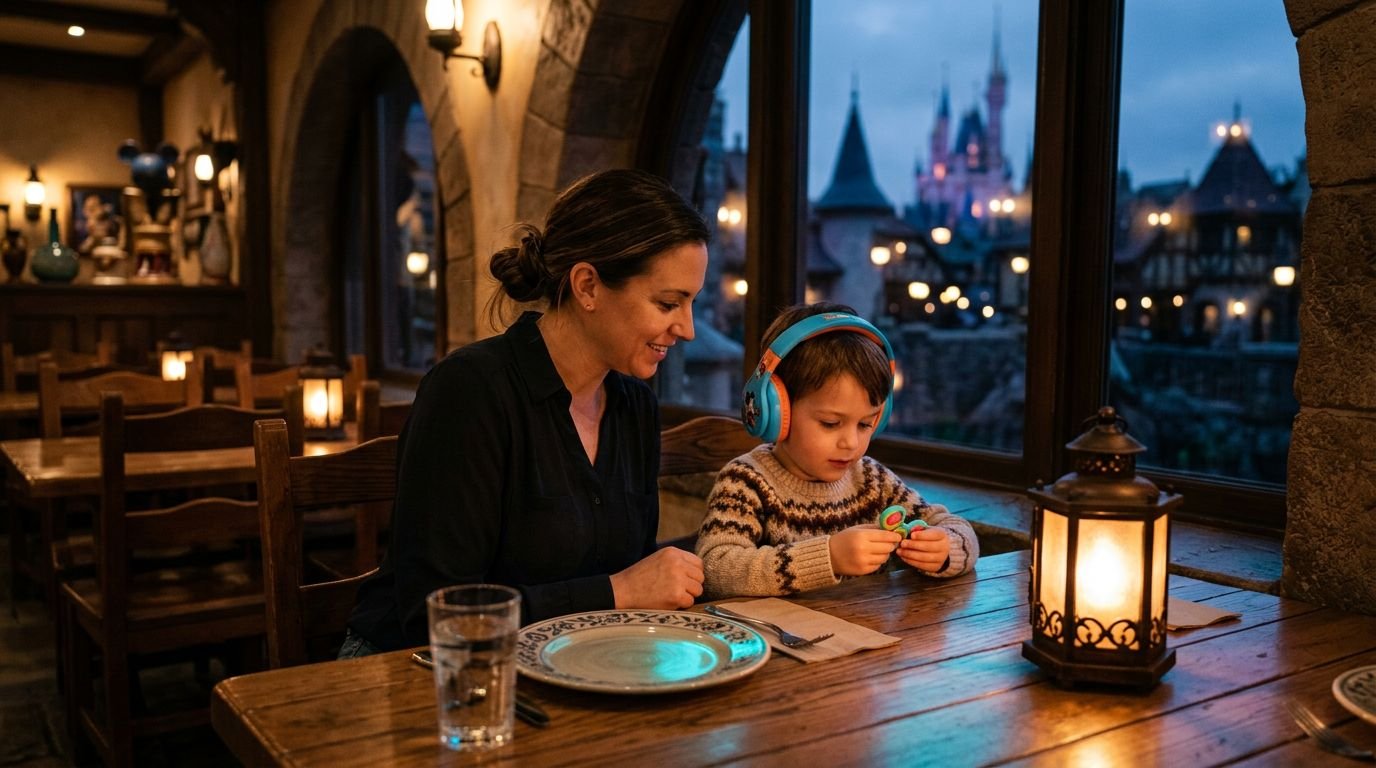
A Disney meal can be a welcome reset, or it can become the hardest part of the day. Noise, unfamiliar foods, long waits, bright lights, and a crowded dining room can feel overwhelming for a child with autism or sensory issues.
Sensory-friendly Disney dining starts with choosing a setting that fits your child, not booking the restaurant everyone else says you have to try. A little planning gives your family more room to eat, rest, and enjoy the park without pushing through overload.
Key Takeaways
- Choose restaurants based on noise, seating, menu comfort, and location, not only popularity.
- Book at less busy meal times when possible, such as an early lunch or late dinner.
- Add dietary notes to reservations, but also speak with a Cast Member when you arrive.
- Bring familiar snacks, noise-canceling headphones, fidgets, and a charged phone for a calmer meal.
- Keep one flexible backup plan in case your child needs to leave or skip the reservation.
Start With Your Child’s Real Dining Needs
Every family has a different definition of a successful Disney meal. For some children, including those with ASD, it means a quiet table and familiar chicken tenders. For others, it means outdoor seating, room to move, and a short meal with no surprises.
Think about what is difficult at restaurants at home. Is it background noise? Waiting at the host stand? Strong food smells? Sitting close to strangers? A character walking toward the table may be exciting for one child and stressful for another, especially for children who struggle with processing disorders.
Write down a few simple priorities before you search for reservations. You do not need a perfect plan. You need a plan that gives your child breathing room.
Consider these questions:
- Does your child do better indoors or outdoors?
- Is a buffet too busy, or does it help because your child can see the food first?
- Are loud celebrations, music, and character visits likely to be difficult?
- Will your family need a meal close to a quiet area, hotel room, or park exit?
- Are there safe foods your child reliably eats?
A dining reservation is not a promise that everything will go exactly as planned. It is a starting point. The goal is to reduce the number of unknowns regarding sensory stimulation before your family is hungry and tired.
A calmer meal is usually more valuable than the hardest reservation to get.
Choose Disney Restaurants With the Setting in Mind
Disney restaurants offer vastly different environments, even within the same park. A themed table-service meal may look fun online, but the room might be dim, busy, or filled with overwhelming sounds. When planning your trip, consider the sensory profile of each location.
Quick-service options are often a better fit for families who need more flexibility. You can use the My Disney Experience app to place a mobile order, find a quiet table when one is available, and leave whenever your child is ready. For example, Columbia Harbour House is a fantastic quick-service choice because it features a quieter upstairs seating area that feels much less hectic than the main floor.
Outdoor seating can also provide relief. Fresh air and open space often reduce echoing, though you should keep an eye on proximity to walkways. If you prefer to stay inside, seek out air-conditioned spaces that offer a retreat from the heat and crowds.
When you are comparing options, look beyond the menu. Check the restaurant location and consider the travel time. A reservation across the park may not be worth the effort after a long morning. If you are looking for specific atmospheres, the Garden Grill offers a rotating, calm environment, while the Sci-Fi Dine-In provides a dark, theater-like setting that can be great for those sensitive to bright lights. Similarly, Coral Reef is known for its lower noise levels and calming, underwater views. If you are staying at one of the Disney Resort hotels, Cape May Cafe is an excellent, calmer choice for a meal away from the park crowds.
Character meals deserve extra thought. Some children love predictable character interactions, while others may need more space. You can let your server know if you would prefer characters not to approach your table. Cast Members will do their best to accommodate, but it is best to manage expectations as this is not guaranteed.
If your family is visiting Walt Disney World with an autistic child, the Download our Disney World with Autism Guide (PDF) can be a helpful planning resource to keep with your trip notes.

Photo by RDNE Stock project
Booking Sensory-Friendly Disney Dining Reservations
Dining reservations typically open 60 days in advance, and popular locations can fill quickly. Check the current booking calendar before your travel dates, as reservation rules and availability can change.
Start with one table-service meal per day at most. This provides enough structure without turning every park day into a race against the clock. Many families do best by choosing off-peak hours for their meals, such as a late breakfast, early lunch, or early dinner, when restaurants are naturally less crowded.
An early lunch during off-peak hours can work especially well. Your family has time for a few attractions first, then a meal before the hottest and busiest part of the afternoon. It also creates a natural break before you decide whether to stay in the park, return to your Disney Resort hotels, or find quiet spots to relax.
When booking, keep your reservations close to where you expect to be. Magic Kingdom, EPCOT, Disney’s Hollywood Studios, and Disney’s Animal Kingdom all require more walking than families often expect. Make sure your meal plan aligns with your theme park reservations so you are not rushing back and forth across a park, which can create stress before anyone sits down.
Use the reservation notes if a dining website or app provides a place for dietary needs or accessibility requests. For food allergies, it is still smart to speak directly with your server or a chef when you arrive. Dietary requests and sensory preferences are different, but both deserve a clear conversation.
You can also call ahead or ask at the restaurant podium about seating. A quiet corner, a table away from speakers, or outdoor seating may be available. It cannot be guaranteed, especially during busy periods, but a polite request gives the team a chance to help.
Avoid booking a meal immediately after a high-demand attraction, parade, fireworks show, or long transportation ride. A 12:30 p.m. reservation may sound easy until your child is overstimulated, hungry, and still standing near a crowded ride exit.
Leave at least 30 minutes of open time before a reservation. More time is even better if your family uses a stroller, wheelchair, mobility device, or needs bathroom breaks before meals.
Use Mobile Order and Familiar Food as Backup
A reservation is helpful, but it should never feel like a test your family has to pass. Some days, your child may be ready for a sit-down meal. Other days, the best choice may be using mobile ordering for quick-service meals and eating in one of the many quiet spots throughout the parks.
Mobile food ordering gives you more control over timing. You can choose a return window, order when your child is ready, and avoid standing in a long ordering line. Keep your phone charged, because the My Disney Experience app is essential for navigating quick-service options, checking park maps, and managing attraction return times.
A portable charger belongs in a park bag. It is not exciting, but it can save a lot of frustration when your phone battery is low and everyone is hungry.
Bring a few familiar snacks even if you have dining reservations. Granola bars, crackers, or dry cereal can bridge the gap when a child cannot wait for a meal. For picky eaters, having a preferred snack on hand can be a lifesaver if the menu is not working that day.
Many children eat less in the heat or when their routine changes. That is normal. Do not pressure your child to use every dining credit or eat a full meal because it was planned. Disney portions can be large, and vacation days do not always follow a normal schedule.
For a broader autism-focused planning reference, families can also find the Download our Disney World with Autism Guide on Amazon. Having guidance ready before the trip can make decisions easier when the day feels busy.
Remember That DAS and Dining Are Separate
Disney’s Disability Access Service, often called DAS, helps eligible guests navigate attraction queues. However, it does not provide front-of-the-line access for restaurants, nor does it remove the need for a dining reservation.
That does not mean you are on your own at meals. Cast Members can often help with practical concerns, including accessibility questions, dietary needs, and seating requests. The best approach is to explain what would help your family in simple terms.
You might say, “My child is sensitive to high noise levels. Is there a quieter table available?” Or, “My child struggles with loud background noise and may need to step outside. Can we let you know if we need a few extra minutes?”
Keep expectations realistic. A restaurant cannot control every sound, crowd, or delay. Still, a kind conversation at check-in can make a potentially stressful moment feel much more manageable.
If your child needs to leave the table, let one adult step out with them while another stays behind. There is no rule that says every family member has to experience every meal in the same way.
Frequently Asked Questions
Can I request a specific quiet table when I arrive?
While Disney cannot guarantee specific seating, it is perfectly acceptable to speak with the Cast Member at the host stand upon arrival. Politely explain your child’s sensory needs, such as a preference for a quieter corner or a table away from speakers, and they will do their best to assist you.
Should I avoid character meals if my child has sensory sensitivities?
Not necessarily, as every child is different. If your child enjoys character interactions but finds them overwhelming, you can ask your server to have the characters skip your table during their rotation. This allows your family to enjoy the meal environment without the pressure of direct, unpredictable contact.
Are there quiet spaces outside of restaurants if my child gets overwhelmed?
Yes, each theme park features Baby Care Centers that offer a quiet, climate-controlled environment away from the typical park bustle. These centers are excellent for recharging, having a snack in a calm setting, or taking a break from the noise and crowds of busy dining locations.
A Flexible Meal Plan Makes Disney Days Easier
The best Disney dining plan is one that fits your family instead of forcing your family to fit the plan. Pick restaurants with a setting your child can handle, book at times that allow for breaks, and keep quick-service food and familiar snacks available. If you find your child needs a more private space to eat or recalibrate, remember that the Baby Care Center serves as a wonderful resource for families needing a quiet environment outside of the busy restaurants.
You do not need every character meal, every popular reservation, or every paid add-on for a good Disney vacation. A comfortable family meal is a win, even if it looks different than the plan you made at home. Think of a peaceful dining experience as a sensory break that helps everyone recharge for the rest of the day.
When your child feels safe and supported, there is more room for the Disney moments your family came to enjoy.
Ready to Plan Your Calm Disney Vacation?
Let us handle the logistics so you can focus on the magic. Contact us today for expert special needs travel planning.