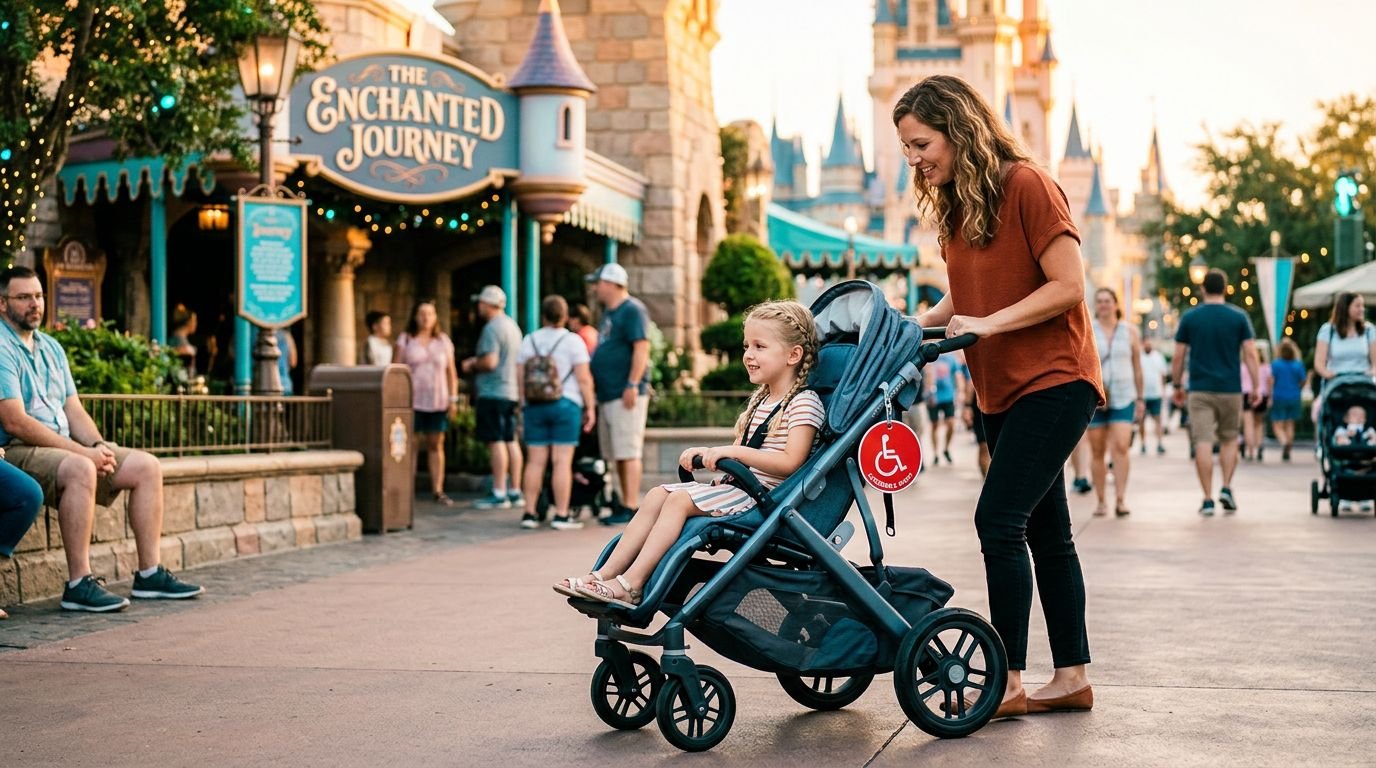
A Disney day includes far more walking, waiting, noise, and heat than many families expect. For children with special needs, leaving a stroller at stroller parking can make a fun day much harder.
Yes, Disney may approve a stroller as a wheelchair for use in attraction queues when your child needs it for safety, fatigue, sensory regulation, or medical support. This option is available at both Walt Disney World and Disneyland Resort theme parks. The process is simple when you know where to go and what to ask for.
Key Takeaways
- Disney may approve a stroller as a wheelchair when a child needs it for mobility, safety, fatigue, sensory regulation, or medical support.
- Visit Guest Relations at the start of the day, explain your child’s functional need, and keep the red stroller tag visible throughout your visit.
- A tagged stroller may enter permitted attraction queues, but your child may still need to transfer into the ride vehicle and follow attraction-specific instructions.
- Check stroller dimensions before traveling: ordinary strollers generally must be no more than 31 inches wide and 52 inches long, while approved mobility strollers may be reviewed up to 36 inches wide and 52 inches long.
- Stroller tags, DAS, Lightning Lane Multi Pass, and Rider Switch are separate tools, so build a flexible park plan around your child’s energy and comfort.
Stroller Wheelchair Disney Rules: What the Tag Allows
Disney provides a stroller accommodation tag for guests who need to use a stroller as a wheelchair. Many families call it a red stroller tag or wheelchair tag. The names vary in conversation, but the purpose is the same.
A standard stroller usually must be left before entering a standard queue. A tagged stroller can enter permitted attraction queues with your child. This helps children who cannot safely walk or stand for long periods. It can also support a child with special needs who needs familiar seating, medical support, or predictable personal space while waiting in a queue.
Disney lists several situations where this accommodation may fit:
- A child uses a stroller as a mobility device instead of a standard wheelchair.
- A child needs medical equipment that must stay with them in a queue.
- An adult uses a stroller to help with walking.
Disney’s attraction queue access guidance explains that the tag is for a guest with a disability who needs the stroller for mobility support.
A stroller tag allows the stroller to enter a queue when permitted. It does not mean the child can remain in the stroller during the ride.
Each attraction has different loading areas, ride vehicles, and safety rules. A cast member will explain when your family needs to transfer your child, use a different entrance, or wait for an accessible ride vehicle.
How to Get a Stroller as a Wheelchair Tag
Start your park day by visiting Guest Relations, where you can ask about accessibility services and related accommodations. It is much easier to handle this before your first ride line feels crowded and stressful.
At Walt Disney World, Guest Relations is at City Hall in Magic Kingdom, with another location near the entrance at EPCOT. At Disneyland Resort, Disneyland Park’s City Hall is near the front. The California Adventure location is at the Chamber of Commerce near the entrance.
If you’re unsure where to go, ask a cast member at the park entrance. They can direct you to the closest location or tell you where the Guest Experience Team is set up that day.
Explain your child’s functional need in clear, simple terms. You don’t need to share every detail of their diagnosis or medical history. If relevant, explain that your child relies on the stroller as medical equipment. You can say something like:
“My child needs this stroller as a mobility device. They cannot safely walk or wait in a long line without it.”
A cast member may ask a few questions so they understand how the stroller supports your child. Disney generally doesn’t require parents to bring a doctor’s note or proof of diagnosis. Policies can change, so be ready to explain why the stroller needs to stay with your child.
Families often call this approval a red stroller tag. It is separate from ticketing and Lightning Lane, and it doesn’t replace other access programs. It gives your family permission to keep the stroller with your child in areas where Disney allows approved mobility aids.
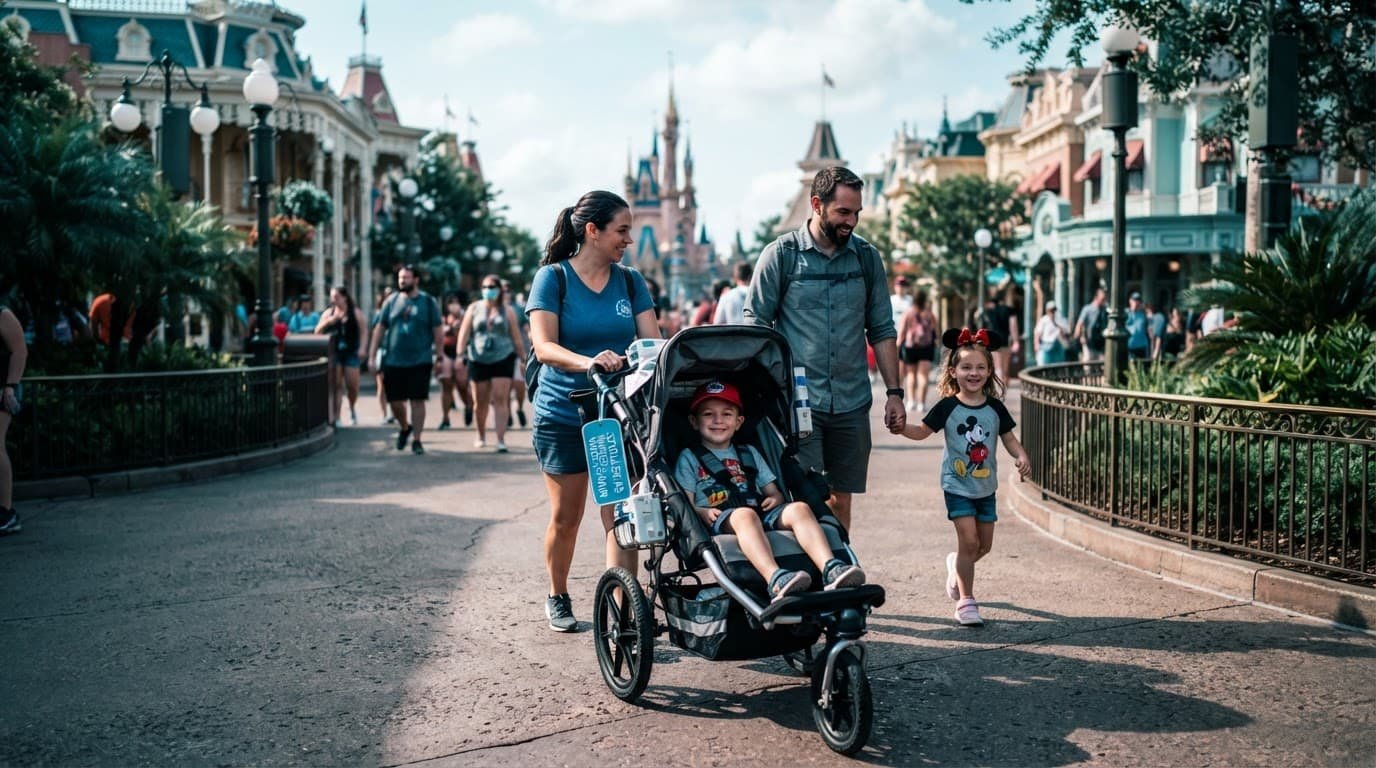
Keep the red stroller tag visible on the stroller throughout the day. If you use stroller parking, take a photo of the stroller and its tag first. Busy parking areas can look very different after a parade, rainstorm, or fireworks crowd.
Stroller Size Limits and Stroller Wagon Rules
Measure your stroller before leaving home. Disney checks the stroller size at the park gate, and a tag does not make an oversized device automatically acceptable. If you’re close to either limit, ask a cast member at the gate to confirm the measurement.
For ordinary strollers, the current limit is 31 inches wide and 52 inches long. Strollers approved as wheelchairs are reviewed under Disney’s size standard, generally up to 36 inches wide and 52 inches long.
Bring the stroller’s product dimensions with you if it is close to either limit. Measure the widest point, including accessories that stay attached.
A few other rules matter:
- The stroller must be stable when stopped and unoccupied.
- It should be intended for a single rider.
- It must fit safely through attraction pathways and queue entrances.
- Never use makeshift straps to secure a child on a ride unless the stroller has an approved transportation restraint system.
Wagons and stroller wagons, including popular styles such as Keenz, are generally not allowed at Walt Disney World or Disneyland Resort, even when a family needs mobility help. A wheelchair tag does not override size or wagon restrictions. Review the current stroller wagon policy details before buying or renting a device for your trip.
Check current resort rules before traveling, since size policies may change. If your child has outgrown a standard stroller, a medical stroller, adaptive stroller, wheelchair, or rented ECV may be a better fit. The right choice is the one that keeps your child comfortable and follows Disney’s current rules.
Using a Tagged Stroller in Attraction Queues
The biggest benefit of a tagged stroller is that your child does not have to walk from stroller parking to the attraction entrance, then stand through a long standard queue. For a child with limited endurance, autism, anxiety, sensory needs, or other special needs, avoiding those steps can make a real difference.
Still, do not assume every queue works the same way. Some attraction queues have narrow areas, stairs, or ride vehicles that require special handling. Stop at the entrance and show the red stroller tag to the cast member. They will tell you where to go.

Plan for the ride vehicle, not only the line
A stroller may solve the queue problem, but your child may still need to transfer into a ride seat. Think through that step before waiting in a queue for 45 minutes.
Ask the Cast Member:
- Does my child need to transfer from the stroller to the ride vehicle?
- Is there a wheelchair-accessible vehicle available?
- Can the stroller wait near the boarding area?
- Is rider switch available if my child will not ride?
- Is there a quieter or alternate entrance for this attraction?
Single rider lines and stroller access
A single rider line is different from an accessible queue and does not provide the same stroller access. It may separate members of your party, so ask the cast member whether the single rider entrance is appropriate.
Do not remove a child from the stroller until the cast member gives specific transfer directions. Some ride vehicles move continuously, while others have a longer loading process.
Keep a small comfort pouch easy to reach. Headphones, a familiar fidget, a communication card, medication, and a portable charger can help during a wait. Put charging cords with devices. Families often remember the tablet and forget the cable.
DAS, Lightning Lane, and Rider Switch Are Separate Tools
A stroller tag, DAS, Lightning Lane Multi Pass, and Rider Switch are separate accessibility services and planning tools. Each addresses a different need.
Disability Access Service (DAS) is for guests who cannot tolerate a standard queue because of how their disability affects them. Instead of waiting in a queue, an eligible guest receives a return time and waits elsewhere. A stroller tag does not approve someone for DAS, and DAS does not replace the tag when a stroller is needed for mobility support.
Lightning Lane Multi Pass is a paid service with scheduled return windows for participating attractions. It is separate from DAS and may help when your family has a few must-do rides. Too many timed reservations can create pressure, so a slower plan often works better than watching the clock all day.
Older planning materials may use the phrase Disney Genie service for earlier app-based planning tools. The Disney Genie service is different from Lightning Lane Multi Pass. The Disney Genie service is not an accessibility accommodation, so check the current Disney app and resort information for available options.
Rider Switch helps when one person in the party cannot or chooses not to ride. To request Rider Switch, ask a Cast Member at the attraction entrance. One adult stays with the non-rider while the rest of the group rides. Then the waiting adult can ride without joining the full line again, following the Cast Member’s attraction-specific instructions.
A single rider line is not a substitute for Rider Switch. Single rider access may split your party, so it is not ideal when staying together matters.
For families with a non-rider, Rider Switch can help when a child needs to stay in a stroller with a caregiver. It also gives siblings and adults a chance to enjoy height-restricted rides without splitting the day into separate waits.
Build a Park Day Around Your Child’s Energy
At theme parks, the best plan for a park visit is not about doing every ride. It is about avoiding the point where your child is too tired, overwhelmed, or uncomfortable to enjoy anything.
Choose one or two priority attractions each morning. Stay in one area of the park instead of crossing it repeatedly. At Magic Kingdom, spend time in Fantasyland or Tomorrowland before moving on. At EPCOT, remember that Remy’s Ratatouille Adventure, Frozen Ever After, and Soarin’ are spread far apart.
A hotel break is always a good choice. So is a quiet meal, a longer rest in the stroller, or leaving before fireworks. Rider Switch can give siblings or adults a chance to ride without forcing your child through another wait.
Disney days change quickly, and your family doesn’t need to push through every hard moment. Check the current park app and terminology before relying on older itinerary advice, especially around Disney Genie Service. A single rider line is not automatically a good family solution, particularly when everyone needs to stay together.
For more autism-focused Disney planning support, the Disney World with Autism Guide on Etsy includes practical ideas for park days, accessibility needs, and breaks. A companion Disney autism travel guide on Amazon is also available for families who want extra planning support.
Frequently Asked Questions
Can I use a stroller as a wheelchair at Disney?
Yes, Disney may approve a stroller as a wheelchair when a guest needs it for mobility support, safety, fatigue, sensory regulation, or medical needs. The accommodation is available at Walt Disney World and Disneyland Resort theme parks.
How do I get a red stroller tag at Disney?
Visit Guest Relations or ask a cast member where the Guest Experience Team is located. Explain your child’s functional need in clear terms; Disney generally does not require a doctor’s note or diagnosis documentation, although policies can change.
Can my child stay in the stroller during a Disney ride?
Not usually. The stroller may enter a permitted queue, but each attraction will explain whether your child must transfer to the ride vehicle or use a different accessible loading process.
Are stroller wagons allowed as wheelchairs at Disney?
Wagons and stroller wagons, including styles such as Keenz, are generally not allowed at Walt Disney World or Disneyland Resort. A wheelchair tag does not override Disney’s size or wagon restrictions, so check the current rules before traveling.
Is a stroller tag the same as DAS or Rider Switch?
No. A stroller tag supports mobility in permitted queues, while DAS, Lightning Lane Multi Pass, and Rider Switch address different accessibility or planning needs and must be requested or used separately.
A More Comfortable Disney Day
Using a stroller as a wheelchair at Disney can reduce walking, prevent stressful transitions, and give your child a familiar place to reset. Ask for the red stroller tag, then follow a cast member’s attraction-specific instructions.
The right tag, a flexible schedule, and tools such as rider switch can make the park feel more manageable. A successful Disney day is one where your child feels supported, even if the plan changes along the way.