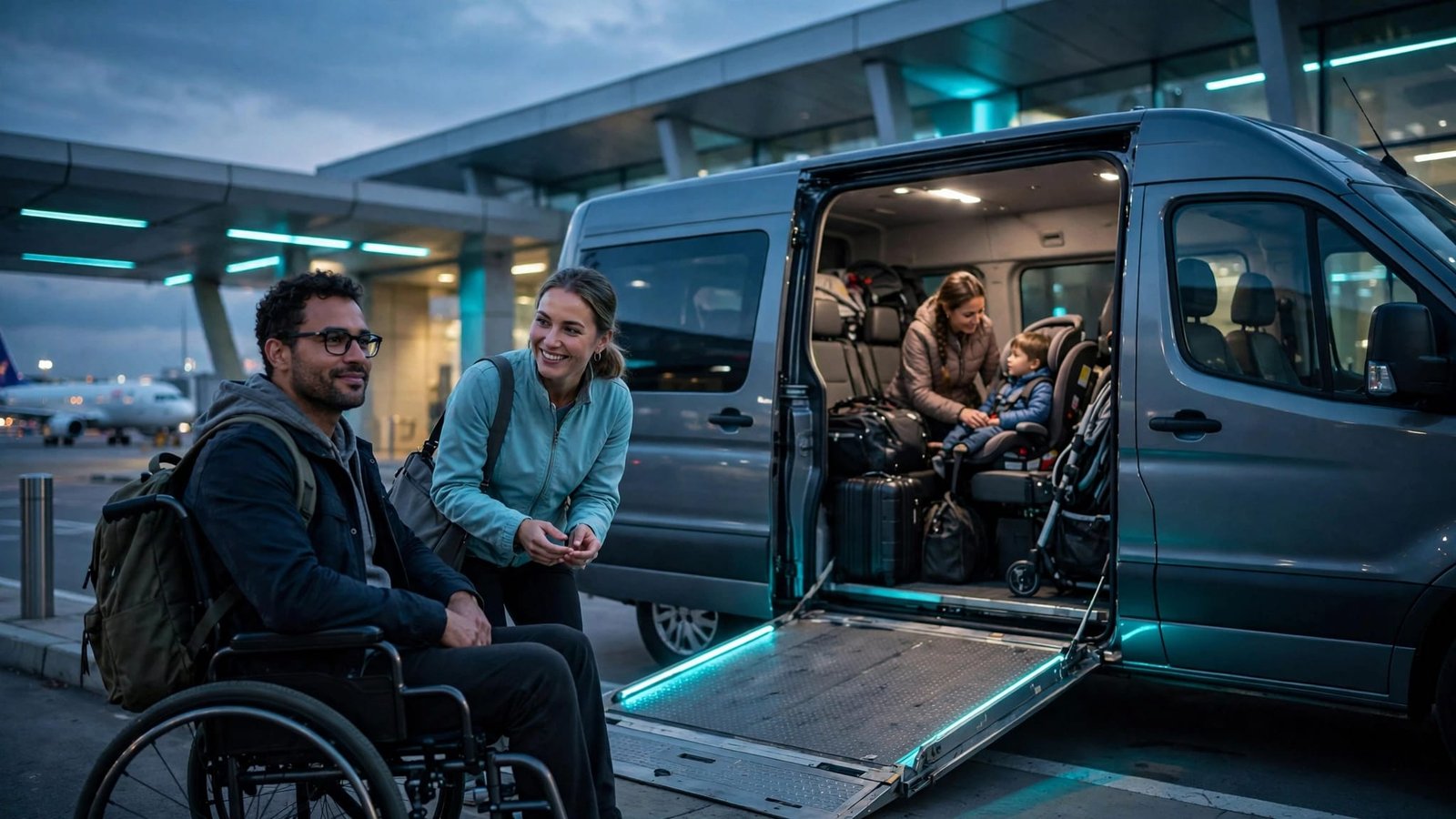
A family vacation should not begin by wondering whether your ride has room for a wheelchair, luggage, car seats, and loved ones. Wheelchair airport transfers offer safer, more comfortable travel from the airport to your hotel, cruise port, or vacation rental.
The right plan covers more than a ramp. Accessible airport transfers mean coordinating the airline, airport, ground provider, wheelchair, children, luggage, and car seats. A little planning before you leave home can take away a lot of airport stress.
Key Takeaways
- Book wheelchair airport transfers early and confirm the vehicle can safely accommodate the traveler, wheelchair, children, caregivers, luggage, and car seats.
- Share the wheelchair’s dimensions, weight, battery type, and occupied-vehicle needs with the transportation provider before confirming the ride.
- Request airline wheelchair assistance when booking, then remind staff at check-in and the gate; airline assistance does not replace an accessible vehicle after arrival.
- Build extra time into flights and transfers for baggage claim, connections, bathroom breaks, medications, service animals, and unexpected delays.
- Keep wheelchair handling instructions, important equipment, provider contacts, and a written backup plan available throughout the trip.
Start With the Full Travel Day, Not Only the Flight
Airport accessibility isn’t one service. It’s a chain of coordinated handoffs. You may need airport ground transportation to get there and airline assistance inside the terminal. You may also need help during a connection and another accessible vehicle after landing.
Each part should work with the next one. A great flight plan can still feel difficult if your family waits at the curb for a vehicle that cannot safely transport a wheelchair.
Know who is responsible for each step
Your private transfer company handles the trip between the airport and your destination. The airline handles wheelchair and guided assistance inside the airport, during boarding, and between gates. Airport staff may also provide terminal and curbside assistance.
Airports may also operate accessible shuttles, elevators, parking, and service-animal relief areas. Ask early who handles each part, including baggage and luggage assistance at claim and the wheelchair pickup process. Do not assume your airline wheelchair request includes your hotel transfer.
Tell both the airline and transportation company if you’re traveling with a power wheelchair, special needs stroller, medical equipment, or several children.
Build breathing room into the schedule
Avoid booking a pickup that leaves no room for baggage claim, wheelchair return, or a delayed flight. Even a 30-minute delay can feel much longer when a child is tired, hungry, or ready to leave the airport.
For a family vacation, extra time is not wasted time. It is time for bathroom breaks, medication, snacks, a change of clothes, and a calm start. If you have a connection, choose one that gives you time for flight connection assistance and movement between gates without rushing.
The cheapest transfer is not always best. A delayed flight, inaccessible vehicle, or missed curbside pickup can leave your family without an accessible backup plan.
What a Safe Wheelchair-Accessible Vehicle Should Include
Not every large van provides wheelchair accessible transportation for someone who remains in their wheelchair. Extra seats don’t make a vehicle suitable for occupied wheelchair travel.
Wheelchair accessible vehicles should match the traveler’s chair, equipment, and family needs. Ask the company to describe the vehicle before you pay. A good provider should answer clearly without making you feel like you’re asking too much.
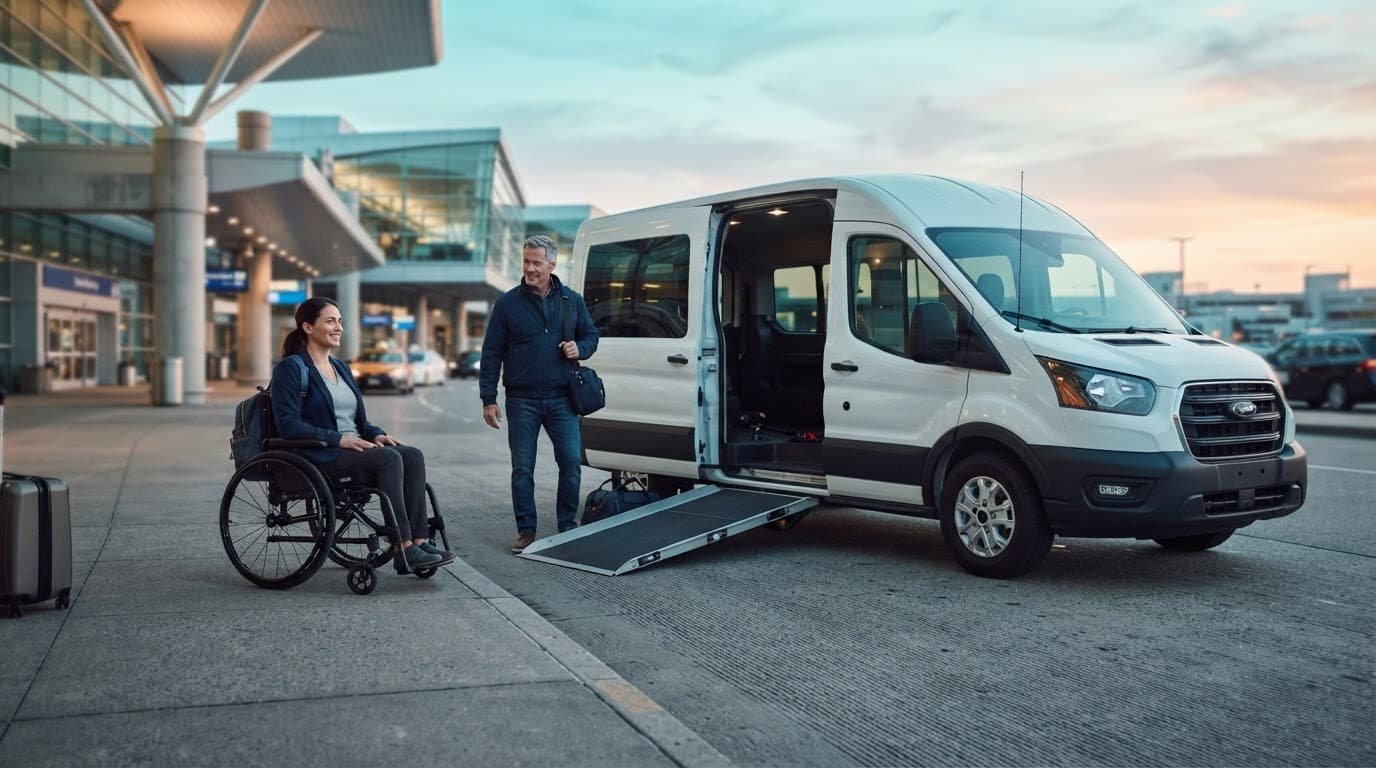
Look for these features when comparing options for secure wheelchair transport:
- A ramp or powered lift with enough weight capacity for the traveler and power wheelchair.
- Confirmation that the chair’s length, width, height, total weight, and occupied-vehicle compatibility suit the vehicle.
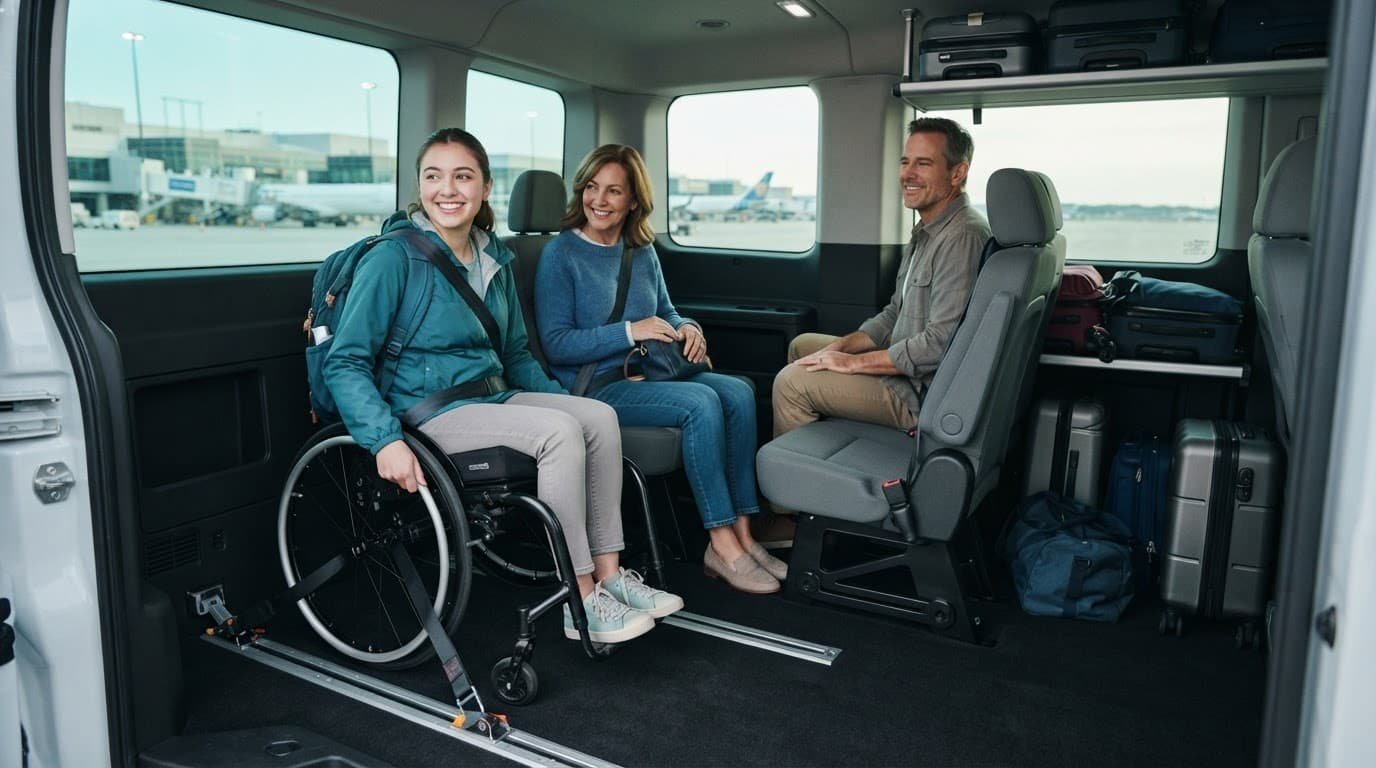
- A wheelchair securement system, including wheelchair tie downs, plus a shoulder-and-lap restraint.
- Enough turning clearance and interior space for passenger seating, caregiver seating, children, luggage, and other mobility equipment.
- Child-seat compatibility if young children will travel with the family.
- A driver trained to operate the lift, secure the chair, and assist safely at the curb.
- Clear policies for flight delays, cancellation terms, and a missed pickup.
- A backup vehicle available if the assigned vehicle fails.
Ask whether the provider uses a rear-entry ramp, side-entry ramp, or powered lift, and confirm the wheelchair lift and ramp type. A ramp may work well for many manual chairs. A lift can suit heavier power chairs or travelers who need more space and stability.
Also ask about weather protection. A transfer may be simple on a sunny day but harder in heavy rain, snow, or a crowded airport pickup area.
Book Accessible Ground Transportation Before You Book Extras
Make advance reservations for your airport ride as soon as you have flight and hotel details. Private accessible vans are limited in many destinations, especially during school vacations, cruise departures, holidays, and major events.
A reserved private transfer may offer door to door service, but confirm the exact pickup and drop-off locations. You don’t need every vacation detail finalized first. You do need a realistic arrival time, flight number, and passenger information.
Questions to ask before confirming a transfer
Share the wheelchair’s make, model, dimensions, total weight, and battery type if you know them. Tell the company whether the traveler will remain seated in the wheelchair during the ride.
Also provide the number and type of passengers, child-seat needs, luggage quantity, and whether a caregiver must sit beside the wheelchair user.
You should also ask:
- Is the price for the vehicle or per passenger?
- Does the provider offer flight schedule monitoring? Is it automatic, or must you call with updates?
- Can the driver meet you inside baggage claim, or only at the curb?
- How will you identify the driver, vehicle, and meeting location?
- Are car seats available, or can you bring your own?
- Is there a fee for late-night pickup, extra luggage, or a cruise-port stop?
- What happens with an after-hours arrival?
- What are the cancellation and no-show policies?
- How should you report a flight change?
- What backup plan is available if the vehicle or driver becomes unavailable?
Get the confirmation in writing. Save the provider, hotel, and airline contacts in your phone and on paper. Include the driver’s number, dispatch number, confirmation number, and pickup instructions.
A family member should also know the plan. One adult might be handling luggage while another stays with the wheelchair user or child. Clear roles can prevent a stressful scramble at baggage claim.
Airline Wheelchair Assistance Is a Passenger Right
The Air Carrier Access Act protects passengers with disabilities who travel on airlines flying to, from, or within the United States. Airlines must provide prompt assistance related to a passenger’s disability.
The U.S. Department of Transportation’s Disability Bill of Rights explains that airport wheelchair assistance can include help through the airport, boarding support, aisle chairs, and assistance with mobility devices.
Request airport wheelchair assistance when you book. Remind the airline at check-in and at the gate. Airlines need you to self-identify when you arrive, even if the service is listed in your reservation.
Assistance should cover the airport path
Airport wheelchair assistance should take passengers from the terminal entrance or curbside area to the gate. It can include help through security, connections, baggage claim, and the pickup area after arrival. Airline staff provide this help inside the airport and during boarding, while a transfer company supplies the accessible vehicle after arrival.
The DOT’s wheelchair and guided assistance guidance also confirms that gate-to-gate help is included for connecting passengers.
This assistance has limits. Confirm procedures directly with the airline, since equipment handling and airport processes can vary by airport and destination. Airline employees aren’t required to provide personal care, such as feeding, administering medication, or helping in a restroom. Bring a caregiver when the traveler needs that type of support.
Boarding is different from walking to the gate
A ground wheelchair gets someone through the airport. An aisle chair is a narrow boarding wheelchair that fits through an aircraft aisle. Airline boarding assistance may use it to help a passenger reach their seat.
If you need an aisle chair, ask for it clearly. Tell the gate team whether the traveler can transfer independently, needs a caregiver’s help, or requires a specific approach.
Passengers who need extra time to board should be offered preboarding. That time can help your family get settled before the cabin becomes crowded.
Plan for Connections, Bathrooms, and Service Animals
A short connection may look fine on a booking screen. It can feel very different when you need wheelchair help, a bathroom stop, medication, food, or a terminal change.
Build extra time into connecting flights, especially when traveling with a wheelchair user. Large airports may require a long ride, elevator wait, security checkpoint, or train transfer.

Airlines generally cannot leave a passenger who isn’t independently mobile unattended in a wheelchair or similar mobility device for more than 30 minutes. If help is delayed, speak to the gate agent and ask for a Complaint Resolution Official, often called a CRO.
Do not skip basic needs to keep moving
Tell the airline assistant about basic needs before rushing to the next gate. Request a stop for a restroom, food, medication, family restroom, or a service animal relief area.
Airline personnel must escort a passenger and service animal to a relief area when requested. If the traveler uses a service animal, locate the appropriate service animal relief area before departure.
The DOT’s accessibility guidance can help you understand the airline’s responsibility for that escort.
For longer flights, confirm the aircraft type, accessible-lavatory availability, and whether an onboard wheelchair is provided. Many aircraft with more than 60 seats must provide an onboard wheelchair, but facilities vary. If a plane does not have an accessible lavatory, ask the airline whether 48 hours’ notice is needed for an onboard wheelchair request.
Protect the Wheelchair and Important Equipment
A wheelchair isn’t regular luggage. For a traveler with a mobility impairment, it supports independence, comfort, positioning, and safety.
Take photos of the chair before the flight. Include the front, back, sides, cushions, footrests, controls, and any existing marks. If the chair has removable parts, label them and bring a simple handling card explaining the traveler’s mobile and mobility needs, including the controls, battery, seating requirements, removable components, and any transfer limitations.
Keep medications, chargers, communication devices, glasses, important documents, and a change of clothes in your carry-on. Families often remember the tablet and forget the charging cable. Put cords, headphones, batteries, and devices together in one pouch.
Before handing over a power wheelchair, check these essentials:
- Battery information and handling instructions are attached.
- The joystick and other controls are protected.
- Cushions and footrests are labeled and secured.
- Communication devices stay in your carry-on.
- Replacement charging equipment is packed and easy to access.
Give airline staff clear handling instructions
Tell the airline whether the chair folds, how it should be lifted, where it should be secured, and how to disconnect or protect the battery. A power wheelchair may need battery information before boarding.
Mobility devices have priority over other items in the cargo area. Request delivery at the aircraft door when available. This is often easier than waiting for the chair at baggage claim.
Inspect the chair before leaving the airport. If it is damaged, report it immediately. Take photos, keep every document, and ask for a written report. The DOT’s current wheelchair protection rule includes requirements for airlines to notify passengers of their rights after wheelchair or scooter mishandling.
Understand the Different Types of Transportation
Choosing the right service prevents a bad match on travel day. A driver may be kind and willing to help, but a standard vehicle cannot replace properly equipped transportation.
Here is a simple way to compare common options.
| Type of service | Best for | What to expect |
|---|---|---|
| Wheelchair-accessible taxi | Shorter or on-demand trips | Convenient for local travel, but limited capacity may exclude some power chairs |
| Private transfer or private airport shuttle | Families needing a dedicated ride | Usually prearranged and may provide a dedicated vehicle. Confirm dimensions, securement, seating, luggage space, meet-and-greet details, and cancellation terms |
| Airport or hotel-operated shuttle | Travelers using scheduled hotel or airport service | May be shared and may not permit an occupied wheelchair. Confirm lift access and storage rules before booking |
| Accessible public transit | Travelers focused on lower-cost transportation | Fixed routes, transfers, crowds, and limited luggage space can make travel harder |
| Wheelchair-accessible transfer | Travelers staying in a manual or power wheelchair | Ramp or lift, secure tie-downs, and a trained driver |
| Airline wheelchair assistance | Moving through the airport and boarding | Ground chair, aisle chair, guided help, and gate support. This is airport assistance, not a vehicle service |
| Stretcher airport transport | Travelers who must lie flat during transport | Specialized medical transportation, not a standard airport shuttle |
Stretcher transportation needs a separate plan
A non-emergency stretcher transfer is not the same as airport wheelchair assistance. It is a form of non emergency medical transportation, usually arranged through medical transport specialists.
It may require medical clearance, extra staff, or a different vehicle. Tell the provider about oxygen, pressure-relief concerns, transfer assistance, medical escort needs, and caregiver seating.
Do not book a regular wheelchair van if the traveler cannot sit safely for the ride. The goal is not to choose the biggest vehicle. It is to choose the service that matches the traveler’s actual needs.
Make Arrival Day Easier for Kids and Caregivers
Arrival day can be loud, busy, and full of changes. A good accessible airport transfer gives your family a quiet space between the airport and the vacation.
Before booking, ask whether the hotel offers accessible hotel shuttles. Confirm they can accommodate the occupied wheelchair, caregivers, child seats, luggage, and the chair’s dimensions. A hotel shuttle isn’t automatically the same as a private transfer. Confirm its schedule, vehicle type, lift or ramp, securement system, and backup plan directly with the hotel.
Keep the first evening simple. Consider grocery delivery, an easy meal, familiar snacks, and a short hotel walk instead of jumping into a packed schedule. If you are traveling to a theme park destination, save the big plans for after everyone has rested.
Disney trips need room for real breaks
Disney vacations can involve buses, monorails, security lines, heat, crowds, and more walking than families expect. A slower first day often makes the rest of the trip more enjoyable.
For families traveling with autistic children, the Disney World with Autism Guide on Etsy includes practical ideas for breaks, visual planning, park days, and accessibility needs. The Amazon edition of the guide is another helpful option for families building a plan around their child’s routine.
You don’t need every paid add-on or every ride reservation for a good trip. A familiar snack, a charged device, a calm transfer, and time to reset may matter more.
Pack for delays, spills, and comfort
A small travel bag can save the day. Include wipes, a backup outfit, medications, water, snacks, headphones, a comfort item, and a portable charger.
For travel basics, stroller needs, and supplies for those unexpected sick-on-vacation moments, visit the Trip Rescue Shop. Keeping key items within reach can make a delayed flight or long pickup wait easier to manage.
What to Do When the Plan Breaks Down
Even a well-planned trip can change. Flights are delayed or canceled. A lift may fail. A driver can get stuck in traffic. The best backup plan is simple and written down before you leave.
Before departure, save the accessible transfer provider’s dispatch number, the airline accessibility contact, and the hotel number. Confirm a second accessible transportation option instead of assuming one will be available. Review cancellation and refund terms before booking, including fees for changes or unused rides.
If the vehicle is late, wait in a known accessible location and call dispatch. For a failed lift or inaccessible replacement vehicle, request a specific accessible vehicle. If a flight is canceled or traffic causes a missed pickup, contact the provider and airline promptly. Don’t accept an unsafe ride because everyone is tired. Document any extra costs and keep the receipts.
Speak up early and ask for the right person
At the airport, tell staff what you need in clear, direct words. “We need wheelchair assistance to baggage claim and the pickup area” is better than hoping someone understands.
If assistance is delayed or you are left without support, ask for a Complaint Resolution Official (CRO). Every airline must have one available during operating hours, either in person or by phone.
You can also contact the DOT Disability Hotline at 1-800-778-4838 if you need help understanding your rights. Keep notes with names, times, gate numbers, and what happened. Those details matter if you need to file a complaint later.
Frequently Asked Questions
What is included in a wheelchair airport transfer?
A wheelchair airport transfer provides accessible transportation between the airport and a hotel, cruise port, or vacation rental. Depending on the vehicle, it may include a ramp or lift, wheelchair securement, caregiver seating, luggage space, and child-seat compatibility.
Can a passenger remain in their wheelchair during the transfer?
Some accessible vehicles are designed for occupied wheelchair travel, but not every large van is suitable. Confirm the wheelchair’s length, width, height, weight, and occupied-vehicle compatibility with the provider before booking.
Is airline wheelchair assistance the same as an accessible airport transfer?
No. Airline wheelchair assistance helps passengers move through the airport, board the aircraft, make connections, and reach baggage claim or the pickup area, while a transfer company provides the accessible vehicle after arrival.
When should I book a wheelchair airport transfer?
Reserve the transfer as soon as your flight and accommodation details are available. Accessible vehicles can be limited during school vacations, holidays, cruise departures, and major events, so early booking gives you more time to confirm the vehicle and backup plan.
What should I do if the accessible vehicle is late or unavailable?
Call the provider’s dispatch number, wait in a known accessible location, and request a specific accessible replacement vehicle. Do not accept an unsafe ride, and document delays, names, extra costs, and receipts in case you need to make a complaint or request a refund.
A Comfortable Transfer Sets the Tone for the Trip
The best wheelchair airport transfers give your family more than a ride. Reserve early, verify vehicle dimensions, ramp or lift details, securement, and seating, and ask about child seats and luggage space.
Confirm meet-and-greet and cancellation policies, request airline assistance, and keep a backup plan for delays or changes. A family vacation feels better when every traveler has a place in the plan. Verify accessibility details directly with both transportation providers and airlines, since standards, vehicles, and airport procedures aren’t identical everywhere.