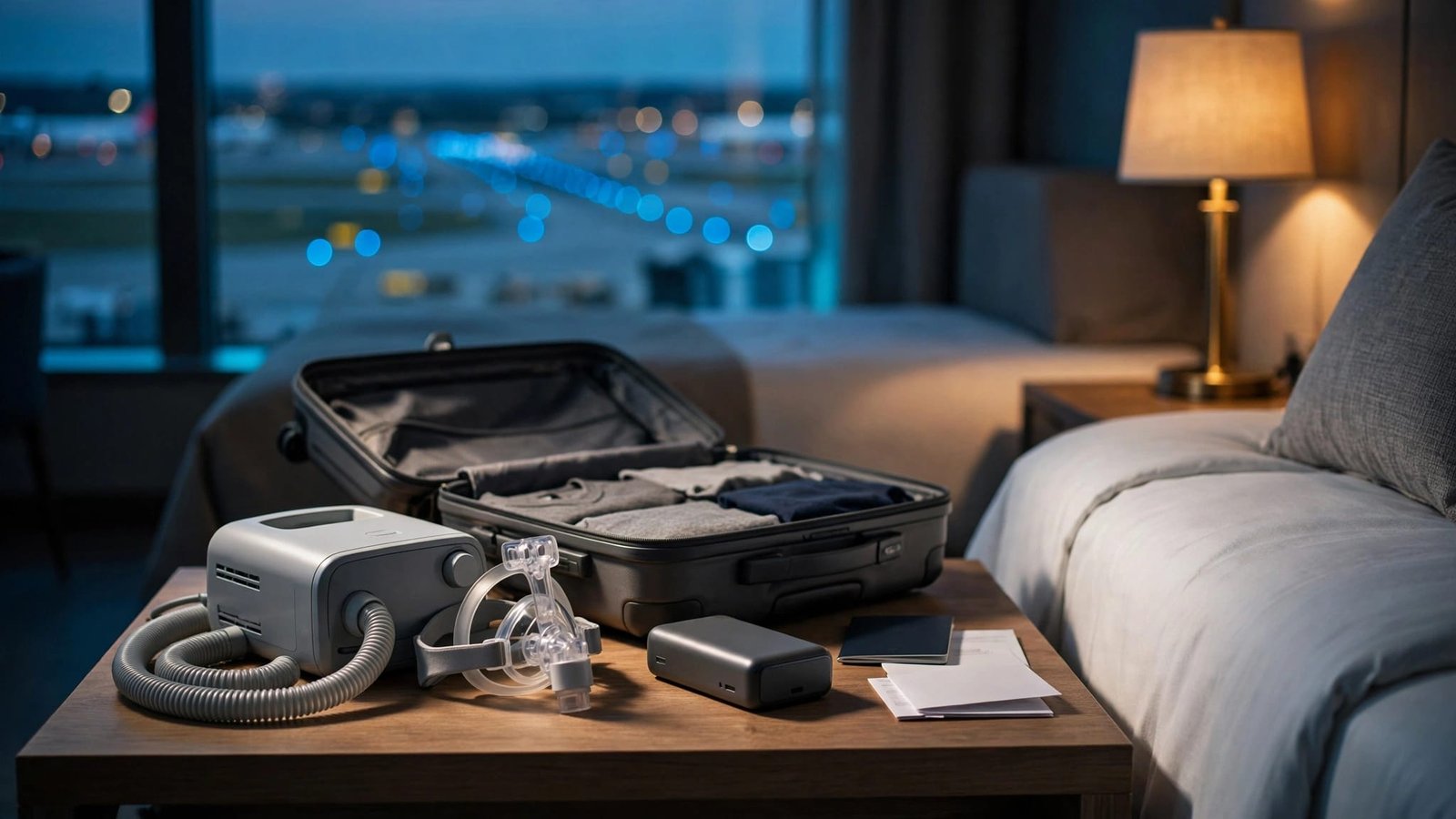
Your prescribed CPAP machine, a medical device, belongs on your packing list beside your medications and travel documents. Traveling with CPAP is easier when you plan for reliable power, airport screening, and a comfortable place to set up each night.
You don’t need to rebuild your sleep routine around your vacation, but a few details deserve attention before departure. Start with your airline, then prepare your equipment and hotel arrangements so you can travel with more confidence.
Key Takeaways for a Comfortable Trip
- Keep your CPAP in carry-on luggage, and empty and dry the humidifier chamber before packing.
- Confirm baggage arrangements and onboard-use requirements with every operating airline.
- Carry spare lithium batteries in the cabin, protect their terminals, and check capacity limits before departure.
- Plan your hotel power connection and follow your machine’s instructions for water and cleaning.
A familiar, tested setup helps you protect your sleep routine without adding unnecessary stress to your trip.
Plan Ahead When Traveling With CPAP
Confirm the airline’s rules before departure
Airport security approval and airline permission are separate. A CPAP may pass screening without being cleared for onboard use.
Contact the airline when you book, especially if sleep apnea means you expect to sleep onboard. Provide your machine’s exact model and ask about advance notice, documentation, seating, batteries, power supply, and onboard operation. Confirm whether heated humidification is permitted and ask about the device’s power requirements.
Ask whether a separate medical-only CPAP bag is exempt from your baggage allowance, and keep the device in your carry-on luggage. Don’t assume one carrier’s answer applies to another. Check the airline policy for each operating carrier, including partner-operated connections, and save its response with your reservation.
Prepare documents and equipment support
Keep a prescription copy, device information, and your equipment provider’s contact details accessible. A prescription can help if you need replacement supplies away from home.
For onboard use, ask whether the airline requires a manufacturer’s aircraft-compliance statement or other paperwork, sometimes called an FAA air travel compliance letter. A medical-equipment tag can identify your bag, but it doesn’t replace required documentation.
Clinical decisions belong with your care team. Ask about travel concerns before departure, and keep using your prescribed sleep therapy settings. Your travel plan should support that routine, not change it.
Pack Your CPAP for the Trip
Protect the machine and humidifier
Use a padded travel bag to keep your CPAP machine, tubing, and mask secure. Keep the equipment with you to avoid delayed luggage or damage in the baggage system.
Empty the humidifier chamber completely before packing to prevent water damage. Let it dry, then pack it according to the manufacturer’s instructions. Water left inside can spill into the machine during handling.
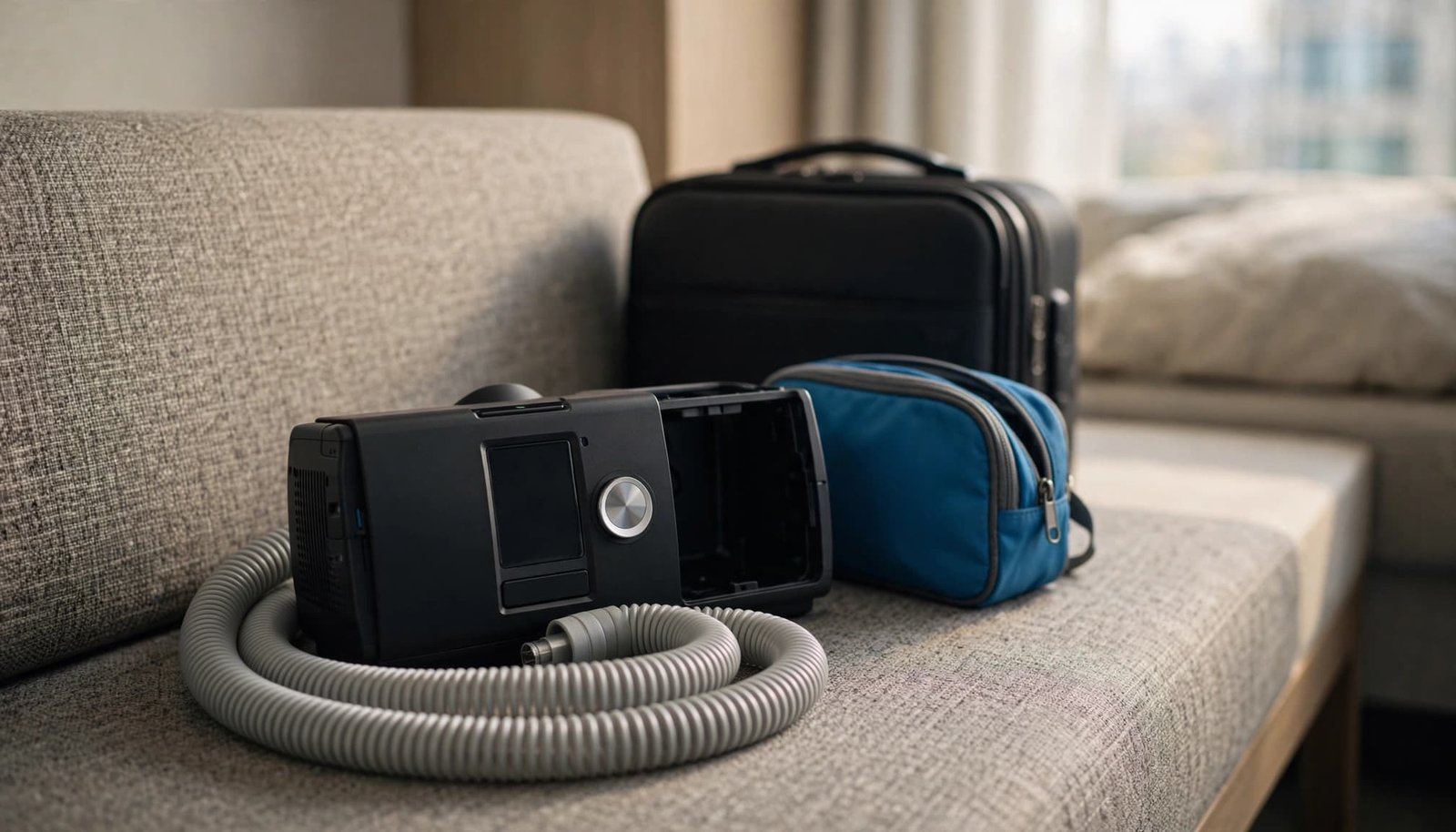
Avoid squeezing the mask beneath heavy items. Protect hose connections and keep clean components in their own pouch.
Bring the small items you depend on
Pack the original power supply, compatible cords, mask, tubing, and any replacement parts your provider recommends. An extra mask cushion or filter takes little space and may prevent a difficult search during vacation. If you use a model such as the ResMed AirMini, check which accessories are compatible.
Bring a suitable extension cord when your lodging permits one. ResMed’s travel tip sheet recommends one because outlets aren’t always near the bed.
For international trips, check your device’s power requirements. A power adapter changes plug shape, but doesn’t convert voltage.
Test the complete setup before departure, including any battery and compatible adapter. Keep the accessories together so you aren’t searching several bags at bedtime.
What Happens at Airport Security?
Tell the officer you’re carrying a CPAP before screening begins. Keep the bag accessible and allow time to unpack and reconnect the equipment.
According to TSA’s CPAP screening FAQ, the machine must come out of its carrying case for X-ray screening. The mask and tubing may stay inside.
Be prepared to remove the machine and follow the officer’s directions. A clear plastic bag can help protect it in a screening bin. Additional inspection may still be required.
After screening, check that your power supply, chamber, mask, and tubing are back in the bag. Don’t rush, even if the line behind you is moving.
An FAA air travel compliance letter is for airline onboard-use approval if requested, not TSA screening.
TSA procedures apply at U.S. checkpoints. For international travel, check departure and transit-country screening requirements too.
Choose Batteries and In-Flight Power Carefully
Check watt-hours before buying
Battery capacity is usually listed in watt-hours, written as Wh. Under the FAA’s lithium-battery rules, spare lithium-ion batteries belong in carry-on luggage.
The standard limit is 100 Wh per battery. Batteries above 100 Wh and up to 160 Wh require airline approval, with up to two larger spares permitted. Larger ordinary spare batteries aren’t allowed under these passenger limits.
For reference, the Medistrom Pilot-24 Lite battery pack is rated at 97.68 Wh. The Expion360 EXP-48PRO is rated at 154 Wh, so airline approval is needed. Capacity alone doesn’t establish compatibility with your CPAP.
Protect terminals against short circuits. If another carry-on is gate-checked, remove spare lithium batteries first.
Test runtime with your actual setup
Battery life changes with pressure, humidification, heated tubing, battery condition, power conversion, and your CPAP’s power requirements. A claim of “two nights” doesn’t guarantee two nights with your equipment.
Test a compatible battery and power supply using your prescribed setup before traveling. Ask your equipment provider how to plan sufficient capacity, including delays, a compatible backup battery, and the airline’s required reserve.
If your airline requests onboard-use paperwork, ask whether it needs an FAA air travel compliance letter. This is separate from FAA lithium-battery capacity rules.
Don’t depend on a seat outlet as your only power source. Availability and permitted use vary by aircraft and airline.
A battery can meet airline capacity limits and still provide too little runtime for your planned sleep.
Set Up Your CPAP in a Hotel
Check the outlet and bedside space
Set up your machine when you arrive, rather than waiting until you’re ready for bed. Choose a stable, dry surface with room around the air intake.
Keep the device away from curtains, bedding, and places where it could fall. Position it according to the manufacturer’s instructions, and route cords where nobody will trip.
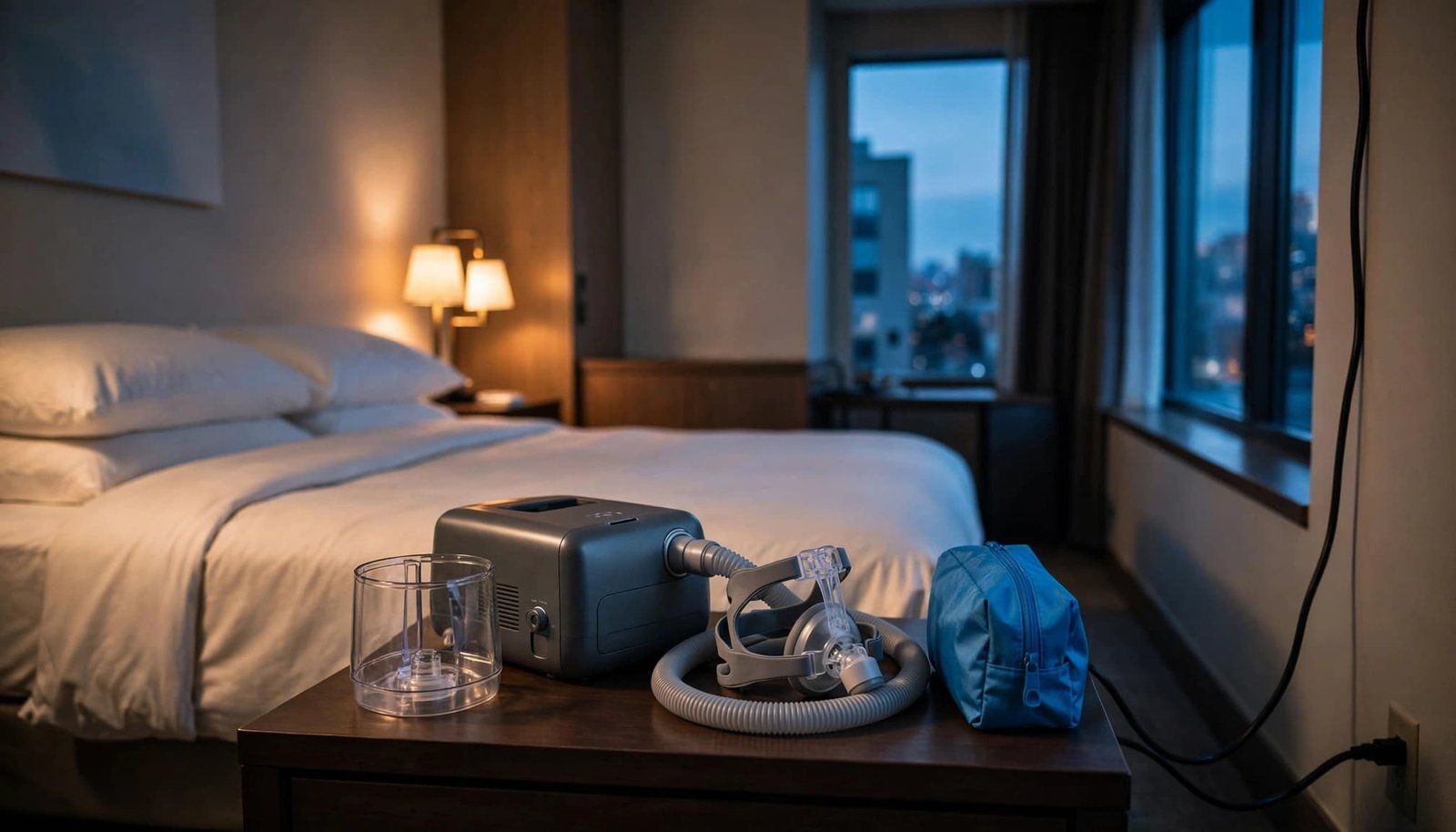
For international stays, inspect the power supply’s input label. A supply labeled 100-240 V may work across that voltage range, but you still need the correct plug connection. A plug adapter changes the plug shape; it doesn’t convert voltage.
Check your device’s power requirements and ask the hotel about outlet placement and extension-cord policies before arrival.
Plan water and cleaning supplies
Follow your exact machine’s instructions for humidifier water. Manufacturer guidance differs, so another traveler’s routine may not suit your model.
Ask the hotel where you can buy distilled water before your first night. Bottled drinking water isn’t automatically distilled, and boiling water doesn’t remove minerals.
If the recommended water isn’t available, ask your equipment provider about an approved temporary option. Confirm whether your model can operate without humidification rather than guessing.
Use the cleaning method recommended for your mask, tubing, and chamber. CPAP wipes aren’t automatically safe for every component, so follow the manufacturer’s instructions. Allow washable parts to dry properly.
Power Plans for Cars, Cruises, and Camping
Traveling with CPAP beyond a hotel stay needs a separate power plan.
For a car or motorhome, use a manufacturer-approved vehicle power connection or compatible DC converter. Don’t assume a generic USB adapter can run your machine. Confirm the vehicle outlet’s capacity and avoid draining the vehicle’s starting battery overnight.
Camping requires a compatible battery and a dependable recharging plan. Keep equipment dry and within its operating-temperature limits. Humidification can increase power use, so test the setup you intend to use with your provider’s guidance.
For cruises, contact the accessibility or special needs department before sailing. Ask about CPAP notification, distilled water, cabin outlets, and permitted extension cords. Ships may restrict ordinary power strips.
Avoid leaving the machine or batteries in a parked car during extreme heat or cold. Keep your equipment provider’s contact information available if something needs attention.
Support for Your Family’s Full Travel Needs
Medical equipment is one part of a comfortable vacation. Room location, transportation, rest breaks, and other family needs matter too.
At K&S The Travel Crusaders, our medical-equipment travel planning helps coordinate practical arrangements around your prescribed routine. Airline approvals and clinical advice remain with the airline and your care team.
Our Trip Rescue Shop offers strollers, cleaning supplies, and everyday travel extras for unexpected sick-on-vacation moments. Purchase CPAP-specific accessories through an appropriate equipment supplier.
Planning a Disney trip with an autistic child? Our firsthand family experience informs the Disney World autism guide on Etsy, also available through our Disney World autism guide on Amazon. Your family’s sleep, sensory, and comfort needs can all be part of the same personalized plan.
Frequently Asked Questions
Do I need a smaller travel CPAP?
A travel-specific machine isn’t required simply because you’re taking a vacation. Your regular CPAP may be the most familiar option.
Compact devices such as the ResMed AirMini can reduce packing space, but check mask compatibility, humidification options, power accessories, and your prescribed therapy needs before buying. Arrange any setup with your equipment provider and test it before departure.
What should I do if my machine stops working?
Check the outlet, power connections, chamber placement, and any displayed error message. Follow your model’s troubleshooting instructions rather than trying another machine’s reset procedure.
Contact your equipment provider if the problem continues. Don’t open the machine or change prescribed pressure settings. If replacement equipment isn’t available, ask your clinician how to manage the interruption safely.
A Comfortable Trip Starts With a Tested Setup
Keeping your CPAP close, confirming airline requirements, and arranging reliable hotel power can prevent avoidable problems. The strongest preparation is a complete setup you’ve tested before leaving home.
You deserve a vacation that supports your sleep and your family’s comfort. Handle the equipment details early so bedtime can stay familiar, even when your destination is new.
Leave a Reply