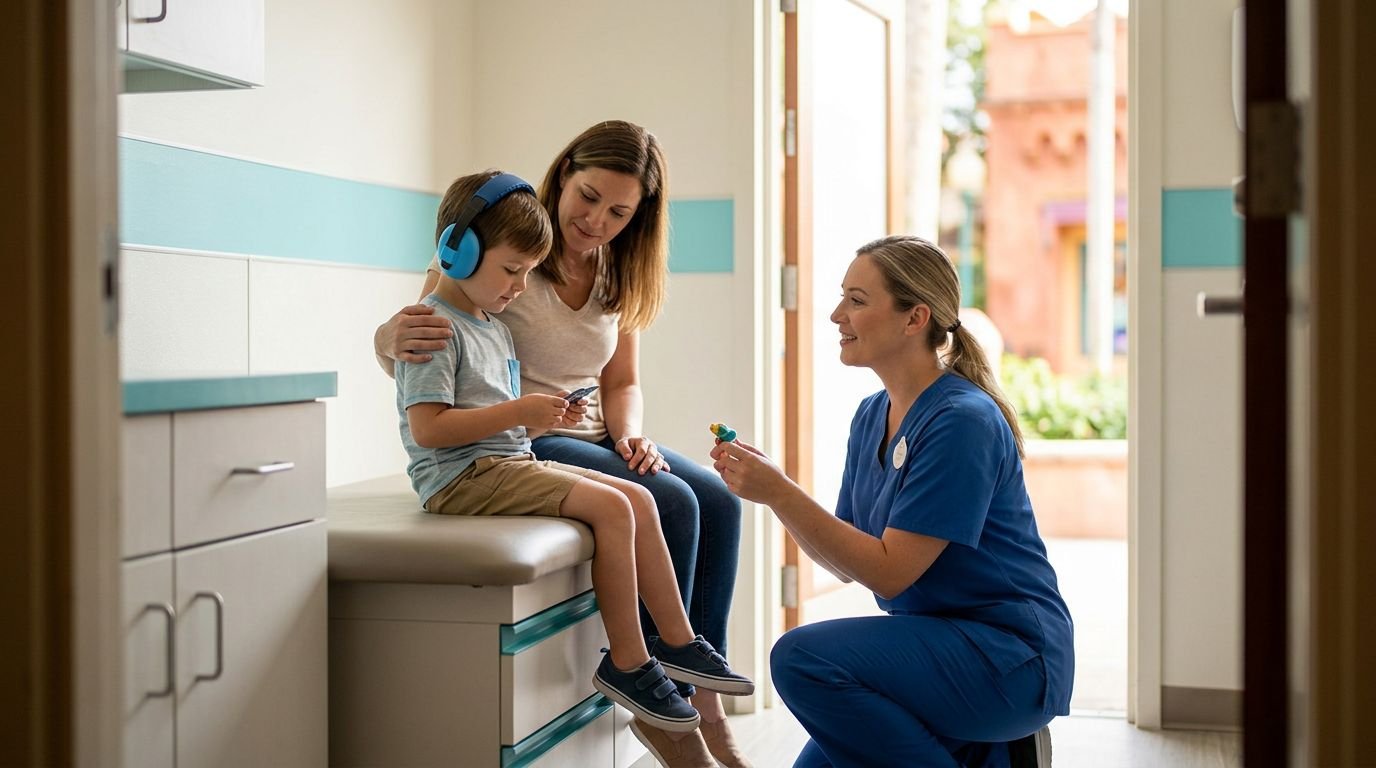
A hard moment at Disney World does not mean your family day is ruined. For autistic children, heat, noise, crowds, a surprise ride closure, or one scratchy wet shirt can turn a fun morning into too much.
Visiting busy theme parks can be overwhelming, but a Disney World first aid center can give your child a calm place to rest when they need a break from the park. While it is not a dedicated sensory room, it serves as a helpful reset space when you know where to find it and what to ask for.
A little planning before your trip can make these moments feel more manageable.
Key Takeaways
- First Aid Centers are available in all four Disney World theme parks and offer a cool, quiet environment that acts as a helpful sensory reset away from crowds and noise.
- Each center is staffed by licensed nurses who can assist with minor medical needs, medication storage questions, and general urgent care guidance.
- First Aid is a shared medical space rather than a private sensory room, so it is important to have a backup quiet place plan for your family.
- Use your child’s early signs of sensory overload as your cue to take a break, rather than waiting until they are already overwhelmed.
- Utilizing First Aid alongside DAS, lower-stimulation attractions, and scheduled midday hotel breaks can help you create a more comfortable Disney day.
First Aid Can Be a Helpful Sensory Reset
Disney World First Aid Centers are medical facilities first. They are staffed by licensed nurses and support guests with injuries, illness, medication concerns, and other medical assistance.
For autism families, these locations can also be a useful place to pause. They are indoors, air-conditioned, and away from the loudest parts of the park. If your child is overheated, crying, shutting down, or struggling with sensory input, a quieter setting may help them regroup.
Disney lists First Aid as a possible break area for guests with cognitive disabilities. You can also review Disney’s current services for neurodivergent guests before you travel.
Still, set realistic expectations. First Aid is not a separate autism lounge with sensory toys or dimmed lighting. Private rooms are not guaranteed, although basic partitions may be available for privacy. It may be busy, and a nurse may need to focus on another guest with a medical concern.
That does not mean you should avoid it. It means you should treat it as one helpful option in your family’s park-day plan.
Your child does not need to “push through” a hard moment to get back to the rides. A short break can protect the rest of the day.
If you need help, keep your explanation simple. You can tell the Cast Member or nurse, “My child is autistic and overwhelmed. We need a quiet place to sit for a few minutes.” You do not need to over-explain your family.
Where to Find First Aid in Each Disney World Park
Before your park day begins, look up the First Aid location on the My Disney Experience app. Search for First Aid or use the park map to look for the medical cross icon. You can also ask any Cast Member for directions. These health facilities are available throughout all four theme parks and both Disney water parks to support guests in need of a quiet space.

These are the usual First Aid Center locations at Walt Disney World:
| Park | Usual First Aid Location |
|---|---|
| Magic Kingdom | Off Main Street, U.S.A., between Casey’s Corner and The Crystal Palace |
| Epcot | Inside the Odyssey building, near the bridge toward the Mexico pavilion |
| Hollywood Studios | Near the park entrance, close to Guest Relations and Crossroads of the World |
| Animal Kingdom | On Discovery Island, near Creature Comforts |
| Typhoon Lagoon | Behind Leaning Palms |
| Blizzard Beach | Between Lottawatta Lodge and Beach Haus |
Park construction, map details, and walking routes can change. Check the app on the morning of your visit, especially if First Aid is part of your family’s support plan.
At Magic Kingdom and Epcot, the centers are strategically placed but often require a significant walk if you are coming from the back of the park. For example, at Magic Kingdom, the center is near the entrance, making it an easy stop when you first arrive. At Epcot, the distance between attractions can feel much bigger than it appears on a map. Do not wait until your child is fully overwhelmed before starting the walk. At Hollywood Studios, the proximity to Guest Relations makes it easy to find assistance, and the Animal Kingdom location on Discovery Island provides a central point for a sensory reset.
A parent who knows where First Aid is located has one less decision to make when the day gets hard.
What First Aid Nurses Can Help With
Disney World First Aid Centers, which are sponsored by AdventHealth, can support many common park-day problems. The staff is equipped to assist with headaches, minor stomach discomfort, heat exhaustion concerns, and the scrapes or blisters that often result from a long day of walking. They can provide basic over-the-counter medications like Tylenol, as well as essential supplies such as bandages.
The nurses are also available to answer questions regarding medication storage. If your child requires medicine to be kept cool, such as insulin, speak with the First Aid team early in the day. Please note that they also offer sharps disposal for guests who need to use hypodermic needles during their visit. Do not assume the center can store every item or that you can retrieve your supplies at any time without checking first.
Disney’s First Aid information explains the health services available in the parks. For issues that go beyond what the park nurses can treat, AdventHealth provides convenient urgent care services through Centra Care. This support includes telehealth visits, prescription delivery, and even in-room visits to Disney Resort hotels to ensure your family remains comfortable.
Bring all required medications in their original containers and carry them with you as directed by your child’s care team. Keep rescue medication, medical supplies, and comfort items in your park bag rather than leaving them at the hotel.
First Aid may have basic supplies and can occasionally offer a place to lie down or sit quietly, though these options depend on availability and current medical needs. Keep in mind that the nurse cannot diagnose an illness or replace your child’s doctor. If your child has a serious medical emergency, tell the nearest Cast Member right away or call 911. Do not try to handle a major concern alone while moving through a crowded park.
Build a Break Plan Before Sensory Overload Starts
The best time to decide where your child can reset is before they are upset. Look at the maps of the theme parks with them if that helps. Point out each Disney World first aid center, restrooms, Baby Care Centers, and a few quieter indoor attractions so everyone knows where to go.
Some children show early signs in small ways. They may become more talkative, stop responding, cover their ears, ask to leave, move faster, or get upset by simple questions. Those are signals to slow down.
Your reset plan might be as simple as this:
- Leave the loud area when your child shows early signs of stress.
- Offer water, a familiar snack, headphones, or a comfort item.
- Choose a Disney World first aid center when a cool, monitored indoor break would help.
- Use a restroom, one of the Baby Care Centers, a quiet attraction, or your hotel room when the first aid station is busy.
- Re-enter the day with one easy choice, not a long list of demands.
A portable charger belongs in this plan too. Your phone helps with park maps, mobile food orders, DAS return times, and contacting the rest of your group. A dead phone can add stress when your child already needs support.
Rain can also change your plan quickly. Pack ponchos, dry socks in a zip bag, and an extra shirt if damp clothing is a sensory trigger. A park day often goes better when you solve the small discomfort before it becomes a big one.
For more family-focused planning ideas, keep a copy of the Disney World With Autism Guide PDF on your phone or consider the Amazon Disney autism travel guide before your trip.
Use First Aid Alongside DAS and Other Supports
First Aid and the Disability Access Service, or DAS, serve different purposes. While First Aid is your primary resource for medical assistance and short, quiet breaks, DAS helps eligible guests avoid spending long periods in a traditional standby queue.
Do not assume an autism diagnosis automatically qualifies a guest for DAS. Disney reviews each guest’s individual needs, and current policies can change, so check the official Disney site before your visit and be ready to explain the specific support your child needs in attraction queues. If your child requires care that goes beyond what the First Aid centers in the theme parks can provide, the staff can often assist with complimentary transportation to a nearby urgent care facility, such as Centra Care.
Remember that DAS does not remove the need for downtime. A child may have a return time for a favorite ride and still need to rest first, and that is perfectly okay. Your day should fit your child, not the other way around.
Lightning Lane Multi Pass is also separate from DAS. It is a paid service, and it may not be necessary for every family. Choose paid upgrades only when they match your real priorities, budget, and energy level.
A calmer Disney World schedule often includes fewer must-do rides, nearby attractions grouped together, regular snack breaks, and the flexibility to leave early. Sometimes, a hotel pool break is far more valuable than one more hour spent in a loud park.
Frequently Asked Questions
Is the First Aid center a private sensory room for my child?
No, First Aid centers are medical facilities staffed by nurses to assist all guests with injuries or illness. While they provide a quiet, air-conditioned environment to reset, they are shared spaces and are not specifically equipped as sensory rooms.
Do I need a medical diagnosis to use the First Aid center?
No, you do not need to provide proof of a diagnosis or medical documentation to use these facilities. If your child is overwhelmed or overstimulated, you can simply explain to the staff that you need a quiet place for your child to take a break.
Should I rely only on First Aid for breaks?
It is best to have a backup plan, as First Aid centers can be busy with medical patients and may not always have space available. Consider identifying other quiet spots, such as Baby Care Centers or lower-stimulation attractions, to ensure you always have a place to retreat when needed.
A Calmer Disney Day Is Still a Successful Day
Disney World first aid center locations provide autism families with a practical place to pause when the park environment becomes overwhelming. It is helpful to know these locations in advance, pack the specific sensory items that help your child reset, and ask for support from staff before a difficult moment escalates.
The goal is not to complete every ride on your itinerary. The goal is a Disney day where your child feels safe, supported, and included.
Remember that a calmer plan leaves room for necessary breaks, snacks, and quiet moments. By incorporating these downtime periods, along with using the Disney World first aid center and Baby Care Centers as vital tools throughout your visit, you can navigate unexpected changes and create better memories as a family. A day tailored to your child’s needs is always a successful one.