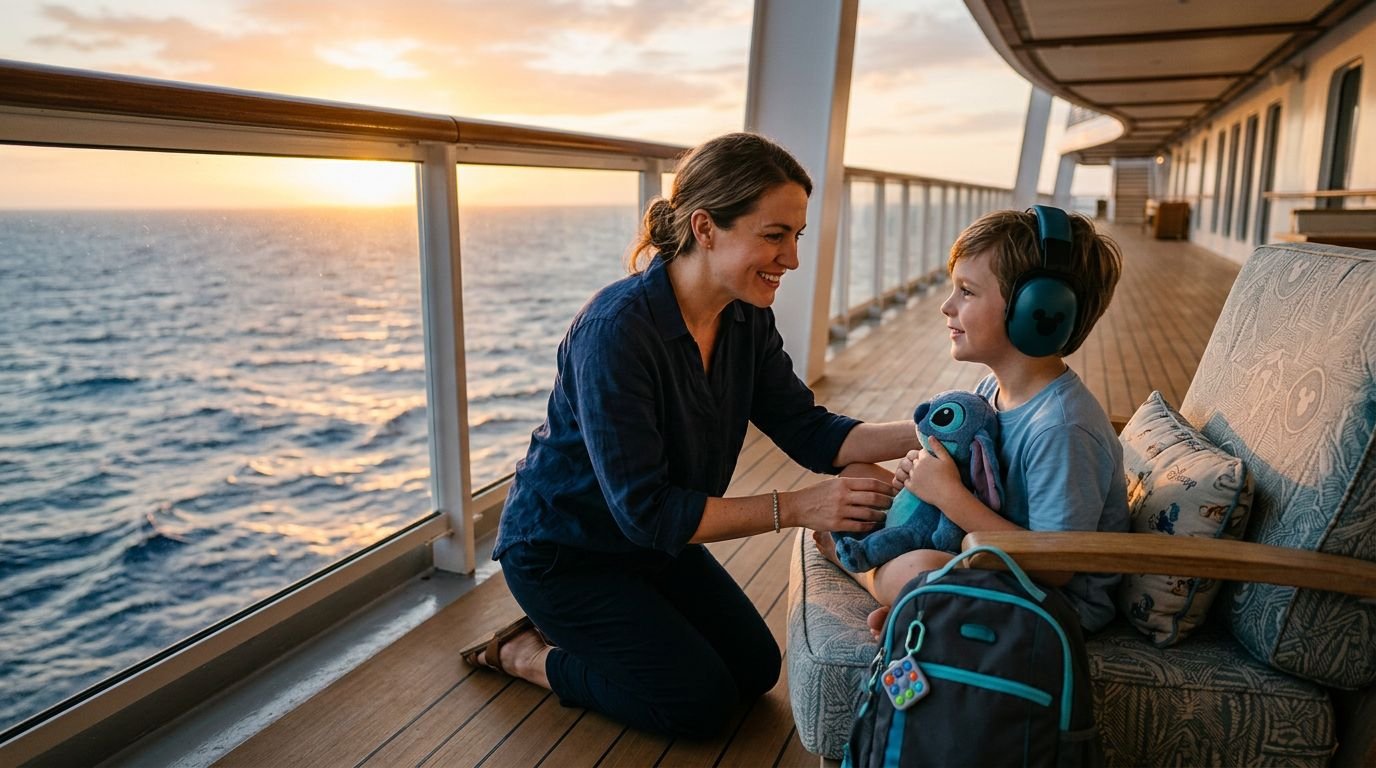
A cruise can feel easier than a busy theme-park day, but it still comes with new spaces, crowds, sounds, schedules, and transitions. A thoughtful Disney Cruise autism plan gives your child familiar comforts and gives you more room to enjoy the trip together. When traveling with special needs, choosing the Disney Cruise Line experience can help ease the transition into a new environment.
You don’t need a packed itinerary or perfect behavior to have a great sailing. You need a flexible plan, clear expectations, and a few simple supports ready before you board.
Key Takeaways
- Contact Disney Cruise Line Special Services well before your sailing date to discuss your family’s needs.
- Keep boarding day light, because the terminal, ship check-in, lunch, and first announcements can feel like a lot.
- Bring familiar sensory tools, noise canceling headphones, snacks, comfort items, and a portable charger in your carry-on.
- Visit the kids club during Open House before expecting independent participation.
- A quieter schedule, room breaks, and one good excursion often work better than trying to do everything.
Disney Cruise autism planning starts before you sail
The best first step is to think about what makes travel hard for your child. Is it waiting? Loud announcements? New foods? Sleeping in a different room? Getting through security? Write down the situations that tend to cause stress at home, school, and on past trips when traveling with special needs.
Then contact Disney Cruise Line before your trip. Disney asks families to reach out to Special Services at least 60 days before sailing when they need disability-related help or have questions. Review Disney’s current autism spectrum disorder support information before you travel. You can also call guest services or Special Services at (407) 566-3602.
Be clear and practical when you contact them. Explain the support your child needs, not only their diagnosis. For example, you may want to ask about a private dining table request, a quieter seating location when available, accessible stateroom features, medication storage, or any questions about boarding.
Disney Cruise Line doesn’t offer a cruise version of Disability Access Service. The DAS program is for Disney theme-park attraction queues. Cruise support is more about advance communication, accessible spaces, and helping your family understand what is available.

Your travel advisor can also help you select a sailing that fits your family. A three-night cruise may sound easier, but it can feel rushed when your child needs time to settle in. A four- or five-night sailing often gives you more breathing room without creating a long trip away from home.
Look at the ports too. A port day doesn’t need to mean a big excursion. Staying onboard can be the right choice if your child is comfortable in the ship’s pool area, wants familiar routines, or needs a slower day.
Your family’s best cruise plan may include fewer activities than another family’s plan. That does not make the trip less special.
Disney’s services for guests with disabilities also cover accessible staterooms, ship access, and support at Castaway Cay. Review the details early, especially if mobility needs, medical equipment, or room layout matter to your family.
Make boarding day calm and predictable
Boarding day has many moving parts. There may be airport travel, a hotel checkout, Port Canaveral traffic, luggage drop-off, security, terminal waiting, photos, and the excitement of seeing the ship. It is a big day before the vacation even feels like it has started.
Avoid planning a major activity for the first afternoon. Let your child explore the stateroom, walk around one deck, eat lunch on the pool deck, and find a calm place to sit. You do not have to rush to every onboard reservation or activity, which helps prevent sensory overload during busy check-in transitions.
Talk through the day before you leave home. A short visual schedule, or a social story, can help:
- Ride to the port.
- Go through security.
- Wait in the terminal.
- Board the ship.
- Eat lunch.
- Find the stateroom.
- Practice the muster drill.
- Choose one fun thing to do.
Use real photos of the ship, terminal, pool deck, and stateroom when possible. Disney Cruise Line’s website and cruise videos can help your child see what is coming. A simple picture on your phone is often easier to process than a long explanation.
Keep important items in your carry-on because checked bags may not arrive at your stateroom for several hours. Pack the items your child may need before dinner or bedtime:
- Noise canceling headphones or ear defenders they already know and like
- A favorite stuffed animal, blanket, fidget, hoodie, or book
- Medication, care supplies, motion-sickness items, and a refillable water bottle
- Downloaded shows, games, music, charging cords, and a portable charger
- Familiar snacks, especially if hunger makes transitions harder
Do not save the muster drill explanation for the moment it happens. Let your child know that everyone must pause, listen, and go to a meeting area. The drill is short, but it can include crowds, instructions, and close personal space.
Choose a stateroom that supports sleep and downtime
Your stateroom is more than a place to sleep. It is your reset space when the ship feels busy, acting as a personal sanctuary away from the crowded quiet spaces found around the ship. Treat it like a small hotel room that needs to work hard for your family.
An inside stateroom can be dark at any time of day, which helps some children sleep. Others may feel uncomfortable without a window or may wake up unsure whether it is morning. An oceanview or verandah room gives more natural light and a view outside, but a verandah requires extra safety awareness.
Think about your child’s sleep needs before choosing a cabin. A family who needs early bedtimes may prefer a room location away from elevators, stairwells, and busy public decks. A white-noise machine, familiar bedtime routine, and soft night-light can make the first night much easier.
Bring a few things that make the space feel familiar. Your child’s usual pajamas, a preferred cup, a bedtime book, and a comfort item can matter more than extra vacation purchases. You can also introduce yourself to your stateroom host on day one to communicate any specific needs or preferences for your cabin setup.
Use the room without guilt. Going back for an hour after lunch is not wasted cruise time. It may be the break that makes dinner, a show, or an evening walk possible. When sensory overload hits, ordering room service allows your family to enjoy a calm meal in the room while exploring other quiet areas of the ship later when your child feels ready.
Dining can stay flexible, even on a Disney ship
Disney Cruise Line uses rotational dining. Your family rotates among assigned restaurants while your serving team rotates with you during rotational dining. This can be a nice benefit for autistic children because the same dining team gets to know your family’s preferences across the sailing.
Still, restaurant changes can be hard. Each dining room has its own lighting, sounds, decorations, and energy level. Talk with your child about the plan before the trip. You are going to dinner, but dinner may be in a different room each night.
If possible, request a dedicated dining table in advance. It is not something to assume will be guaranteed, but it is worth asking about if your child needs more space, predictable conversation, or less social pressure.
Tell the helpful cast members on the dining team about your child’s food preferences, food allergies, sensory needs, or a child who may need a quicker meal. They can’t remove every sound or surprise, but good communication helps them and other cast members support your family.
You also have choices beyond the main dining room. Quick-service food near the pool deck can work well on a low-energy day. Ordering room service can be helpful when your child is too tired to return to a restaurant. Check the current menu and ordering details once onboard.
Pirate Night, themed dinners, character appearances, and high-energy entertainment can be exciting. They can also be loud. Children who are sensitive to sound may need a break when attending loud events or deck parties. You do not have to stay through every part of the event. Consider arriving early, sitting near an exit, or enjoying only the parts your child wants.
A portable charger still matters on a cruise. Your phone may hold the Disney Cruise Line Navigator app, dining information, activity schedules, messages, photos, and entertainment. A dead battery can make a small change feel much bigger.
What to know about Disney kids clubs
The youth spaces are one of the biggest questions for a first-time Disney Cruise autism family. Some children love the structured activities, themed rooms, and freedom to play. Others may prefer to visit with a parent and leave after a few minutes. Both responses are okay.
Disney’s Oceaneer Club and Oceaneer Lab are designed for children ages 3 to 10 during reserved programming hours. Disney states that children need to be toilet-trained and able to participate with peers within the counselor-to-child group ratio. When autistic children join these groups, it helps to understand that youth activities and babysitting services cannot provide one-on-one care or counselor-assisted medical attention.
Read Disney’s current youth club guidance for guests with disabilities before making plans around club time. It is important to know the expectations before you board.
Start with open houses. During these scheduled times, the whole family can enter the kids club together. Let your child look around, touch a few activities, find the restroom, and see where the exits are. There is no need to push for a drop-off on the first visit.
Ask staff members about the day’s activity schedule and quieter times. Give these cast members useful information about your child, such as communication style, preferred calming tools, food concerns, and what helps when they need a break. Keep the conversation simple and direct if you are traveling with children who have special needs.
Attend additional open houses later in the voyage if your child wants to explore the environment again without the pressure of staying. For some autistic children, a short first visit works best. Stay nearby and set a clear pickup time. You might say, “You can try the kids club for 30 minutes, then we will come back and decide what you want to do next.”
Tweens and teens have separate spaces and programming. Disney lists activities for tweens ages 11 to 14 and teens ages 14 to 17. Older children may want more independence, but they still benefit from knowing the plan for meals, check-ins, and leaving a loud activity.
Do not build your adult dinner, spa appointment, or excursion around the hope that your child will use the club. Make a backup plan that works if they decide it is not a fit that day.
Plan port days around your child’s energy
Port days can be wonderful, but they often start early and add more transitions. You may need to get dressed, eat breakfast, leave the ship, walk through the port, wait for transportation, and return through security later. A full-day excursion can lead to sensory overload for some families when dealing with new environments, heat, and crowds.
Choose one priority. It may be a beach, a short tour, a character experience, snorkeling, or simply seeing a new place. Look at the real length of the excursion, not only the activity description. A three-hour tour may include extra waiting, walking, loading, and transportation.
Book an excursion only if the pace works for your child. Private transportation can be worth the added cost when a large motor coach, fixed schedule, or crowded group activity is likely to create stress.
When sailing with the Disney Cruise Line, visiting Castaway Cay gives many families an easier port day because the ship docks at a private island. You can return to the ship when your child is done, instead of waiting for a long ride back to port. Even then, heat, sand, crowds, sunscreen, and wet clothes may be sensory challenges.
Staying onboard is also a valid plan. The ship is often quieter while many guests are ashore, and you can enjoy relaxed swimming options near the pool deck. You may find shorter lines for lunch, calmer pool time, and space to relax without the pressure of a scheduled excursion.
Build a flexible rhythm instead of a packed schedule
A Disney cruise has shows, deck parties, movies, character meet and greets, pools, crafts, trivia, sports, shops, restaurants, and activities happening all day. You cannot do it all. Your child does not need to do it all.
Choose one anchor activity for the morning, one for the afternoon, and one possible evening option. Everything else is a bonus. This keeps the day comfortable without making your child feel rushed from one event to another.
You might plan a morning activity, pool time after lunch, and a family movie after dinner. If your child wants to stay in the pool instead of going to the movie, that is an easy change. If they are tired after dinner, the stateroom can be the evening plan. For loud deck parties, packing noise canceling headphones can help prevent overstimulation and keep everyone comfortable.
Check the Navigator app, but do not let the app control your trip. Activity times can be helpful, yet your family’s energy level matters more than a schedule on a screen.
For more Disney Cruise autism travel support before or after your cruise, the Disney World With Autism Guide PDF on Etsy offers practical family planning ideas. The Disney autism travel guide on Amazon is another helpful resource for sensory needs, flexible Disney days, and realistic expectations.
The same core idea applies at sea and in the parks. A calm child, a familiar snack, a quiet break, and one favorite experience can be more meaningful than a long list of completed activities.
Frequently Asked Questions
Does Disney Cruise Line offer a Disability Access Service (DAS) program like the theme parks?
No, the DAS program is specifically designed for attraction queues at Disney theme parks and is not available on cruise ships. Instead, Disney Cruise Line focuses on advance communication, accessible staterooms, and individualized support through Special Services to help families prepare.
Can my autistic child receive one-on-one care in the youth clubs?
Disney’s Oceaneer Club and Lab cannot provide one-on-one care or personal counselor assistance, as children must be able to participate within the standard counselor-to-child group ratio. However, families can explore the spaces together during scheduled Open House times before deciding if independent participation is a good fit.
What should I pack in my carry-on for boarding day?
You should pack essential comfort and care items in your carry-on because checked luggage may take several hours to arrive at your stateroom. Helpful items include noise-canceling headphones, favorite fidgets or comfort objects, medications, motion-sickness supplies, downloaded entertainment, and familiar snacks.
Final Thoughts
A first cruise does not have to look like anyone else’s vacation. The strongest Disney Cruise autism plan is built around your child’s needs, your family’s pace, and room to change course when needed.
Prepare early, pack familiar comforts, communicate with Disney Cruise Line, and rely on helpful cast members to make the journey smoother. Traveling with special needs can be wonderfully rewarding when you leave open space in every day and focus on what brings your family joy.
Leave a Reply