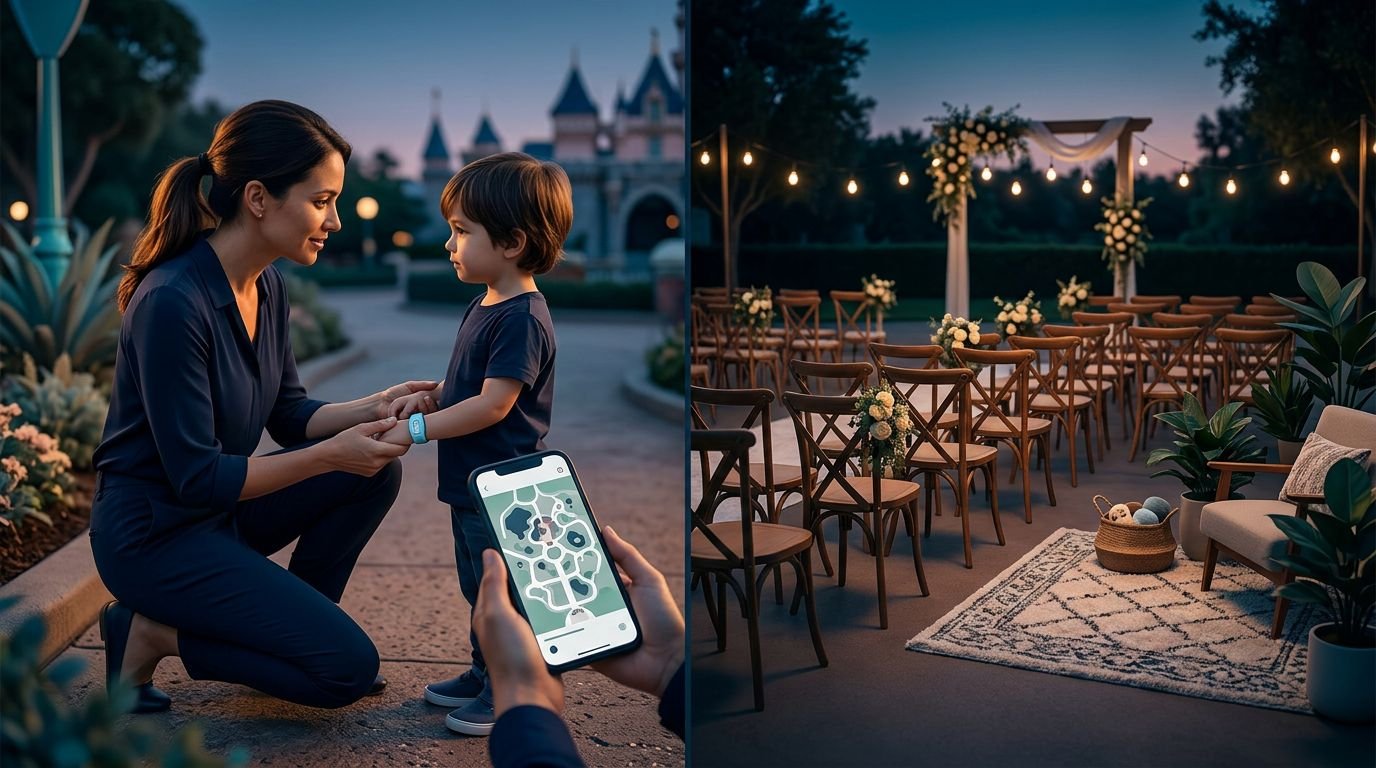
A Disney World trip can hold big feelings, busy spaces, and many moving parts. Disney elopement safety has two meanings for autism families.
It can address wandering and elopement in the parks, while also supporting a small Disney wedding with clear rules, calm spaces, and fewer surprises. For families with special needs, Disney elopement safety starts with understanding which kind of planning your trip requires.
You may be planning an intimate ceremony, a honeymoon, or a family vacation around the wedding. Either way, safety planning should make the trip feel more comfortable, not more restrictive.
A clear plan gives everyone room to enjoy the moments that matter.
Key Takeaways
- Disney elopement safety can mean preventing wandering in the parks or planning a small wedding with clear rules, calm spaces, and realistic expectations.
- Create one simple safety plan with current photos, emergency contacts, meeting places, likely destinations, sensory-break phrases, and clearly assigned caregiver roles.
- DAS may reduce stress from conventional queues, but it does not replace supervision, a wandering plan, Cast Member support, or a clear response if someone becomes separated.
- Include the resort and ceremony location in your plan by checking transportation, exits, quiet areas, venue rules, attire limits, accessibility, and backup options before the trip.
- A safe Disney wedding or vacation can include early departures, short ceremonies, sensory breaks, and changed plans while still feeling personal and meaningful.
Two Meanings of Elopement, One Calm Plan
In autism support, elopement means leaving a safe area or caregiver without warning. It can happen when someone is overwhelmed, drawn toward something interesting, trying to escape noise, or focused on a destination.
In weddings, elopement means a small, intimate marriage celebration. At Disney, these two meanings can overlap. A couple may want a quiet ceremony while supporting a child, sibling, or autistic adult who is prone to wandering.
Both situations need a plan for wandering and elopement that is simple and respectful of special needs. Family members and other trusted guests can help clarify roles before the day.
If your traveler is an autistic adult, include them in every conversation about safety. Ask what helps when they feel overloaded, where they would go for a break, and how they want others to respond. Tracking tools, identifying information, and staff communication should be discussed with their consent whenever possible.
A wedding safety plan also needs clear expectations about locations, attire, transportation, crowds, and resort policies. A beautiful day should not depend on guessing what is allowed.
Start With a Shared Safety Plan
The best shared park safety plan is not a long document that nobody reads. It is one clear page that every caregiver, travel companion, and wedding support person understands.
The plan should reflect your family’s special needs and include a clear response to wandering and elopement.
Keep the plan simple enough to use when the park is loud and everyone is tired.
| Park or resort moment | A practical safety step |
|---|---|
| Entering the park | Take a current photo and confirm the first meeting place. |
| Changing locations | Tell the group where you are going before leaving a land, restaurant, or attraction. |
| A sensory break is needed | Use a familiar phrase such as “quiet break” or “hotel break.” |
| Someone becomes separated | Tell the nearest Cast Member the person’s name, description, last known location, and likely destination. |
| Returning to the resort | Confirm who is responsible for room access, transportation, and evening check-ins. |
Prepare Before You Leave Home
Use real photos to build a simple social story for the trip. Include the airport or car ride, hotel room, park entrance, security, favorite attractions, restrooms, and what happens when it is time to leave.
Talk through the plan without making it scary. A child may understand, “If we cannot see each other, find a Cast Member with a name tag.” An autistic adult may prefer a phone location share, a written emergency card, or a set meeting spot.
Bring a small emergency card that reflects the traveler’s special needs. Include the traveler’s name, caregiver phone number, communication needs, and anything helpful during a stressful moment. Keep the language short. You do not need to share a full medical history.
A wearable tracker can help some families, but it is not a substitute for supervision. Use a device the traveler already knows and accepts. Test the battery, app, location accuracy, and alerts before travel day.
Keep phones, headphones, chargers, and comfort devices together in one pouch. Families often remember the tablet and forget the charging cable. A portable charger belongs in every park bag.
Know the High-Risk Areas in Disney Parks
Wandering often happens during transitions. The ride ends, the crowd moves, the music gets louder, or a familiar adult stops to pay for something.
These areas deserve extra attention:
- Ride exits and gift shops can pull a child or adult away from the main path before the rest of the group catches up.
- Parades, fireworks, and large show exits create moving crowds, blocked sightlines, and sudden changes in noise.
- Water attractions and splash areas can be exciting, slippery, and hard to monitor during busy times.
- Restrooms and family restrooms need a clear plan for who waits, who enters, and where everyone meets afterward.
- Transportation stops such as buses, monorails, boats, and the Disney Skyliner can bring quick decisions and crowded queues.
- Hotel elevators, pools, food courts, and arcade areas can also become high-risk spaces after a long park day.
Stay close during these moments, but avoid making the trip feel like constant correction. If someone says they are done, treat that as useful information. Leaving early can be the right call.
For more park-specific ideas, these wandering and elopement safety tips for Disney vacations are a helpful starting point for families.
What to Do If Someone Gets Separated
Even careful families can become separated for a few minutes. The goal is to respond quickly and calmly.
- Tell the nearest Cast Member right away. Share the person’s name, clothing, recent photo, communication style, and last known location.
- Keep one adult with the remaining group. Do not send every adult in different directions unless a Cast Member directs you to do so.
- Think about likely destinations. Many people return to a favorite attraction, a hotel room, a familiar exit, a restroom, or a quiet place.
A safety plan works best when it includes likely destinations, not only the last place you saw someone.
Use DAS for Queue Support, Not as a Safety System
Disney’s Disability Access Service, often called DAS, can support some guests with special needs. It may help when a developmental disability, such as autism spectrum disorder, makes a conventional queue difficult.
It gives an eligible guest the option to wait outside the standard line and return later.
That can reduce sensory stress. It does not replace a wandering plan, a meeting place, or adult support during busy transitions.
Review Disney’s current Disability Access Service details before your trip. Eligibility is decided individually, and a diagnosis does not automatically mean approval. Disney uses a live video chat process, and the guest requesting DAS needs to be part of that conversation.
Current DAS procedures generally allow the registered guest and up to three additional people. The DAS guest must be present and ride with the group. Rules can change, so check your My Disney Experience app and speak with Guest Services when something is unclear.
Some older planning materials refer to a Disability Access Service Card. Families should verify current procedures rather than assume a physical card is issued.
Keep Return Times From Becoming Another Stressor
DAS can give your family a calmer place to wait. Use that time for a snack, bathroom stop, indoor break, quiet walkway, or a nearby low-wait attraction.
Lightning Lane Multi Pass is separate from DAS and costs extra. It can be useful when your family has a few must-do rides, but it also adds scheduled return windows to watch.
EPCOT is a good example. Remy’s Ratatouille Adventure, Frozen Ever After, and Soarin’ Around the World are popular, but they are spread far apart. A plan that sends your group back and forth across the park can create more pressure than it solves.
Choose one or two priorities. Stay in the same area when possible. Leave room for bathroom stops, shade, meals, weather, and a change of plans.
If you want a written tool for building calmer park days, the Disney World With Autism Guide PDF includes planning ideas for DAS, breaks, communication, and park-day pacing.

Make the Resort Part of Your Safety Plan
Your hotel is more than a place to sleep. For families with special needs, it is where everyone resets after the parks. Whether you choose a Disney resort or a Good Neighbor Hotel, wandering risks can increase around hotel elevators, pools, food courts, buses, and open walkways.
Before arrival, ask the resort about room locations, building access, pool gates, and the closest transportation stop. Do not assume a ground-floor room is always safer. For one traveler, fewer stairs may help. For another, an upper floor or quieter building may offer more comfort.
If a family member is prone to wandering and elopement, tell the Front Desk what type of help would be useful. Keep it brief and protect their privacy. With the person’s consent, you might explain that they may become separated and ask staff to call the primary contact if they are found alone.
Do not expect resort staff to monitor exits or replace caregiver support. Their help is most useful when your group already has a plan.
Temporary travel alarms can be helpful in some rooms. Choose devices that do not interfere with normal door use or emergency exits. Never add a lock, door blocker, or other item that could prevent someone from leaving during an emergency.
At night, confirm who has the room key, who is responsible for children, and where shoes, communication devices, and comfort items are located. Small routines make unfamiliar rooms feel more predictable.
Wedding Planning Rules, Costs, and Comfort
Wedding planning for families with special needs at Disney World involves more than preventing wandering. It also means considering sensory fit, protecting your budget, following property rules, and choosing a ceremony that fits your family.
Official Disney Fairytale Weddings have wedding minimums that start around $15,000, and couples comparing Disney elopement packages should budget carefully. Fairytale Weddings costs can rise with the venue, date, food and beverage, photography, flowers, entertainment, transportation, and guest count.
A smaller off-site or nearby celebration can cost much less than official Disney elopement packages, including some restaurant events near Disney Springs. Third-party companies such as Just Marry and Easy Elope have offered Orlando-area wedding elopements in the roughly $1,850 to $5,300 range. Exact pricing, vendor options, and availability change, so ask for a current written quote. Verify Disney Cruise Line wedding or honeymoon arrangements separately, since cruise policies differ.
A Good Neighbor Hotel, the Swan and Dolphin, Paddlefish Disney Springs, and Paradise Cove all have different event rules. Ask each venue about ceremony space, rain plans, parking, photography time, music volume, guest access, and cancellation terms before sending deposits. Confirm current rules for the Swan and Dolphin, and check location-specific policies for other Disney Springs venues.

Theme Park Wedding Attire Has Limits
Do not plan a pop-up ceremony in a theme park, a resort lobby, or another public Disney space. A quiet spot may look perfect online, but it isn’t automatically an approved wedding location.
Adults should also avoid arriving at the theme parks in wedding attire, such as a wedding dress, long train, costume, or character-inspired outfit. Disney restricts costumes for guests age 14 and older, and attire that creates character confusion or safety concerns may not be allowed.
Approved wedding attire can work well for a private ceremony at a private resort or nearby venue, subject to its rules. At an approved venue, choose wedding attire that balances comfort and formality. If you have an official Fairytale Weddings package, ask your planner for written guidance about attire, photography, and access. A portrait session is not the same thing as permission to hold a ceremony in the park.
Character appearances also should not be assumed at outside venues. Disney character entertainment must be arranged through Disney and is limited by approved locations and availability. A third-party venue cannot promise a character appearance without written confirmation.
Build a Wedding Day That Feels Safe and Personal
A smaller wedding can still feel meaningful for families with special needs. In fact, an intimate ceremony can make the sensory experience more predictable, with flexibility similar to Disney elopement packages. You can control sound, timing, food, seating, lighting, wedding attire, and guest expectations.
Visit the ceremony area ahead of time when possible. Walk the route from the car or resort transportation to the ceremony space. Find the nearest quiet room, restroom, exit, and indoor backup area.
Keep the ceremony short if that works best for your group, whether this is your first wedding or a vow renewal. Comfortable wedding attire can make a short ceremony easier. You do not need a long reception, crowded dance floor, surprise fireworks, or a packed photo schedule to have a special wedding day.
Give Every Person a Clear Job
The couple should not have to solve every problem during the ceremony. One person can communicate with the planner. Another can support the child or adult who may need a break. A third person can handle transportation, food, or hotel coordination.
If someone is prone to wandering, their support person should not also be the photographer, officiant, or person checking guests in. Give that role to someone who can stay focused.
Autistic couples can also choose a pause phrase before the ceremony, such as “I need a minute.” The officiant should know that a pause is allowed. Guests do not need an explanation.
Share only the information people need. Wedding planners may need to know about a quiet exit route. A photographer may need to plan photos around comfortable wedding attire and avoid flash photography. Family members may need to know that leaving early is okay.
For more autism-friendly Disney planning support, you can also find the Disney travel guide on Amazon.
Frequently Asked Questions
What does Disney elopement safety mean for autism families?
It can refer to preventing wandering and elopement in Disney parks, or to planning a small Disney wedding safely. Families may need to plan for both when an autistic child, adult, or wedding guest is traveling with them.
What should be included in a Disney wandering safety plan?
Include a current photo, emergency contact information, communication needs, meeting places, likely destinations, and clear caregiver roles. Practice the plan before leaving home and make sure everyone knows how to contact a Cast Member if someone becomes separated.
Does DAS replace supervision or a safety plan?
No. Disney’s Disability Access Service may provide a calmer alternative to waiting in a conventional queue, but it does not replace adult support, sensory planning, meeting places, or a response plan for wandering and elopement.
Can we hold a private wedding ceremony inside a Disney theme park?
Do not assume that a quiet public space is an approved wedding location. Ask Disney or the private venue for written guidance about ceremony locations, wedding attire, photography, guest access, and character entertainment before making plans or sending deposits.
A Safe Disney Day Can Still Feel Magical
A missed ride, a quiet ceremony, or an early return to the hotel does not mean the day failed. It means your plans respected the people you love.
The strongest Disney elopement safety plan includes clear roles, sensory breaks, realistic priorities, and permission to change course.
When everyone knows how to ask for help and where to go next, there is more room for the wedding, the vacation, and the memories you came to make.