
Flying with a ventilator is possible for some medically stable travelers, with airline approval and a dependable backup-power plan. Your respiratory team must decide whether a commercial flight is appropriate for you.
For families traveling with a ventilator, the goal is uninterrupted respiratory support, including during airport waits, connections, and ground transportation. Careful preparation gives you and your family a clearer plan for each stage. Start with your clinician’s assessment before committing to your flights.
Key Takeaways
- Arrange the clinician’s written sign-off and airline acceptance before booking nonrefundable travel.
- Plan usable battery capacity for at least 150% of the expected flight duration, plus additional power for the ground journey.
- Keep your ventilator, spare power packs, and essential respiratory supplies in the cabin, never in checked luggage.
Before Booking: Is a Commercial Flight Suitable?
A medical clearance letter is important, but it doesn’t replace an assessment of the complete journey.
Arrange a Fitness to Fly Assessment
Your respiratory team should assess your ventilation needs and medical stability. A respiratory therapist can help assess your ability to tolerate reduced cabin oxygen related to cabin pressure. The FAA’s passenger health and safety guidance addresses medical concerns associated with air travel.
Bring your itinerary to the appointment. Include flight lengths, connections, transfers, and overnight stops. Your team can determine whether you need supplemental oxygen, additional monitoring, or a medical escort.
Don’t treat the often-quoted 2 to 4 litres-per-minute oxygen range as a universal airline allowance. Some airlines supply no medical oxygen. Higher oxygen needs require specialist assessment and may make commercial travel unsuitable.
Decide Between Commercial Travel and an Air Ambulance
Stable ventilator-dependent travelers may be able to fly commercially with accepted equipment and appropriate support. Needing a wheelchair doesn’t automatically rule out commercial travel.
Some passengers need a trained caregiver; others need a medical escort. Cabin crew don’t provide routine ventilator management.
Critically ill travelers who need ICU-level treatment generally need a medically equipped air ambulance. Your treating team should make that decision based on clinical needs.
Arrange Airline Approval and Medical Documents
Airline acceptance, airport screening, and medical clearance are separate parts of flying with a ventilator. Completing one doesn’t automatically satisfy the others.
Understand the Advance-Notice Window
Plan around a 48 to 72-hour minimum notice window, while starting the arrangements much earlier.
For covered U.S. flights, airlines may require up to 48 hours’ notice for ventilator use. Airline-supplied oxygen can involve up to 48 hours’ notice domestically or 72 hours internationally. International carriers may have different medical-clearance procedures.
Arrange acceptance with every operating airline, including connecting flights sold under another airline’s booking code. Keep the written response with your reservation.
Prepare the Medical and Equipment Paperwork
When an airline requires a MEDIF or its own medical form, your physician must complete it. MEDIF isn’t a universal requirement for every domestic U.S. passenger using a ventilator.
Carry a physician’s letter explaining medical clearance, required equipment, and necessary assistance. Include your prescription, exact ventilator settings, medication list, and respiratory team’s contact information.
Keep the manufacturer’s aircraft-use statement and device manual accessible. An advertising description such as “FAA-approved” doesn’t replace the applicable manufacturer’s compliance label.
Save printed and offline copies so documents remain available without airport Wi-Fi.
Calculate Backup Power for the Whole Journey
Many airlines require enough fully charged batteries for 150% of the expected flight duration. A 10-hour flight therefore needs at least 15 hours of usable battery capacity.
Calculate Runtime at Your Prescribed Settings
A rough estimate of four to six hours per battery isn’t a guarantee. Runtime depends on the ventilator, settings, battery condition, and connected accessories.
For the 15-hour requirement, the calculation looks like this:
| Usable runtime per fully charged battery | Batteries needed for 15 hours |
|---|---|
| 4 hours | 4 |
| 5 hours | 3 |
| 6 hours | 3 |
These are total full-battery equivalents, not a recommendation for a particular device. Your equipment provider should establish usable runtime with your prescribed setup.
Add power for airport waits, transfers, connections, and unexpected overnight stays. Don’t count a seat outlet as your backup.
Keep Battery Capacity and Airline Limits Separate
Lithium-ion spares belong in carry-on baggage, with terminals protected against short circuits and batteries protected against damage.
Under standard passenger rules, lithium-ion spares up to 100 Wh are allowed. Spares above 100 Wh through 160 Wh require airline approval, with a two-spare limit. Larger ordinary spare batteries fall outside those standard allowances.
The 150% runtime requirement doesn’t override battery restrictions. Your equipment provider should build a compatible power plan that meets both requirements.
Fully charge and test every battery before departure.
Pack Your Ventilator and Respiratory Supplies

Keep Essential Equipment With You
Carry the ventilator as essential medical equipment in your hand luggage. It must remain accessible rather than being stored in the aircraft hold.
If you use a transport ventilator or portable ventilator, confirm the specific model’s aircraft-use, power, and stowage instructions with the equipment provider.
Highly dependent users should carry at least one spare ventilator, spare batteries, and compatible masks, filters, and tubing. Include the original power supplies and charging cords.
For travelers with a tracheostomy, our tracheostomy supplies and safety planning covers additional airway supplies and caregiver preparation.
Remove essential equipment before any bag is gate-checked. When two adults are traveling, divide backup consumables between their carry-ons without separating the working emergency kit.
Plan Humidification and Other Respiratory Devices
Sheffield Children’s guidance advises that most ventilators aren’t suitable for use with a humidifier system onboard.
Its time-limited equipment guidance describes cough-assist machines and humidifiers as ineligible for onboard use when written, while allowing nebulisers and suction machines. Those statements aren’t universal airline rules.
Your accepted equipment plan needs to cover each device separately. Your respiratory team should provide a suitable humidification and airway-clearance plan. Don’t remove prescribed support or substitute another method on your own.
At the Airport and During the Flight
Tell security officers about connected respiratory equipment before screening. Explain clearly if support cannot be interrupted. Medical equipment still requires screening, and security permission doesn’t establish permission to operate it onboard.
Use preboarding to organize supplies and settle into the agreed seating arrangement. Equipment and tubing must stay secure without blocking aisles, exits, or another passenger’s movement.
There isn’t a universal FAA rule limiting takeoff and landing ventilator use to 24-hour users or emergencies. The FAA’s medical electronic device guidance recognizes that life-sustaining ventilators cannot simply be switched off. Your approved flight arrangements must support the prescribed therapy throughout the journey.
If an alarm sounds, assess the traveler and alert cabin crew immediately. Follow the written emergency plan and use backup equipment as you’ve been trained.
For severe breathing difficulty, blue or gray coloring, or reduced responsiveness, request emergency assistance immediately. Don’t change prescribed settings to manage an unexplained alarm.
Prepare Destination Care and Family Support
A dependable plan continues after landing. Arrange compatible charging, accessible transportation, and equipment servicing or replacement support at your destination.
A plug adapter changes the plug shape; it doesn’t convert voltage. Use power supplies compatible with your ventilator and the destination’s electrical supply.
Keep your equipment provider’s number and insurance assistance details available offline. Our travel insurance coverage basics explains why emergency medical coverage, evacuation benefits, and pre-existing-condition exclusions deserve attention.
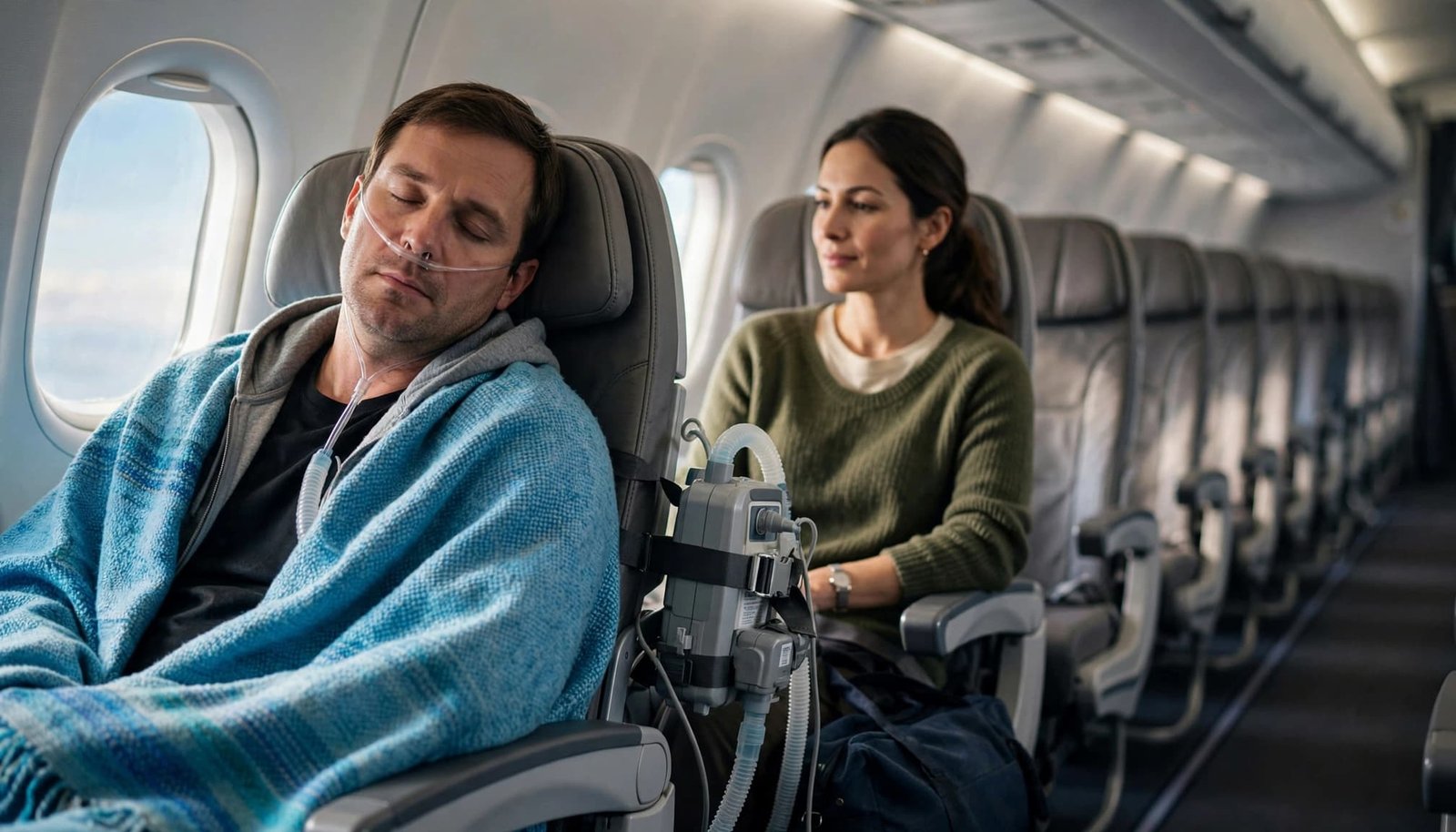
Your family’s comfort matters, too. Leave room for meals, rest, sensory breaks, and unhurried care routines. Our special needs travel planning helps coordinate accommodations, transportation, and realistic pacing. Clinical decisions stay with your healthcare team.
If your trip also includes Disney World with an autistic child, our family guide is available on Etsy as a downloadable guide and through Amazon as our Disney autism guide. It supports vacation and sensory preparation, not ventilator care.
Our Trip Rescue Shop travel essentials includes strollers, cleaning supplies, and everyday extras for unexpected illness on vacation. These complement your packing plan; they don’t replace prescribed medical supplies.
Your Pre-Flight Checklist
Before leaving home, bring these arrangements together:
- Keep airline acceptance, medical forms, prescriptions, and emergency contacts in one accessible folder.
- Charge all batteries and document usable runtime for the complete journey.
- Pack the spare ventilator and respiratory supplies required by your care plan.
- Give each caregiver a clear role for equipment, communication, and emergencies.
- Keep destination equipment support, transportation details, and insurance assistance information available offline.
Frequently Asked Questions
Is a Medical Clearance Letter Enough to Board?
No. A clearance letter addresses medical suitability, but the airline also needs an acceptable equipment, battery, seating, and assistance arrangement. When required, the airline’s medical form must also be completed.
Do I Need a Spare Ventilator for Overnight Travel?
If you cannot safely go without ventilation overnight, discuss a spare ventilator with your respiratory team and equipment provider. Highly dependent travelers should carry one. Extra batteries won’t protect against failure of the ventilator itself.
Can I Fly With an Oxygen Concentrator?
Yes, a compliant portable oxygen concentrator may be used under applicable airline requirements. It must meet your prescribed oxygen needs and have sufficient battery capacity.
Personal compressed or liquid oxygen supplies aren’t permitted aboard U.S. passenger aircraft. A concentrator and a ventilator have separate functions; one doesn’t automatically replace the other.
A More Comfortable Trip Starts With Reliable Support
Flying with a ventilator works best when clinical sign-off, airline arrangements, and backup power support the same care plan. A working device alone isn’t enough without accessible supplies and trained help.
Begin with your respiratory team. Then build the flights, transfers, and vacation pace around the support you need throughout the journey.
Leave a Reply