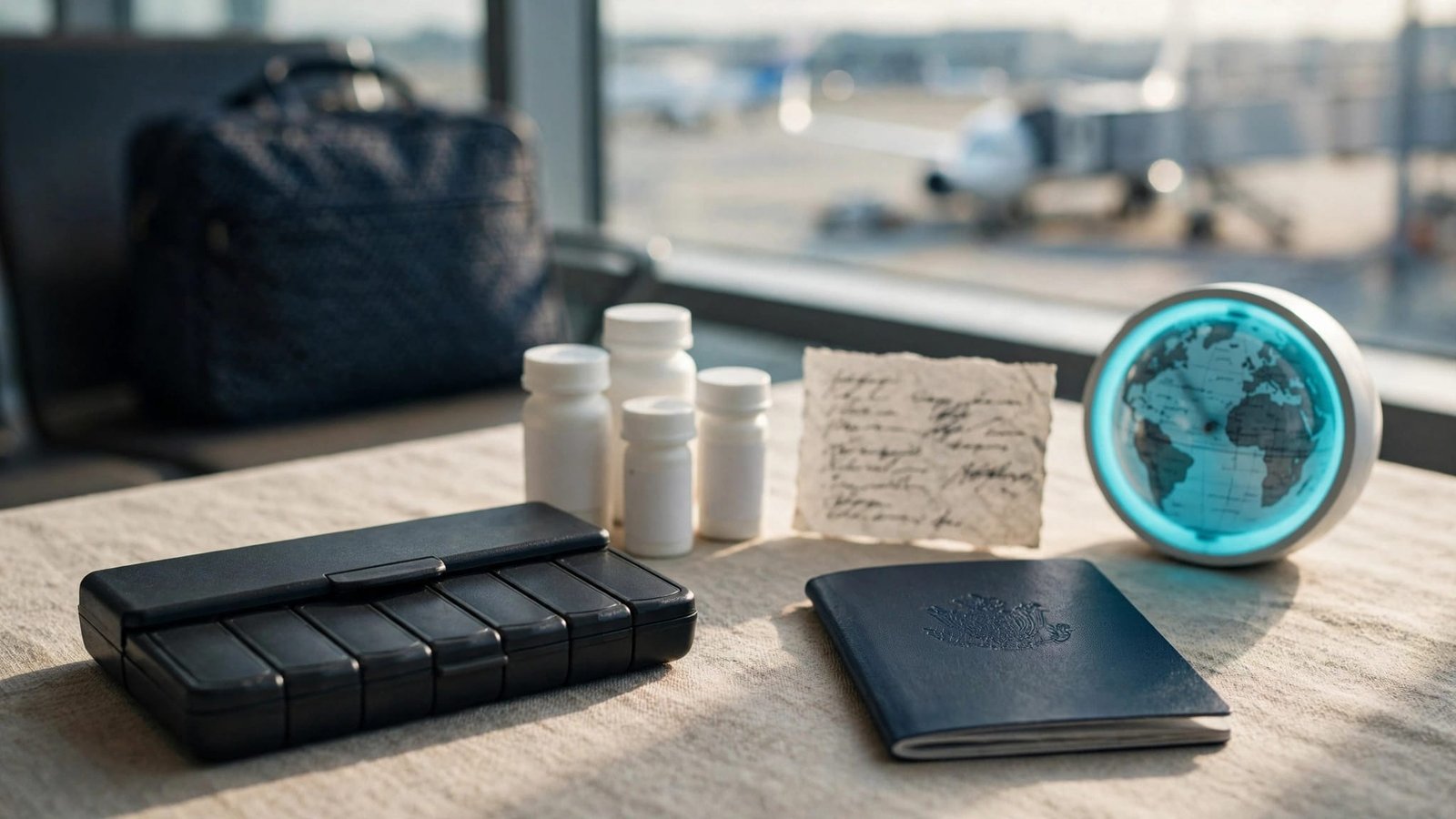
When your family crosses time zones, follow the medication schedule’s prescribed interval rather than switching automatically to local time. If timing is unclear, confirm the plan with your prescriber or pharmacist before travel.
A written medication plan gives parents and caregivers one less detail to manage on a busy day. It should state when to give each dose and what to do if plans change.
Key Takeaways
- Follow each medicine’s prescribed interval when crossing time zones. Ask your prescriber or pharmacist to approve any schedule change, especially for time-sensitive treatments.
- Write down each medicine’s name, dose, schedule, food requirements, missed-dose instructions, and travel-day transition. Give every caregiver the same instructions and record each dose when it’s given.
- Insulin, medicines with food or fasting rules, and birth control can have specific timing requirements. Follow the instructions for the exact medicine or formulation you take.
- Keep medicines in your carry-on luggage and bring enough for the trip plus an approved extra supply. If you miss a dose, follow its written instructions and don’t double it unless a clinician or the medicine’s specific directions tell you to.
Start With a Written Medication Plan
Arrange Your Pretravel Review
The CDC recommends a pre-travel consultation at least 4-6 weeks before travel for people with chronic conditions. Bring your itinerary and every prescription, including medicines taken only when needed.
Ask your doctor and pharmacist to review the itinerary and each prescription before departure. Insulin, seizure medicines, anticoagulants, and other time-sensitive treatments need individualized instructions for the first dose, last dose, connections, arrival, and return journey. Ask your pharmacist to clarify any timing questions.
A Journal of Travel Medicine study of immigrant travelers reported medication nonadherence in 60% and chronic-disease health problems in 32%. Those findings describe that study population, not every traveling family, but they support planning ahead.
Give Every Caregiver the Same Instructions
Record each medicine’s generic name, amount, usual schedule, food requirements, and instructions after a missed administration. Include the last home-time and first destination-time administration.
Keep a printed copy and an offline phone copy. Name one adult responsible for administration, with a clear handoff when another caregiver takes over.

Match Prescription Schedules to Time Zones
For fixed-interval medicines, count hours since the last dose rather than choosing the same time each day. Follow the medicine’s dosing interval instead of assuming local time will work. CDC travel guidance recommends arranging medication schedule changes with your healthcare team.
Prescription wording helps your pharmacist identify questions about the medication.
| Timing sensitivity | Directions | Timing approach |
|---|---|---|
| Strict | “Every 8 hours” or “every 12 hours” | Keep each dose at the prescribed interval with a written transition plan. |
| Moderate or strict | “Twice daily” or “morning and evening” | Establish whether doses need even spacing or should follow meals and waking hours. |
| Potentially flexible | “Once daily” | Use only the timing window approved for that medicine. |
Twice daily doesn’t always mean every 12 hours, and once daily doesn’t automatically mean flexible.
UK Specialist Pharmacy Service guidance says most medicines can be taken up to two hours late. Time-critical medicines can have different rules, so don’t use that allowance for every medicine.
Planned Parenthood’s guidance on birth control across time zones also explains why the daily interval between each dose matters more than the clock’s label.
Adjust Eastbound and Westbound Travel Carefully
Eastbound travel shortens the day and can bring doses too close together. Westbound travel lengthens it and can leave a longer gap across time zones.

Eastbound: New York to Paris
Illustration only: During eastbound travel, when Paris is six hours ahead of New York, an 8 a.m. New York dose corresponds to 2 p.m. in Paris. For a medicine taken every 24 hours, that equivalent time is the next scheduled time unless the prescriber approves a change.
Switching immediately to 8 a.m. Paris time would shorten the interval to 18 hours.
A prescriber or pharmacist may approve gradual changes of 1-2 hours daily for some medicines. At two-hour steps, the local schedule could move through 2 p.m., noon, 10 a.m., and 8 a.m. Confirm the appropriate transition for the prescription with a prescriber or pharmacist. Don’t apply this example without approval.
Westbound: Paris to New York
Illustration only: During westbound travel, with the same six-hour difference, an 8 a.m. Paris dose corresponds to 2 a.m. in New York. Waiting until 8 a.m. New York time creates a 30-hour interval.
A prescriber or pharmacist may approve gradually moving the schedule later. Larger approved steps may take about 3-4 days; one-hour daily steps take six days.
Short trips may suit a schedule based on home time. Longer stays may be easier with a gradual, approved move toward local time.
Protect Medicines With Food or Blood Sugar Rules
Insulin Needs Its Own Travel Plan
On eastbound flights, a shortened day can reduce insulin needs. Westbound flights can require additional insulin coverage during a longer day, sometimes after arrival.
Those changes depend on the insulin regimen, meals, activity, and glucose readings. Your diabetes team must provide the dose, monitoring instructions, and any pump-clock changes. Don’t calculate a dose adjustment from flight direction alone.
Plan more frequent blood sugar checks during the trip and keep prescribed hypoglycemia treatment accessible. Include overnight connections, delayed meals, and prescribed doses in the written plan. More walking, heat, and unfamiliar food can also change insulin needs after landing.
Keep Levothyroxine’s Fasting Routine
A convenient local time won’t help if it changes how your medication is absorbed.
In a levothyroxine timing study, average TSH was 1.06 mIU/L with fasting administration and 2.93 mIU/L when taken with breakfast. That difference shows why meal timing belongs in your schedule.
Keep the prescribed fasting interval, including the wait before breakfast. Follow your prescription’s instructions for separation from calcium, iron, and other medicines. For prescriptions taken with food, have an appropriate snack available during flights rather than relying on meal service.
Know Your Birth Control Timing Window
Progestin-Only Pills Have Different Rules
For norethindrone or norgestrel progestin-only pills, the timing window is three hours. ACOG’s progestin-only pill guidance advises taking a late dose promptly and using backup contraception for 48 hours when it’s more than three hours late.
Use condoms or avoid vaginal sex during that period.
These instructions don’t apply to every progestin-only formulation. The CDC’s formulation-specific missed-pill instructions cover a missed dose and distinguish norethindrone and norgestrel from drospirenone, which has different rules. List the medication name and formulation from your prescription on your travel schedule so caregivers follow the right instructions.
Combination Pills Allow More Flexibility
Combination birth control pills are generally fine one or two hours late. Still, keep a consistent daily routine so a small delay doesn’t become a missed pill.
Planned Parenthood’s birth control pill instructions explain what to do when pills are missed. After two or more consecutive missed active combination pills, use backup contraception for seven days while taking active pills correctly.
Emergency contraception may also be needed, depending on where you are in the pack and recent unprotected sex. Get prompt pharmacist or clinician advice rather than waiting until the trip ends.
Make Doses Easier for the Whole Family
Set a persistent alarm using the approved intervals. Test how it behaves when your device changes time zones or during daylight-saving changes, and don’t adjust the schedule without your healthcare team’s approval.
Use a repeating alarm that stays active until acknowledged instead of relying on an easy-to-miss notification. Record each dose immediately after it’s given, including the local date and time zone, so the next caregiver knows whether it was given.
A notification tells you when medication is due. A shared record tells the next caregiver whether it was given.
For children and other dependents who rely on familiar routines, keep daily routines around doses predictable. Use the usual cup, familiar food when permitted, and a short explanation before each transition. On arrival day, leave room for rest and meals.
Our special needs travel planning draws on our firsthand family experience with special-needs and autism travel. We use real-world planning to account for accommodations, transportation, and pacing. Kellie has a B.A. in Child Development. Medication decisions remain with your healthcare team.
For Disney preparation, our family guide covers sensory needs, transitions, and flexible park planning. It’s available as an Etsy PDF guide and through our Amazon guide listing.
Pack Medication for Delays, Not Just Vacation Days
Carry medicines in your carry-on luggage, in their original labeled containers. Bring prescription copies and a doctor’s letter listing generic names, doses, and relevant supplies or care needs.
Pack enough medication for the full travel period plus an approved extra supply. An additional week is a useful planning target when prescribing limits and destination laws permit it. Arrange required permissions for controlled medicines before departure, including transit countries.
Refrigerated medicine needs protection during airport waits, flights, transfers, and hotel stays. Our guide to traveling with refrigerated medication covers cooling arrangements and storage transitions. Protect it from freezing as well as heat.
Keep the medicine bag accessible throughout the travel day if an airline gate-checks your larger carry-on. A supply packed beneath the aircraft won’t help when a dose becomes due.
For practical family supplies, our Trip Rescue Shop offers stroller options, cleaning supplies, and items for unexpected sick-on-vacation moments. Keep cleaning products separate from medicines and food.
Handle Missed Doses and the Return Journey
If you miss a dose, follow the medication’s written instructions for that dose. Don’t double a missed dose unless a clinician or the medicine’s specific instructions explicitly direct it, and don’t skip or add doses just to match local time zones.
For warfarin, take a forgotten dose when remembered on the same day unless the next dose is nearly due. If you don’t remember until the next day, skip it and resume the usual schedule. Never double warfarin. Record the missed dose and follow your anticoagulation team’s reporting instructions.
Contact a pharmacist promptly when the instructions don’t cover your situation, especially after vomiting or an uncertain dose. Seek urgent help for a suspected overdose or serious symptoms.
Before travel home, record when you last took your medicine and follow the approved return plan for any time-sensitive treatment. A one-hour daylight saving time change is smaller, but adjustments for time-sensitive medicines still need an approved plan. CDC’s general travel-health guidance can help with preparation, but it doesn’t replace your approved plan.
Frequently Asked Questions
How should I adjust medication times when I cross time zones?
Count the hours since the last dose for medicines taken at fixed intervals, rather than switching automatically to the same local clock time. Ask your prescriber or pharmacist for an approved transition plan before travel.
What should I do if I miss a dose while traveling?
Follow the medicine’s written missed-dose instructions, and don’t double a dose unless a clinician or the medicine’s specific instructions direct you to. Contact a pharmacist if the instructions don’t cover your situation or you’re unsure whether a dose was given.
Do insulin doses need to change for eastbound or westbound travel?
Flight direction can affect the length of the day, but insulin adjustments depend on your regimen, meals, activity, and glucose readings. Ask your diabetes team for dose and monitoring instructions, and don’t calculate an adjustment from flight direction alone.
How should I keep track of doses when caregivers take turns?
Name one adult responsible for giving each dose and make a clear handoff when another caregiver takes over. Record each dose immediately, including the local date and time zone, and keep a printed copy and an offline phone copy of the plan.
A Clear Schedule Supports a Calmer Family Trip
A dependable medication plan protects prescribed intervals while keeping meals, rest, and caregiver responsibilities manageable. Write down the transition, keep supplies close, and record every dose.
We help families plan travel around the routines that support a comfortable vacation. With clear instructions and room for unexpected delays, you can spend less time sorting out schedules and more time enjoying your trip together.
Leave a Reply