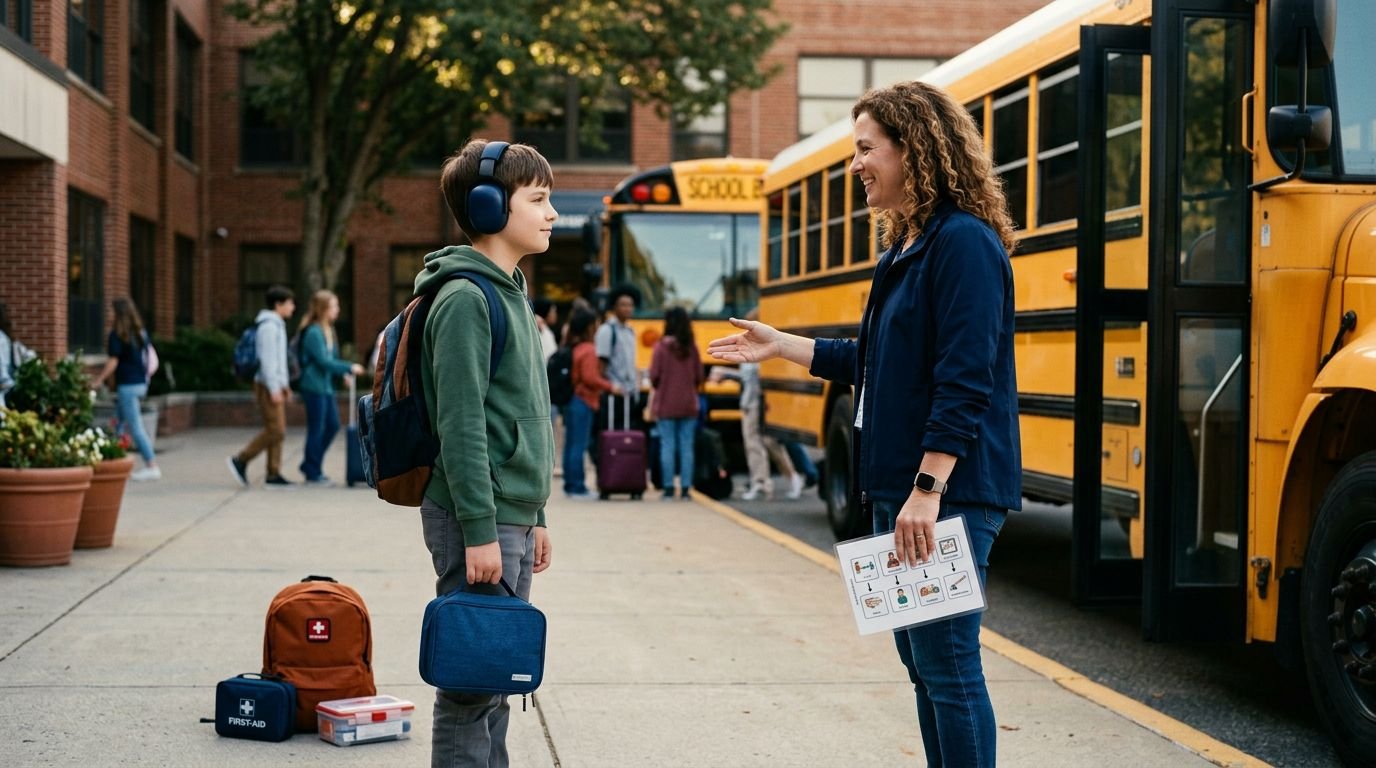
A school trip can be exciting, but one unexpected change can make the day feel too big. For a student with autism spectrum disorder, a thoughtful trip plan gives them more than a packed lunch and permission slip. It offers familiar supports and adults who know what to do when plans change.
The goal is not to make a student act like everyone else. The goal is to help them participate safely, comfortably, and with dignity.
Key Takeaways
- Equal access means students with autism should receive the supports they need to participate in school trips; parent attendance should not be required as a condition of participation.
- Plan early with the family, teacher, support staff, nurse, and transportation team, and put supervision, communication, health, and emergency responsibilities in writing.
- Use an honest visual schedule, social story, change card, and familiar travel toolkit to make transitions, sensory breaks, and unexpected changes easier to manage.
- Prepare a private safety profile and a clear missing-student response before anyone boards the bus, especially when elopement or communication differences are concerns.
- Build backup plans for delays, transportation problems, overnight stays, and crowded destinations so staff can respond calmly without adding unnecessary demands.
Autistic School Trip Planning Starts With Equal Access
Field trips are part of the school experience. They are not a reward students must earn by tolerating crowds, noise, sudden changes, or expected social skills.
The U.S. Department of Education’s field-trip access guidance states that students with disabilities must have equal access to school activities, including field trips. A parent can choose to attend, but a school should not make parent attendance a condition of participation.
Put needed supports in writing
Document accommodation requests by reviewing the student’s IEP, Section 504 plan, behavior support plan, health plan, and transportation needs well before the trip.
The team may need to plan for:
- A one-to-one aide, interpreter, nurse, or other school-day support to attend the trip.
- A shorter visit, an early departure option, or a calm place for breaks.
- Medication, food, mobility, communication, and bathroom supports.
- A bus seat, boarding routine, or transportation safety plan that fits the student.
A field trip is not the time to test whether a student can manage without the support they normally receive.
Hold one focused planning meeting
Parents know details that a permission slip cannot cover. They can share what causes distress, what helps their child recover, how they communicate when overwhelmed, and what safety concerns need attention.
Include the teacher, trip leader, special education staff, nurse when needed, transportation staff, and the parent or caregiver. Give each adult a role before the day begins. If the school team needs additional expertise, a certified autism center may offer individualized guidance, but consulting one isn’t required for access.
| Team Member | Main Responsibility |
|---|---|
| Trip leader | Keeps the group schedule, contacts the school, and makes final trip decisions. |
| Assigned support adult | Stays with the student during transitions, breaks, and high-risk areas. |
| Parent or caregiver | Shares current calming supports, communication needs, and emergency contacts. |
| Nurse or trained staff member | Manages medication, health needs, and medical emergency instructions. |
A short meeting can prevent a lot of confusion later.
Give the Student a Plan They Can See
A schedule in an adult’s head does not help a student who needs to know what comes next. Visual schedules show the sequence of the real trip and connect it to the student’s daily routine. Visual supports make the trip feel more predictable and can reduce transition anxiety, even when the day cannot go perfectly.
The Children’s Hospital of Philadelphia recommends advance preparation, picture schedules, and added support when needed for students with autism on field trips.
Build a visual schedule for the real day
Use photos, icons, words, or AAC based on the student’s established communication skills and what they already understand. Keep the schedule simple and honest.
Show the important steps:
- Arrive at school.
- Get on the bus.
- Ride to the destination.
- Visit the activity area.
- Eat lunch.
- Take a break.
- Ride back to school.
- Go home.
Add pictures of the bus, entrance, lunch space, bathrooms, and meeting point when possible. A student may also need a small “first, then” card for the next two steps, or a break/change card paired with a familiar regulation item from the student’s distraction toolkit.
Keep the printed schedule and change card in the staff’s travel toolkit. Phones lose service, batteries die, and paper still works in a crowded museum or on a delayed bus.
Use social stories and practice runs
Social stories explain what the student may see, hear, do, and feel. They can include simple reminders such as, “The bus may be loud. I can wear my headphones,” or, “If I need a break, I can show my break card.”
Read them several times before the trip, using calm, direct language, and practice retrieving and using the student’s distraction toolkit. Use travel training to rehearse putting on a backpack, waiting near a door, getting on the bus, or walking a route. When available, use familiar peer buddies for low-pressure social skills practice, without making peer interaction mandatory.
If positive reinforcement or applied behavior analysis strategies are already part of the student’s school plan, use the familiar approach set by a behavior analyst already on the team. Do not introduce a new reward system, new demand, or new behavior expectation during a busy outing.
A visual schedule should include a “change” card. Plans change, but the student should be told what changed and what happens next.
Set Up Supervision Before Anyone Boards the Bus
The trip plan needs a real supervision plan, not a vague promise that adults will “keep an eye out.” Every adult should know who is responsible during loading, unloading, bathroom stops, transitions, meals, and free-choice activities.
There is no single staff-to-student ratio that fits every child. Support should match the student’s needs, the destination, and the risks involved. During transitions and delays, a designated support adult should carry the familiar distraction toolkit or keep it accessible. This familiar support can help, but it never replaces supervision.
Create a private safety profile
For a student with elopement risk, communication differences, or a history of leaving an area when distressed, prepare a short safety profile. Share it only with staff who need the information.
Include a current photo, preferred name, communication methods, likely triggers, calming tools, medical concerns, parent contacts, and places the student may go if they become overwhelmed. Add details such as an attraction to water, parking lots, doors, elevators, or quiet corners.
The wandering prevention resources from Autism Speaks include emergency forms that can help families and schools organize this information.
Agree on the response if a student is missing
Before the trip, document the safety procedures, including who responds, where the student may go, and how the team searches. Do not spend the first five minutes debating who should search, who stays with the class, or who calls the school.
Assign one adult to remain with the group and keep students together. Assign another adult to check the last known location and alert destination staff. The trip leader should contact school administrators and emergency services right away when the student cannot be located immediately or is near traffic, water, public transit, or another immediate danger.
Record the time and location the student was last seen. Have the safety profile ready. Stay calm, use simple language, and avoid having many adults call the student’s name at once.
Prepare for Sensory, Health, and Distress Needs
A student can enjoy a field trip and still reach their limit. Noise, crowds, unfamiliar smells, waiting, heat, and hunger can combine into sensory overload quickly.
Because sensory sensitivities vary, the plan should match the student’s needs and known triggers. Plan breaks before the student is overwhelmed. A quiet hallway, parked bus, shaded bench, empty classroom, or designated room can work if the destination approves it ahead of time.
Make sensory breaks easy to request
Decide how the student will ask for help. They may use a break card, AAC device, hand signal, word, or picture. Adults should know the signal and respond without making the student explain themselves in front of peers.
When a behavioral meltdown happens, treat it as a distress response, not intentional misbehavior. Reduce language and demands. Move away from noise when it is safe. Offer familiar regulation tools. Give the student time.
A sensory break is not a reward for good behavior. It is support that can stop distress from becoming an emergency.
Pack a travel toolkit the student already knows
The best distraction toolkit is filled with familiar items, not surprise purchases handed over on the bus. Pack it in a small bag that stays with the assigned adult or student.
The assigned adult or student should be able to reach the distraction toolkit without unpacking the whole bag. Before the trip, check that the distraction toolkit matches the student’s sensory, communication, food, and health needs.
Consider bringing:
- Noise-canceling headphones, sunglasses, a hat, or a familiar hoodie.
- Preferred snacks, water, wipes, and safe foods for long delays.
- Fidgets, comfort items, a visual timer, a communication device, and low-tech backup cards.
- A charged tablet or phone, charging cord, portable battery, and downloaded content.
- Extra clothing and basic cleaning supplies in case of illness or an accident.
For families preparing a personal travel bag beyond the school trip, Trip Rescue Shop has travel items such as strollers, cleaning supplies, and practical vacation essentials.
Medication should follow school policy. Keep it with the nurse or trained staff member, along with written dosage instructions, permissions, and emergency contact details.
Plan for Delays, Overnight Trips, and Big Destinations
The hardest moment may not happen at the destination. It may happen when traffic stops, the bus breaks down, a flight is delayed, lunch runs late, or a favorite activity closes.
Good travel planning includes an emergency backup plan before leaving school. Carry an updated travel itinerary with removable or editable pieces, because a delay or closed attraction can increase transition anxiety. Show the student the revised order: “Now we wait on the bus. Next we have a snack. Then we go to the museum.”
Prepare transportation and overnight details
For a bus trip, use travel training to practice loading and assigned seating before the morning rush. For public transit, review platforms, stations, and other shared transportation risks. During delays, keep a distraction toolkit with familiar items accessible, along with the same emergency contacts and safety information used on the daily school route.
For flights, families and school staff should ask the airline about group procedures early and review TSA Cares travel support before flying. Pack a carry-on travel toolkit with medication, sensory supports, communication tools, safe foods, chargers, and an extra outfit. Keep a distraction toolkit with familiar items accessible during security waits.
Overnight trips need a hotel plan too, with a distraction toolkit that keeps familiar items accessible if the room changes unexpectedly. Ask for a quieter room location when available, room for needed mobility equipment, refrigerator access for food or medication, and a clear plan for nighttime support.
For a complex destination, families or school teams may also consult a certified autism center for practical guidance.
Autism travel insurance may help with certain covered problems, but it isn’t a behavior plan. Read the policy carefully. Ask about early departure, medical care, delayed baggage, lost devices, and limits for disability equipment before assuming coverage applies.
Keep Disney trips flexible
A school trip to Walt Disney World can bring extra noise, walking, waiting, transportation changes, and crowd pressure. Choose a few meaningful activities instead of trying to fill every hour. Offer low-pressure group participation that supports social skills, without making peer interaction a condition of enjoying the trip.
For families planning their own Disney vacation, the Disney World With Autism Guide on Etsy and the Amazon edition of the guide offer practical ideas for park breaks, accessibility needs, and lower-pressure days.
A calm schedule is not a missed opportunity. It is often what makes the trip possible.
Frequently Asked Questions
Should a parent attend an autistic student’s school trip?
A parent or caregiver may choose to attend, but schools should not make parent attendance a condition of participation. The school should arrange the supports the student normally needs during the school day.
What should be included in an autistic school trip plan?
The plan should cover accommodations, supervision, communication methods, sensory breaks, medication and health needs, transportation, emergency contacts, and responses to delays or a missing student. Assign each responsibility to a specific adult before the trip begins.
How can a school prepare an autistic student for a field trip?
Use a visual schedule, social story, photos of important locations, and practice runs for transitions such as boarding the bus. Explain changes simply and include a familiar change card and regulation tools.
What should staff do if an autistic student becomes overwhelmed?
Treat the behavior as a distress response rather than intentional misbehavior. Reduce language and demands, move to a quieter area when safe, offer familiar regulation tools, and give the student time to recover.
What should happen if a student goes missing during a trip?
The team should already know who stays with the group, who checks the last known location, who contacts destination staff, and when to call school administrators or emergency services. Record the time and location, use the student’s safety profile, and avoid having many adults call the student’s name at once.
Final Thoughts: A Calmer Plan Is a Safer Plan
The strongest emergency plan starts long before the bus doors close. It gives the student familiar supports, gives staff clear responsibilities, and helps everyone respond safely when the day changes.
This approach works best when it is personal. One student may need headphones and a break card. Another may need a trained support adult, a safety profile, and a clear plan for every transition.
A successful trip is not measured by how much the class fits into one day. It is measured by whether each student had a real chance to take part safely.