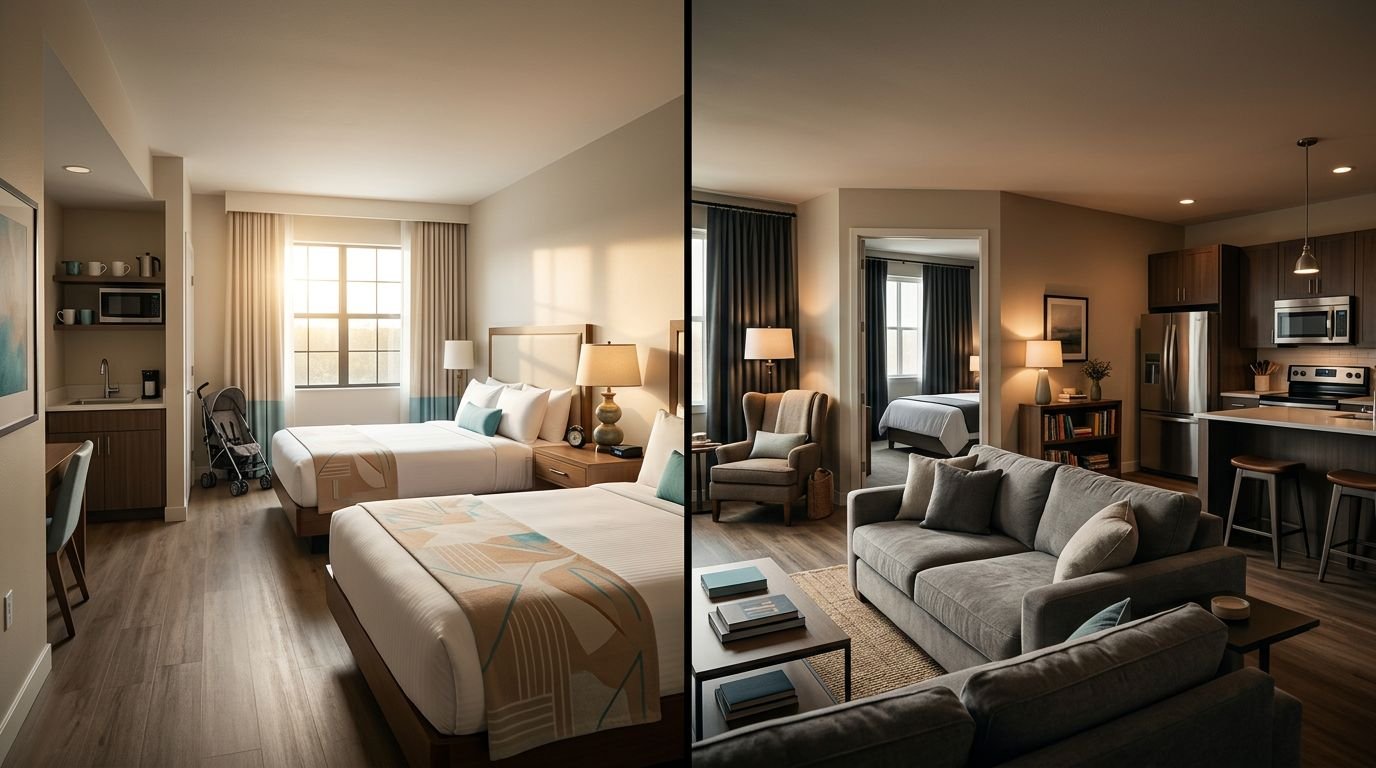
A Walt Disney World vacation can be wonderful. The wrong room can make mornings and returns from the theme parks harder. When families compare the Disney hotels autism families may consider, they’re really comparing recovery time, routines, transportation, privacy, and flexibility. For a child on the autism spectrum, the right room can help the sensory system recover after a busy day.
The right answer isn’t always the closest hotel or biggest house. An on-site Disney hotel can make midday breaks, transportation, and plan changes easier. A vacation rental may provide a kitchen, separate bedrooms, and the quiet your family needs to sleep well.
Start with your family’s daily needs, then weigh the lodging details that matter most. Eligible military families may also include Shades of Green in the comparison.
Key Takeaways
- Compare Disney hotels and vacation rentals based on your family’s daily needs, including breaks, sleep, meals, transportation, privacy, and sensory recovery.
- On-site Disney resorts can make midday breaks and transportation easier, while vacation rentals usually provide more control over kitchens, separate bedrooms, noise, and personal space.
- Family Suites, Fort Wilderness cabins, moderate resorts, deluxe resorts, The Swan and Dolphin, and Shades of Green may each fit different budgets and support needs.
- Look beyond the nightly rate by considering cleaning fees, parking, tolls, gas, transportation time, and resort fees when comparing total costs.
- A flexible sensory plan matters as much as the address: preview the trip, schedule breaks, identify an exit plan, and review current Disney accessibility information before visiting.
Disney hotels autism families often choose for easier breaks
Being on Disney property is less about extra perks and more about reaching a familiar base quickly. A child on the autism spectrum may benefit from returning quickly for quiet time when the day feels too intense.
Still, buses, boats, the monorail, and Skyliner lines can be crowded at peak times. Review Disney’s neurodivergent guest resources before booking, so you know what support is available in the parks and at your resort.

Compare Disney resorts with nearby rentals based on your family’s actual daily needs. On-site lodging shortens the route to a familiar room, while a rental usually offers more control over meals, noise, and space.
Some families use the term hybrid resorts for lodging that combines resort services with suite, cabin, or villa-style living space. The term is descriptive, not necessarily an official Disney tier. Eligible military families should also include Shades of Green when comparing on-site lodging and total costs.
| What your family needs most | Disney hotel | Vacation rental |
|---|---|---|
| A fast midday reset | Disney transportation can bring you back without driving. | You may need to drive, park, and walk back to the home. |
| Familiar meals | Food courts and mini-fridges are convenient, but may be busy. | A kitchen makes preferred foods and meal routines easier. |
| Space to spread out | Fort Wilderness Resort has cabin-style options with more residential space and outdoor surroundings; standard rooms are compact. | Separate bedrooms and living space give everyone room to decompress. |
| Less shared noise | Ask for a quiet building or higher floor away from pools. | A private house can be calmer, though nearby pools and neighbors still matter. |
| Simple transportation | No rental car is required for many Disney Resort stays. | A rental car gives more control, but adds traffic, tolls, and parking. |
| Predictable total cost | Some value resorts, including All-Star Music, may cost less, but colorful theming and pool activity may not suit every child. | Nightly rates may look lower until cleaning, parking, and resort fees are added. |
There isn’t one universal quiet winner. A large Disney resort might be busy near the lobby and food court, but peaceful near a far building. A rental can be calm indoors, then have a loud shared pool or busy road outside.
Before you book, watch current resort walk-through videos in short clips. Show your child the lobby, room layout, pool area, food court, and transportation stop. Familiar pictures can make the first arrival feel less unknown.
When an on-site Disney resort is the better fit
An on-site stay helps when a child on the autism spectrum needs a quick break from the parks. The on-site resorts many families choose are not always the most expensive ones. They are the ones that make breaks feel possible.
Larger families may want to compare Disney’s Art of Animation Resort and Disney’s All-Star Music Resort, two value resorts with Family Suites. Their Family Suites include a bedroom, additional sleeping space, two bathrooms, and a kitchenette. An All-Star Music suite can support autistic children’s routines, with one child settling early while another watches a familiar show.
These value resorts are colorful, busy, and heavily themed. For children on the autism spectrum, giant character figures, pool noise, and crowded food courts can feel exciting or overwhelming. Requesting a room away from the main pool can help.
For a quieter option, consider moderate resorts such as Port Orleans Resort, French Quarter. It has a smaller, more compact layout than many Disney resorts. Among moderate resorts, the walk to the food court, bus stop, and pool is manageable for many families.
Cabins at Fort Wilderness Resort offer a full kitchen, a separate bedroom, and outdoor space. They can be a strong option for families managing selective food routines or children who need room to move. Families may describe cabin, villa, or suite-style stays as hybrid resorts, not an official Disney classification, because they combine resort amenities with extra living space. Because Fort Wilderness Resort is large and wooded, families with a child who may wander need a clear safety plan and close supervision.
Deluxe resorts and Disney Vacation Club villas cost more, but location can make a real difference. Some deluxe resorts may reduce transportation time. Disney’s Contemporary Resort is within walking distance of Magic Kingdom, while the monorail can ease breaks at Magic Kingdom or EPCOT.
The Swan and Dolphin are another middle-ground choice. They are independently operated hotels inside Walt Disney World, not Disney-operated resorts, with convenient access to EPCOT and Disney’s Hollywood Studios. Eligible military families may also want to compare Shades of Green for eligibility, location, and total cost.
A resort-only trip can also be a good first step. A few nights with pool time, resort dining, Disney Springs, and no park tickets may help your child get used to the setting without the pressure of a full park day.
When a vacation rental is the better fit
A vacation rental rarely wins on convenience. It often wins on control.
Hybrid resorts, meaning suite-style or villa-style stays with extra space, can offer a middle ground. They may reduce the work of managing a separate rental, but not every nearby suite property provides the same setup.
A full kitchen lets you bring the breakfast your child eats at home. It can also support picky eaters, familiar meal routines, and grocery storage. Laundry helps after a wet pool day or a spilled snack. Separate bedrooms can protect sleep, especially for a child on the autism spectrum when siblings have different schedules. A private living room gives your child a place to reset without everyone sitting in the dark.
For some families, a rental car is a comfort. You control the temperature, music, departure time, and who shares the ride. That can feel easier than waiting for a busy Disney bus after fireworks.
The trade-off is the drive. Check the actual route to each park before booking, because listing distance is not actual travel time. Traffic near Lake Buena Vista, Kissimmee, I-4, and park exits can add time. That matters after fireworks or a long park day.
Look beyond the nightly rate, too. Cleaning fees, booking fees, parking, tolls, gas, and grocery runs all affect the total. Eligible military families can also compare the on-property option, Shades of Green. It isn’t a vacation rental, but it belongs in the broader lodging comparison. A lower-priced rental can cost more than expected once every extra charge is included.
Ask practical questions before reserving:
- Is the pool shared or private, and how close is it to the house? Ask whether pool noise carries into bedrooms.
- Are there stairs, balconies, busy roads, or unsecured doors that could increase wandering risk?
- Can you share recent photos of the bedrooms and kitchen, and confirm there is storage for familiar foods?
- Is there a quiet bedroom where your child can sleep and decompress safely, away from the main living area?
A rental is often the better fit when food routines, sleep, and personal space matter more than being close to the parks.
A simple sensory plan matters more than the address
The lodging choice supports the plan, but no room can fix a packed schedule. Good vacation planning means fewer priorities, a clear exit plan, and respect for your child’s sensory system.
- Preview the trip in simple pieces for a child on the autism spectrum. Show photos or short videos of the airport, hotel room, security screening, park entrance, and one favorite attraction.
- Use a short, flexible visual plan. Try “breakfast, bus, one ride, snack, hotel break.” Avoid promising an exact ride order when weather and closures can change the day.
- Pick one or two must-do experiences each morning. At EPCOT, Remy’s Ratatouille Adventure, Frozen Ever After, and Soarin’ are spread far apart. Don’t spend the day crossing the park to chase every reservation.
- Plan for waiting differently. Disney’s current Disability Access Service information explains eligibility and registration. DAS is for guests whose disability makes a conventional queue hard to tolerate. Eligibility depends on disability-related queue needs, not an autism spectrum diagnosis alone. DAS isn’t automatic for autism, and it isn’t a no-wait pass.
- Decide what leaving looks like before your child’s sensory overload peaks. That may mean returning to the hotel, taking quiet time with a snack, using a ride-share, or ending the park day early.
When DAS is active, a return time is requested through the My Disney Experience app. Your family can wait elsewhere rather than standing in the standby line. Keep a portable charger with you every day. Your phone may hold tickets, maps, food orders, messages, and return times.
Lightning Lane Multi Pass is separate from DAS and costs extra. It can help when your family has a few true must-do rides. It can also create another clock to watch. Buy it only when scheduled return windows will make the day easier.
A slower day with one favorite ride and a calm hotel break is a successful Disney day.
Food, transportation, and planning support
Quick-service meals at Walt Disney World often give families more control than a long table-service meal. Review menus and dining options ahead of time, mobile order when your child is ready, and take food to a quieter outdoor table or back to your room.
At EPCOT, Sunshine Seasons has a wide range of familiar meal choices. At Hollywood Studios, Docking Bay 7 can be fun for Star Wars fans, but review the menu first if your child on the autism spectrum prefers familiar foods. Bring safe snacks anyway. Hunger and heat can make a small problem feel much bigger.
Review the Sunshine Seasons menu before your visit, and plan mobile-order timing around your child’s usual routine. Transportation planning can also protect the day’s rhythm. Check current Disney transportation details, allow extra time, and identify a quiet place to pause if plans change.
Keep headphones, a familiar device, charging cords, and a portable charger together in one small pouch. Families often remember the tablet and forget the cable. A fully charged phone is not an extra on a Disney day.
Check Disney’s current official resources for dining, transportation, and accessibility policies before your trip. Details can change, so use third-party guides as supplemental planning help, not as official policy.
For more first-person sensory planning ideas, Izzy’s Guide to Disney World for Autistics offers helpful perspective on pacing and dining.
A special-needs travel planner can support vacation planning around your child’s actual needs. They can help compare lodging, transportation, ticket options, and dining choices. Eligible military families may also compare Shades of Green after confirming current eligibility requirements and bringing a valid military ID.
These third-party guides can supplement that research. Consider the Disney World with Autism Guide PDF or the Disney World with Autism guide on Amazon.
Frequently Asked Questions
Are Disney hotels or vacation rentals better for autism families?
Neither option is best for every family. Disney hotels make park breaks and transportation easier, while vacation rentals often provide more space, familiar meals, privacy, and control over the environment.
Which Disney resorts offer more space for larger families?
Disney’s Art of Animation Resort and Disney’s All-Star Music Resort offer Family Suites with separate sleeping areas, two bathrooms, and a kitchenette. Fort Wilderness cabins also provide a full kitchen, a separate bedroom, and outdoor space.
Are vacation rentals cheaper than Disney hotels?
A rental’s nightly rate may look lower, but cleaning fees, booking fees, parking, tolls, gas, and grocery runs can increase the total. Compare the full trip cost, including transportation time and convenience, before booking.
Does Disney’s Disability Access Service automatically apply to autistic guests?
No. DAS eligibility depends on whether a disability makes a conventional queue difficult to tolerate, not on an autism diagnosis alone. Review Disney’s current DAS information because policies and registration details can change.
How can families make a Disney hotel room quieter?
Request a room away from pools, food courts, elevators, and other busy areas, and ask about a higher floor or quieter building. Watch current resort walk-through videos and preview the room, transportation stop, pool, and food court with your child before the trip.
Choose the stay that gives your family room to reset
The best place to stay is the one that supports your child’s needs after the excitement wears off. Disney hotels make park breaks easier, while vacation rentals offer more space, familiar meals, and privacy.
Choose the option that makes mornings calmer, meals more familiar, sleep more reliable, and resets more realistic. Value resorts, suite or cabin stays, and vacation rentals can all work, depending on your family’s needs. A Disney trip does not need to look like anyone else’s vacation to be a wonderful one.
Comments
One response to “Disney Hotels vs. Vacation Rentals for Autism Families”
[…] The goal is not to find one perfect Disney resort. The goal is to find the accommodation that supports your family’s routines, sensory needs, budget, and park plans, whether that is an on-property Disney hotel or an off-site vacation rental. […]