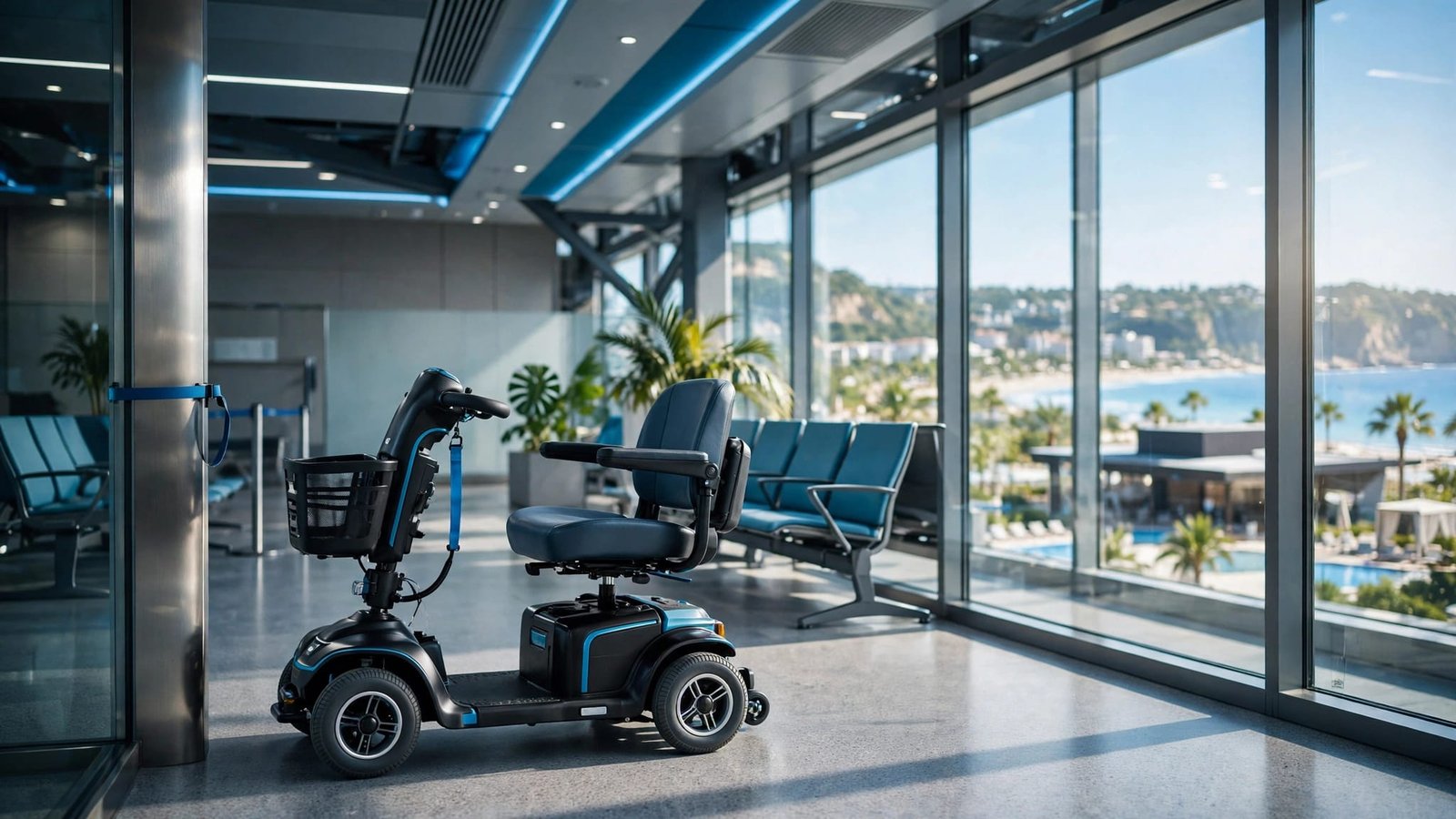
Yes, you can take a mobility scooter on a plane when its battery and dimensions meet the flight’s requirements. Traveling with a mobility scooter becomes more manageable when your carrier-provided assistance, equipment handling, transportation, and resort access work together.
Your scooter supports your independence, so protecting it deserves careful planning. We help families think through those details so the travel day feels less stressful. Start with the carrier arrangements, then build a comfortable plan for arrival.
Key Takeaways
- Contact the carrier when booking, ideally at least 48 hours before departure, with your scooter’s specifications.
- Battery handling depends on the battery type and how the scooter protects it.
- Photograph your scooter before handover and inspect it before leaving the destination airport.
- Arrange accessible transportation and resort features around your actual equipment and transfer needs.
1. Arrange Airline Support Before Your Flight
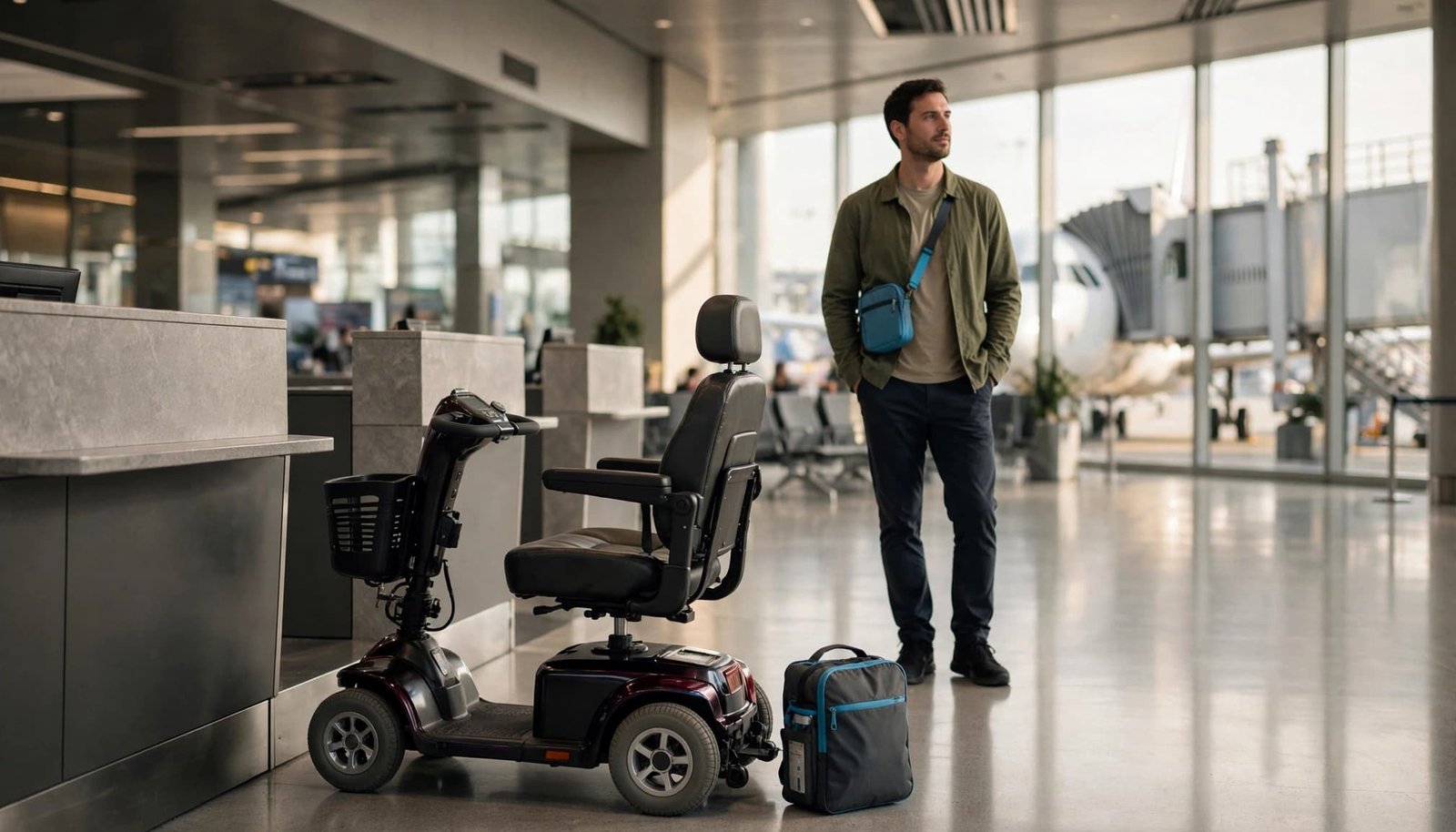
Share a Complete Scooter Profile
Contact the carrier’s accessibility team when booking. Aim for at least 48 hours’ notice, although this isn’t a blanket federal requirement for ordinary wheelchair assistance.
Provide a complete profile for the mobility device, including its make, model, serial number, weight, and full dimensions. Include folded dimensions when relevant, battery chemistry, watt-hour rating, and manufacturer handling instructions.
Describe your transfer needs, too. Explain whether you can walk short distances or need an aisle chair and boarding assistance. Our wheelchair air travel guide covers these arrangements in more detail.
Include Every Flight and Connection
Send the equipment profile to each operating carrier, including a different carrier handling a connection. Aircraft cargo doors and loading limits vary.
Request assistance through connecting airports and allow extra time between flights. Record whether your scooter should return at the aircraft door or baggage claim.
The Air Carrier Access Act protects passengers with disabilities on covered flights to, from, and within the United States. Disability-related airport assistance and transporting your assistive device generally don’t carry an additional charge.
2. Prepare Your Scooter Battery for Flying
Battery rules need careful attention. A removable lithium battery and a securely installed sealed battery don’t follow identical procedures.
Lithium-Ion Batteries and Spare Batteries
For scooters designed for battery removal, the lithium-ion battery must travel in carry-on baggage. Protect exposed terminals against short circuits and place each removed battery in a protective pouch.
TSA’s mobility-device battery guidance describes removal and protective packaging. FAA guidance also allows some adequately protected lithium-ion batteries to remain installed. Removal and protective-packaging requirements for lithium ion batteries depend on the scooter’s design and applicable rules.
Under FAA mobility-device battery rules, removed or inadequately protected lithium-ion batteries have a maximum rating of 300 Wh. Spare allowances are one battery up to 300 Wh or two batteries up to 160 Wh each. Spares travel in the cabin.
Keep the manufacturer’s battery label readable and carry its specifications. Watt-hours equal volts multiplied by amp-hours. If capacity appears in milliamp-hours, divide that figure by 1,000 first.
Lithium-metal, non-rechargeable batteries are forbidden with these mobility devices.
Sealed Batteries and Spillable Batteries
Non-spillable sealed lead acid batteries can usually remain installed when securely attached, protected against short circuits, and safeguarded against accidental activation.
Unsealed wet-cell batteries require special handling, but they aren’t universally prohibited as mobility-device batteries. Spillable batteries may remain installed when secured, terminals are protected, and the scooter stays upright throughout handling and storage.
If upright transport isn’t possible, separate removal and approved packaging may be necessary. Include any upright-only requirement prominently in the handling instructions.
3. Prepare for Screening and Gate Handover
Plan to arrive at least two hours before a domestic flight and three hours before an international flight. Allow additional time for complicated transfers or battery handling.
Protect Your Scooter Before Handover
Photograph every side of the scooter, including controls, wheels, battery compartment, and existing marks. A short video can document working brakes and controls.
Label each removable component with your name, address, and phone number. Attach a simple handling card showing approved lifting points, freewheel operation, battery instructions, and an emergency contact.
Remove baskets, cup holders, mirrors, and unattached cushions when safe. Pack permitted loose accessories and fragile controls in your carry-on. Keep essential positioning supports available when you need them.
Know What Happens at Security and Boarding
You don’t have to stand or walk through security if doing so is unsafe. Explain your mobility needs before screening begins. TSA may screen you while seated and inspect the scooter and attached items.
The TSA officer makes the final screening decision. Passing security doesn’t determine whether equipment meets aircraft loading requirements.
Scooters generally travel in the cargo hold. You can usually use yours through the airport and hand it over near the aircraft door for gate-checking.
Before boarding, review the return location on the equipment tag. Arrange transfer assistance separately. Carrier staff don’t provide medication administration or personal bathroom care.
4. Inspect Your Scooter Before Leaving the Airport
Take time to inspect your scooter as soon as it’s returned, whether that’s at the aircraft door or baggage claim.
Look for bent components, missing accessories, damaged wiring, loose seating, and new error messages. Test the controls, brakes, and movement only if the scooter appears safe.
If something is wrong, photograph it immediately. Report the problem before leaving the airport and request a written damage report and claim number. Keep your equipment tag, boarding pass, receipts, and employee names.
Request a suitable temporary mobility device if yours is unusable. If the issue isn’t resolved, ask for the airline’s Complaint Resolution Official, or CRO.
Travel insurance coverage varies and isn’t automatic. Ask your insurer whether your scooter is insured in transit, then check the policy’s limits and exclusions. This coverage doesn’t replace airline obligations for assistive devices, which differ from standard suitcase limits. Ordinary baggage coverage doesn’t tell the whole story.
5. Match Ground Transportation to Your Scooter
Airline assistance doesn’t include your resort transfer. Reserve transportation that accommodates your scooter, luggage, companions, and transfer needs.
For a private car, collapsible mobility scooters, travel scooters, and folding scooters may fit in the cargo space. Confirm folded dimensions, the heaviest individual component, and the vehicle’s weight capacity. Some scooters may still need loading help or a ramp. A rigid mobility scooter or powered wheelchair often needs a ramp or lift.
A vehicle lift may use an inside hoist, an external hitch-mount platform, or a hybrid system that moves equipment onto a platform and into the vehicle. Vehicle capacity and the device’s dimensions determine which setup fits.
For buses and other public transport, confirm the operator’s rules, designated mobility spaces, and securement requirements. Don’t assume a scooter is approved for occupied travel. Transfer to a vehicle seat when the device and transport arrangement require it.
Train plans should include station access, boarding ramps or lifts, and suitable onboard space. Our wheelchair airport transfer guidance helps families connect the airport journey with the next part of their vacation.
6. Plan Resort Access Around Your Daily Needs

An accessible room is only one part of an accessible stay. Your daily routes matter just as much.
Choose a Room That Fits Your Equipment
Request doorway measurements, clear space beside the bed, bathroom access, and turning room. Match these details to your mobility scooter’s size and your transfer needs.
Plan a safe overnight parking and charging location that doesn’t block the doorway or your route to the bathroom. Bring the manufacturer’s charger.
For international stays, the charger label determines whether a voltage converter is needed. A plug adapter changes the plug shape, not the voltage.
Plan the Routes You’ll Use Most
Include the lobby, restaurants, pool, transportation stops, and any beach access in your resort plan. A step-free entrance doesn’t guarantee smooth paths throughout the property.
Steep slopes, loose gravel, sand, long distances, and heavy doors can affect scooter access. A shorter route to dining may be more useful than a preferred view.
Request the features you need in writing, including suitable shower access or a pool lift. Keep charging time and comfortable rest breaks in your daily schedule.
Family Resources for a More Comfortable Trip
Families managing mobility and sensory needs often benefit from one coordinated plan. Our personalized special-needs travel planning can help connect accommodations, transportation, and a comfortable vacation pace.
For Disney trips with autistic children, our Disney World with Autism: The Complete Family Guide is available through our Amazon book listing and our Etsy PDF guide. It complements mobility planning with family-focused preparation.
For practical packing needs, our travel supplies shop includes strollers and cleaning supplies for illness during vacation. These supplies support your trip, but don’t replace suitable mobility equipment.
Frequently Asked Questions
Can I Charge My Scooter Battery During the Flight?
Check expected battery life against the airport journey and arrival needs, then plan charging before departure. Passenger-seat outlets aren’t a dependable or approved charging arrangement for mobility-device batteries. Keep enough charge for the airport journey and arrival.
Can a Folding Wheelchair Travel in the Cabin?
Some folding manual wheelchairs fit approved onboard storage spaces. Mobility scooters generally don’t. Cabin storage depends on the chair’s dimensions and the aircraft’s available storage.
Is a Recreational Electric Scooter Treated the Same Way?
No. A recreational electric scooter doesn’t automatically qualify for mobility-aid transport rules. Airlines often restrict these devices differently, even when they fold or have removable batteries.
A Comfortable Trip Starts With Connected Planning
Traveling with a mobility scooter works best when each part of the journey supports the next. Clear battery information, careful equipment handover, and suitable resort access help protect your independence.
We can help you bring those details together with personalized travel planning. Your vacation should leave room for comfort, family time, and enjoying the destination at your own pace.
Leave a Reply