
You can make traveling with Parkinson’s more manageable by protecting medication timing, arranging mobility support, and leaving room for rest. Your trip should fit your needs, including the days when symptoms or energy levels change.
A written plan helps you and your travel companion handle delays without rushed decisions. Start several weeks before departure, then carry that plan through the journey home.
Key Takeaways for a More Comfortable Trip
- Schedule a medical appointment 4 to 6 weeks before departure.
- Keep labeled medications, an extra supply, and your written dosing plan in your carry-on.
- Have your prescriber approve time-zone adjustments before travel.
- Request airline mobility assistance and TSA checkpoint support separately.
- Protect rest days and build movement breaks into long periods of sitting.
Four to Six Weeks Before: Build Your Care Plan
Review Your Itinerary With Your Healthcare Team
Schedule a medical check-in 4 to 6 weeks before travel. Bring your itinerary, medication list, a concise predeparture checklist, and questions about fatigue, balance, freezing of gait, and long travel days.
Ask your neurologist or doctor to review your itinerary, symptoms, and travel-day needs, and identify medical support at your destination. Your plan should cover medication timing, food requirements, missed doses, and the return journey. Review medication and travel decisions with your care team.
If you use a medication pump or another treatment device, include supplies, charging needs, storage requirements, and troubleshooting instructions. Your travel partner should know where those instructions are kept.
Prepare for Care Away From Home
Carry a clinician’s travel letter or medication list showing generic and brand names, doses, frequency, allergies, and your prescriber’s name and telephone number.
Keep printed and offline phone copies. Add emergency contacts, your lodging address, and insurance information.
For international travel or cruises, look for travel insurance with terms addressing pre-existing conditions, emergency treatment, and medical evacuation. Coverage depends on the policy. Keep its assistance number available offline.
Before departure, identify nearby healthcare facilities, such as a hospital or medical service. This keeps you from searching during a stressful moment if you become ill.
One Week Before: Pack Medication and Daily Essentials
Keep all medications in your carry-on, in their original containers with labels intact. Pack enough for the entire trip plus 3 to 5 days of extra medication, within applicable import limits. Don’t rely on foreign pharmacies for refills.
If your carry-on is gate-checked, remove medication and medical paperwork first. Keep them in your personal item, where you can reach them during delays.
Keep your prescriber’s or pharmacist’s contact information with your medication record. If medication is lost or becomes inaccessible, use it to ask for instructions. Don’t substitute medication, double a dose, or change doses without individualized guidance.
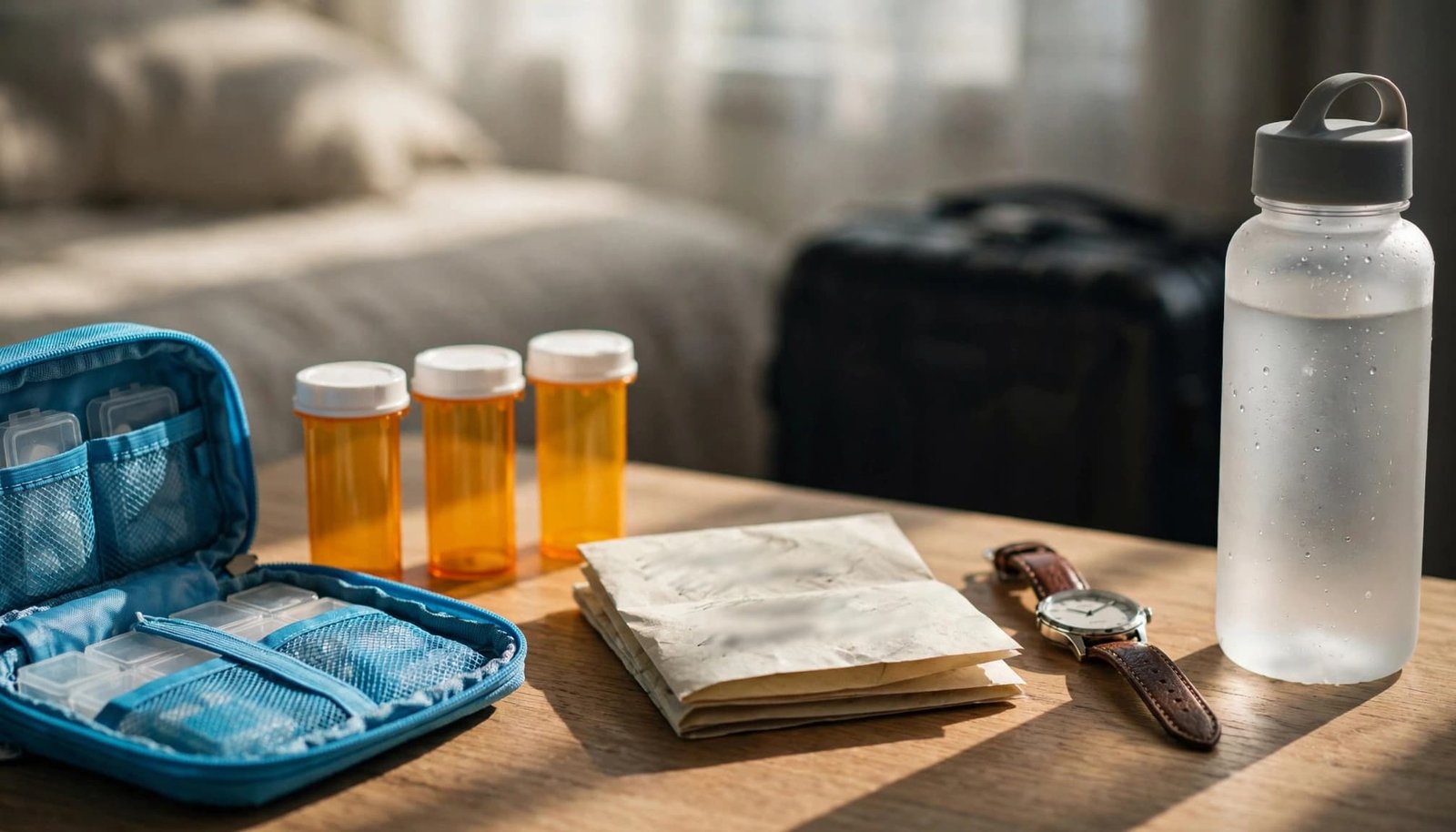
Pack these practical extras together:
- Bring familiar snacks, a refillable water bottle, and any supplies needed to take medication.
- Include a medical ID, charging equipment, and a printed medication record.
- Label your walker, cane, or trekking poles with your name and contact information.
- Keep spare clothing and personal-care supplies accessible.
Follow the medication’s storage instructions. A parked car or unsuitable hotel refrigerator can damage temperature-sensitive supplies.
Our guide to traveling with prescription medication covers paperwork and cross-border planning. A clinician’s letter doesn’t override a country’s medication restrictions.
For everyday extras, our Trip Rescue Shop travel supplies include strollers and cleaning supplies for unexpected sick-on-vacation moments. Keep those comfort items separate from your medical essentials.
Before Crossing Time Zones: Write Down Every Transition
Understand the Different Timing Approaches
Parkinson’s medication schedules aren’t interchangeable. Immediate-release medication, extended-release formulations, and continuous treatments can need different instructions.
The APDA travel guide describes adding one dose for each 3 to 5 hours gained and removing one dose for each 3 to 5 hours lost, always with your doctor’s approval.
Its examples describe these travel-day adjustments:
| Route | APDA’s time-change description | Adjustment requiring doctor approval |
|---|---|---|
| New York to Los Angeles | Three hours gained | One additional dose |
| New York to London | Five hours lost | One fewer dose |
These examples aren’t a personal dosing schedule. Other guidance emphasizes preserving the usual interval between doses instead of switching automatically to destination time. Your prescriber should choose the approach for your exact treatment.
Make Alarms and Caregiver Handoffs Dependable
Write down the last home-time dose, travel-day doses, first destination-time dose, and return schedule. Include the date and time zone.
Use a repeating alarm that stays active until acknowledged. Phone clocks can change automatically, so review how reminders behave across time zones and daylight-saving changes.
Record each dose immediately after taking it. If companions share medication responsibilities, name one person responsible at a time.
An alarm shows when a dose is due. A shared record shows whether it was taken.
Keep both the plan and dose record available offline.
Travel Day: Arrange Help Before You Need It
Request Airline Mobility Support
Request wheelchair or electric-cart service when booking, including connections and arrival. Remind staff at check-in and the gate.
You can request assistance even if you walk short distances. Explain what becomes difficult, such as prolonged standing, long terminals, or rushed transfers.
Tell the boarding agent about Parkinson’s and request early boarding and seating assistance. Choose an aisle seat near the bathroom when possible, and avoid emergency-exit rows.
Airline assistance doesn’t include medication administration or personal bathroom care. Arrange a companion if you need that support. An onboard wheelchair doesn’t guarantee an accessible aircraft lavatory.

Arrange Screening and Ground Transportation Separately
For U.S. checkpoint assistance, request TSA Cares passenger support at least 72 hours before departure, or call 855-787-2227. This is separate from airline wheelchair service.
Arrive at the airport or station at least 2 hours before departure. Allow more time for international flights, large terminals, or complicated transfers. Keep assistance confirmations and your itinerary available offline to reduce stress if a handoff is missed or plans change.
Arrange an accessible vehicle after arrival if needed. Airport assistance doesn’t replace ground transportation.
If you bring a wheelchair, carry its dimensions, battery details, and handling instructions. Inspect it before leaving the airport, and report damage or missing parts immediately.
Choose Transportation That Fits Your Mobility
For train travel, reserve boarding assistance and suitable seating. Include station access, platform changes, luggage handling, and the route to the bathroom in your plan. Confirm that your assistive devices and transfer needs fit the station and carriage arrangements.
For buses, arrange lift-equipped service when needed. A lift doesn’t describe every boarding or seating detail, so match the service to your mobility device and transfer needs.
Car travel offers more control over breaks. Schedule stops for medication, meals, bathroom visits, and gentle movement. If Parkinson’s affects your driving, discuss driving safety with your clinician before planning a long route.
Cruises can reduce repeated packing, but long corridors and shore excursions still take energy. Choose a cabin location that limits walking. Consider how you’ll reach dining areas and whether ports require tender boats.
Our accessible cruise planning guidance covers cabin features and shore access. Carry enough medication for the sailing and possible delays rather than expecting the ship’s medical center to replace your prescriptions.
At Your Destination: Protect Movement and Rest
Keep Movement Comfortable and Familiar
Before and during long periods of sitting, try gentle toe taps, heel taps, or seated marching as tolerated. Keep movements within your usual exercise guidance.
When safe, add short standing or walking breaks. Use handrails, keep mobility aids within reach, and avoid rushing transfers. Ask your physical therapist about travel-friendly exercises before departure if balance or transfers are difficult.
Crowds, tight spaces, and fatigue can make freezing of gait harder to manage. Pause rather than pushing forward. Use only familiar visual or rhythmic cues recommended by your therapist.
Your companion can help create space and reduce pressure without pulling you forward.
Build Each Day Around Your Energy
Plan a rest day before travel and another afterward. After a time-zone shift, keep arrival day light to allow for jet lag, meals, medication, and recovery.
Choose lodging with dependable elevators, nearby meals, and bathroom features that match your needs. Schedule outings during your usual stronger periods, with time to return to your room.
PCLA suggests at least 32 ounces of water daily, but that isn’t a personalized hydration target. Plan water access and hydration breaks during outings, and follow your clinician’s fluid advice, especially with fluid restrictions. Choose water regularly rather than relying on coffee or soda.
The Parkinson’s Foundation travel guidance includes destination support. Call 1-800-4PD-INFO (1-800-473-4636) for help finding local exercise classes, support groups, and Centers of Excellence.
Before traveling home, record your last dose and follow the approved return schedule.
Frequently Asked Questions About Traveling With Parkinson’s
What Vacation Options Work Well With Parkinson’s?
A comfortable choice has manageable travel days, accessible transportation, nearby meals, and flexible activities. A single-base stay can reduce packing and repeated transfers.
The right destination depends on your interests, mobility, symptom patterns, and available support. Plan around the day you can comfortably manage, rather than a full sightseeing schedule.
What Should I Do if a Dose Is Missed?
Follow the written missed-dose instructions for your exact medication. Don’t double a dose unless those instructions or your clinician direct you to.
If you’re unsure whether a dose was taken, contact your pharmacist or prescribing team. A dose record helps prevent uncertainty when travel companions change responsibilities.
What if Our Family Also Needs Autism Travel Support?
For Disney trips that include a child with autism, our family guide supports sensory preparation, transitions, and flexible park plans.
It’s available as an Etsy Disney autism PDF guide and through our Amazon Disney autism guide listing. These resources support family planning; they don’t replace your Parkinson’s medication or mobility plan.
A Comfortable Trip Starts With Room to Adjust
Traveling with Parkinson’s works better when medication, movement, and rest are part of the original plan. Keep your approved schedule close and leave space for changing energy levels.
We can help coordinate accommodations, transportation, and vacation pacing around your needs. Your healthcare team guides treatment, while we help make the travel details more manageable.
Leave a Reply